Japan defense report flags China-Russia pressure near Tokyo
Japan defense report says China-Russia bomber patrols and Russia-North Korea military links are raising Tokyo’s security concerns.
Sofia Reyes ·
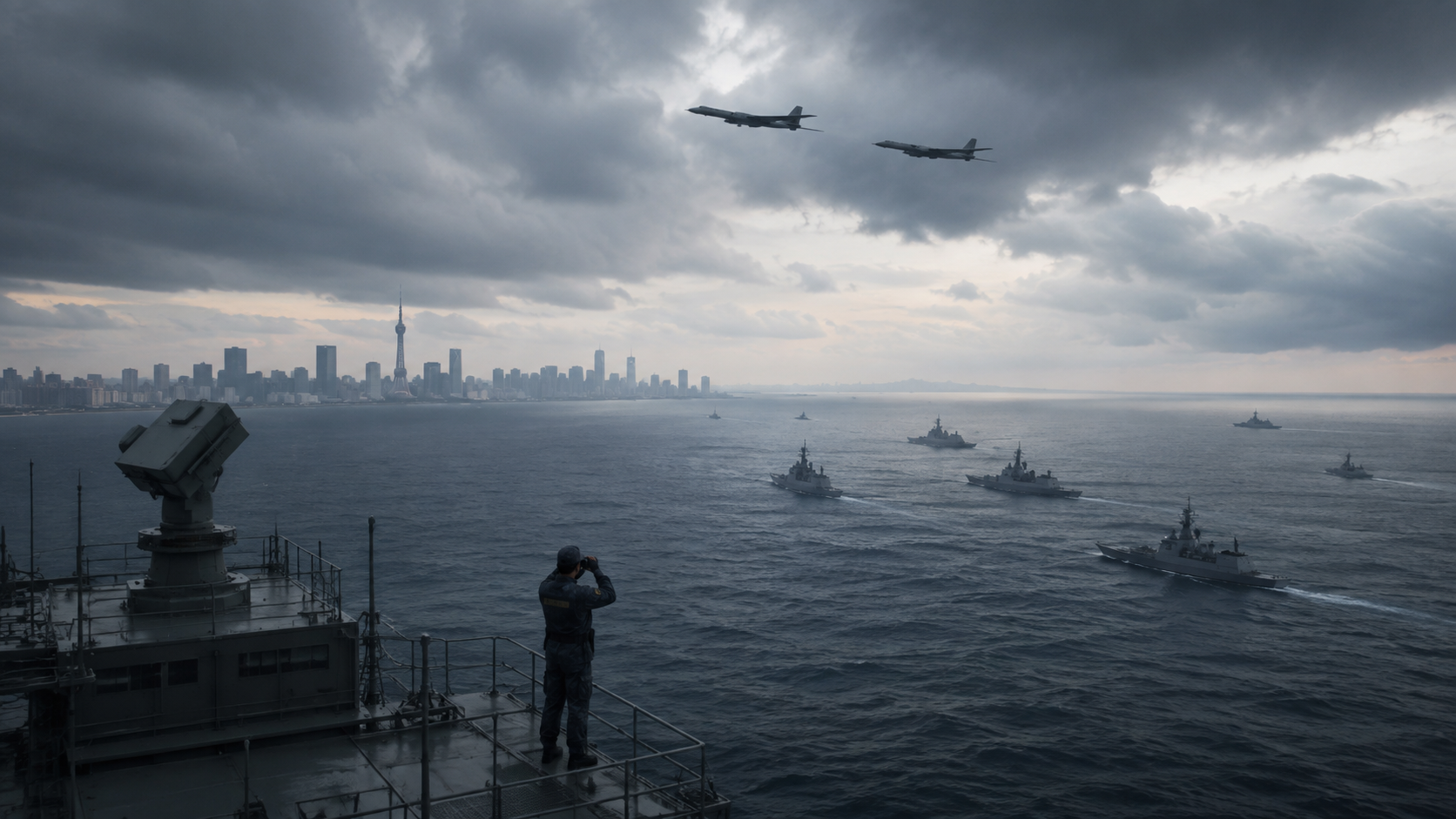
Japan defense report says China-Russia bomber patrols and Russia-North Korea military links are raising Tokyo’s security concerns.
Tokyo’s annual defense white paper, released Tuesday, describes a sharper regional security problem built around air patrols, naval movements and weapons cooperation. The report places China, Russia and North Korea at the center of Japan’s threat assessment as the government weighs how quickly to strengthen its own military base.
Bomber routes alarm Tokyo
The white paper cites a December 2025 patrol in which Chinese and Russian bombers passed over Japan’s southern islands and then flew on a track pointing toward Tokyo. The aircraft reversed course before entering Japanese airspace, according to the report.
Japan said China and Russia used a similar route in June 2026, adding to a pattern that began before the latest political dispute. Joint strategic bomber flights near Japan have taken place at least once a year since 2019, according to the white paper.
The report said "Joint Chinese and Russian bomber flights and naval exercises are clearly intended as a show of force against our country and represent a serious concern for national security." That language makes the flights more than an operational issue for Tokyo; it frames them as military signaling aimed directly at Japan.
Beijing rejects Tokyo’s warning
China’s Ministry of National Defense rejected Japan’s assessment, saying Tokyo exaggerated regional risk and promoted a "China threat" narrative to support its own military expansion. The ministry said it had "strong dissatisfaction and firm opposition" to the white paper.
Beijing also linked the dispute to Taiwan, calling the issue a matter of China’s sovereignty and a red line in relations with Japan. The ministry urged Tokyo to stop interfering in China’s internal affairs and warned against what it described as remilitarization.
The political backdrop is Prime Minister Sanae Takaichi’s remarks in parliament in November 2025 about Taiwan, which Beijing has pressed her to retract. Riho Aizawa, a research fellow at the National Institute for Defense Studies in Tokyo, wrote in a recent report that "China and Russia now have a relationship in which China can apply pressure on Japan with the support of Russian military power at a time that serves China’s political interests."
Scrambles, ships and missiles
Japan’s air force has already been busier. Defense Ministry data released in July showed fighter-jet scrambles against Chinese or Russian aircraft near Japan reached a three-year high in the first quarter of 2026.
The pressure is not limited to the air. In July, Tokyo said a Chinese destroyer fired its machine gun inside the exclusive economic zone of a Japanese island in the Pacific, after the same destroyer had been observed sailing nearby with a Russian frigate and another Chinese warship.
Japan’s white paper also points to Russia’s 2024 military alliance with North Korea as a longer-term risk. The report said cooperation with Moscow could support Pyongyang’s weapons development, including what it described as "extremely rapid" progress on missiles and advanced hypersonic systems.
Tokyo did not say it had clear evidence of formal three-way military coordination among China, Russia and North Korea. It did note, however, that the leaders of the three countries appeared together at a military parade in Beijing in September 2025.
For the first time, the white paper includes a dedicated section on Japan’s defense industry. It highlights drones and artificial intelligence as technologies shaping modern combat, a signal that Tokyo sees industrial capacity as part of deterrence, not just procurement.
If Chinese-Russian patrols stay frequent, Japan’s Defense Ministry may face pressure to fund more surveillance, air defense readiness and domestic production. That would add a regional risk premium to Northeast Asia’s macro setting, keep Tokyo’s defense planners under strain and support demand across the aerospace, drone and electronics supply chains.
If military contacts ease and diplomatic channels stabilize, the immediate tempo around Japan could fall. The open questions are whether Russia expands military support for North Korea, whether China keeps using Taiwan disputes to shape military signaling, and how fast Japan can build an industry able to absorb new defense demand.