

North Korea changes flag as Kim reshapes national symbols
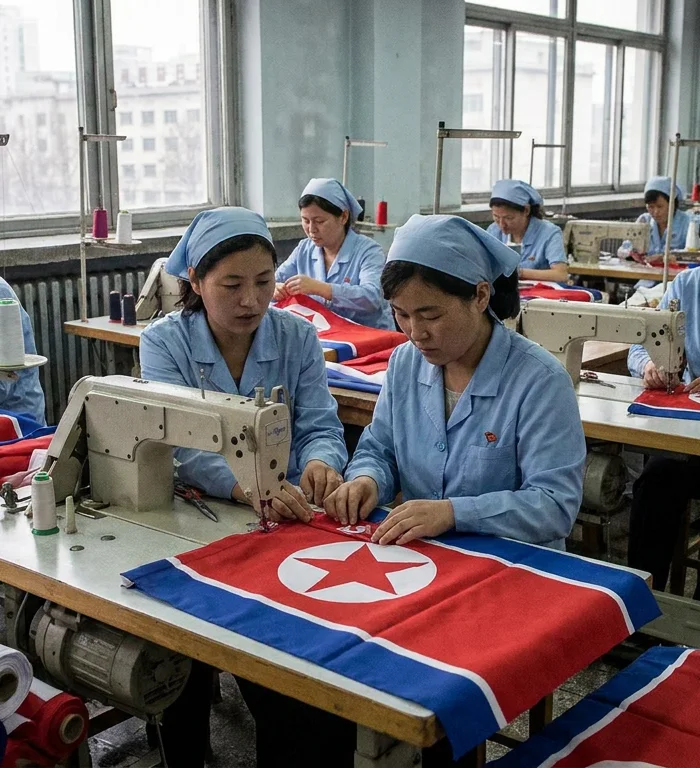
Kim Jong Un has disclosed constitutional revisions changing North Korea's flag, shortening its shape and shifting its red star inward.
The redesign extends a series of changes to national symbols and policy under Kim, including revisions to the anthem and the abandonment of longstanding reunification policy. It alters an emblem introduced under his grandfather, Kim Il Sung, whose government adopted a Soviet-designed flag after World War II.
A shorter flag retains the star
The revised design preserves the red star but places it nearer the middle of a shorter flag. North Korean state websites appear to have adopted the version, although those appearances do not establish how widely the redesign has been implemented.
An accompanying photograph identifies the revised flag at a September commissioning ceremony for the North Korean destroyer "Kang Kon." The constitutional disclosure makes the modifications public, but the account does not establish when authorities first authorized or began using them.
The alteration addresses a visible feature of the previous design: its elongated proportions could leave the fabric folded over itself, obscuring the star. That practical difference is distinct from the political significance of changing an emblem associated with the country's founding leadership.
Moscow's design outlasts an early objection
Historical records describe a dispute over the flag's length at a parliamentary gathering in 1948. A North Korean official sought a shorter design, but the proposal failed and the proportions chosen by the Soviet designers prevailed.
The resulting flag could be difficult to display fully, particularly when its weight prevented it from extending horizontally. Across the border in South Korea, observers have sometimes noticed that problem with a North Korean flag mounted on a pole approximately 500 feet high.
The symbolism also had a specific geographical and political foundation. According to research published in 2016 by Fyodor Tertitskiy, who has studied the flag's history, its central red band and star represented communist unification of the peninsula, while the blue bands stood for the seas on either side.
Kim revises an inherited state symbol
The state's account of the flag's origins subsequently changed. Tertitskiy says North Korean propaganda began assigning authorship to Kim Il Sung rather than acknowledging the Soviet designers.
Official messaging also recast the flag as an expression of the founder's struggle against Japanese rule and a shared national bloodline. The emblem therefore carried a domestic founding narrative beyond the political meaning attached to it by its original designers.
Kim's redesign now sits alongside his departure from reunification policy, changing both an inherited symbol and a policy once associated with its imagery. That parallel does not establish why he ordered the new proportions; no explanation from Kim for the specific design choices is provided.
The unresolved implementation questions concern the precise dimensions, the effective date and any timetable for replacing existing flags. State website imagery offers an indication of adoption, but not a complete account of the transition.
More stories
- Nvidia names Kress interim CEO after Huang exits in scandal
- Lutnick faces White House review over Nvidia AI exports
- Nelson Mandela Bay firms face 76% power tariff premium
- Kallas warns Russia seeks to redirect Ukraine talks
- Europe to join next Ukraine talks, Kushner says
- Melaka vote puts living costs before 687,697 voters
- Singapore faces 400-post Indonesia disinformation push
- Royal Navy expands 10-country drone plan after Russian activity rises 41%
Latest news
- FAA halts US departures after communications disruption
- Europe faces unity test as Trump revives Ukraine diplomacy
- Democrats push AI regulation as two state veterans arrive
- Lutnick faces AI chip scrutiny as Bessent faults Commerce
- AI investment boom binds global suppliers to US spending
- Senate Democrats face leadership fight after midterm gains
- Trump extends Jones Act waiver for another 90 days: official
- Russia reports 1% growth as refinery output declines 18%