

Europe faces unity test as Trump revives Ukraine diplomacy
Europe named an E5 negotiating team after President Trump’s envoys briefed Zelenskyy, as leaders tried to avoid being sidelined in Ukraine diplomacy.
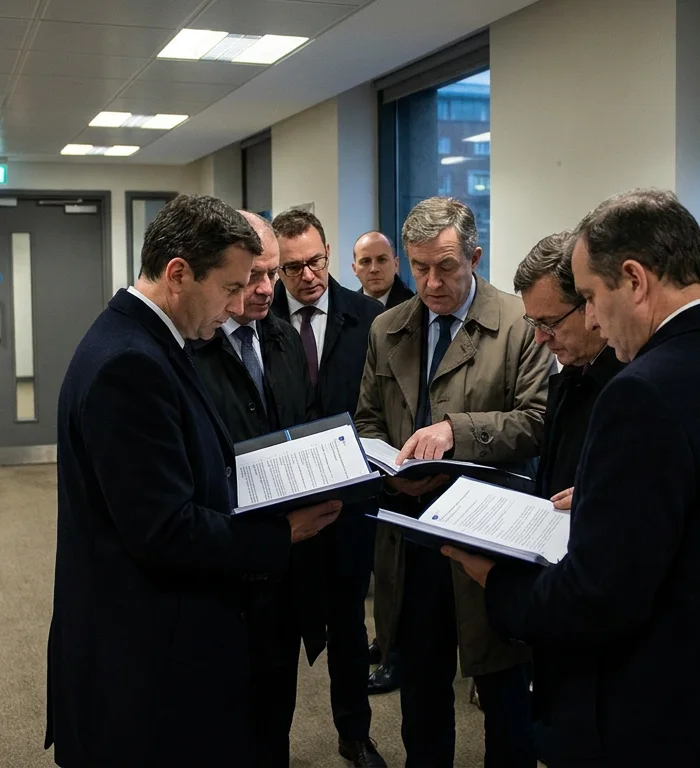
Europe named a seven-member negotiating format in Dublin after President Trump’s envoys briefed Volodymyr Zelenskyy on Ukraine peace talks.
The diplomatic focus shifted late Thursday to Casement Aerodrome, a military airfield west of the Irish capital, where Trump’s two main envoys stopped after talks in Abu Dhabi and Moscow. Ukrainian President Zelenskyy was briefed there, and senior European security officials were also updated, though they had not been part of the main discussions.
Dublin airfield draws the envoys
The briefings took place as European leaders were gathered in central Dublin for two meetings: a European Political Community gathering and an informal European Union summit. The setting sharpened an old problem for the bloc: how to influence diplomacy over a war that directly affects European security when Washington and Moscow reopen their own channels.
The next point of tension is President Trump’s expected meeting in China next week with Vladimir Putin and Xi Jinping. Leaders in Dublin treated that encounter as a test of whether Europe and Ukraine would be kept inside the process or asked to respond after larger powers had shaped the terms.
E5 advisers get the mandate
European governments had argued over who should speak for the continent. Germany, France and the UK, known as the E3, sought a central role, while the Berlin Group, which includes additional governments, met separately and EU institutions also pressed their claim.
The compromise gave the negotiating role to national security advisers from the E3 plus Italy and Poland, a format described as the E5, together with the European Commission and European Council. The seven designated representatives will handle technical talks for Europe.
Council President Antonio Costa, who chaired the meetings, said at the end of the summit that "Europe must speak with one clear and united voice." Swedish Prime Minister Ulf Kristersson made the same point more bluntly, warning that a spread of national approaches to Russia "could absolutely profit Russia."
Funding and security crowd agenda
Several leaders tried to move the discussion from representation to the substance of any settlement. Irish Prime Minister Micheal Martin said "the substance of any peace agreement is as important as who represents Europe," adding that the continent needed clarity on what would make peace sustainable.
Officials said leaders also discussed European security and how to finance Ukraine in 2027. Those issues matter because any ceasefire or peace framework would have to be matched by long-term military, budgetary and institutional commitments, not just diplomatic language.
Jared Kushner, Trump’s son-in-law, sought to reassure European leaders at the airbase, saying, "We cannot conclude this deal without the Europeans being at the table." German Chancellor Friedrich Merz said he saw no need for an institutional debate, while Slovenian Prime Minister Janez Jansa described the disorder as self-inflicted: "This chaos is our own fault."
The optics were complicated by absences. Prime Ministers Pedro Sanchez of Spain, Rob Jetten of the Netherlands and Bart de Wever of Belgium skipped the gathering because of domestic political pressures, while UK Prime Minister Andy Burnham and Canada’s premier, Mark Carney, attended.
Shenzhen meeting tests coordination
The European Political Community format drew about 50 leaders on Thursday, but local reporters repeatedly asked whether it was too loose to handle major decisions. The EU leaders’ meeting on Friday was informal, meaning it could not produce binding decisions.
If the E5 and EU institutions remain aligned with Washington and Kyiv, Europe will have a clearer channel to press its security and funding requirements into any Ukraine framework. If President Trump’s meeting with Putin and Xi instead produces understandings before European input is settled, governments in Dublin signaled they may face another round of internal disputes over representation, guarantees and Ukraine financing.
Merz warned that the China meeting could become a "second Anchorage moment," referring to President Trump’s August 2025 meeting with Putin in Alaska, which he said yielded little after a high-profile reception. His message to Washington was direct: "please, no surprises," and continue working as part of "Team Europe" alongside Ukraine.
More stories
- FAA halts US departures after communications disruption
- Lutnick faces AI chip scrutiny as Bessent faults Commerce
- Senate Democrats face leadership fight after midterm gains
- T-Mobile agrees to drop 50 GB cap in New York broadband deal
- Iran threats put Bessent security alongside sanctions push
- Nvidia's Huang gets Trump backing as spy allegations widen
- Trump administration escalates election suits before vote
- Trump holds back on Bolsonaro claim to Brazil leadership
Latest news
- Democrats push AI regulation as two state veterans arrive
- AI investment boom binds global suppliers to US spending
- Trump extends Jones Act waiver for another 90 days: official
- Russia reports 1% growth as refinery output declines 18%
- North Korea changes flag as Kim reshapes national symbols
- Nvidia names Kress interim CEO after Huang exits in scandal
- Lutnick faces White House review over Nvidia AI exports