

FAA halts US departures after communications disruption
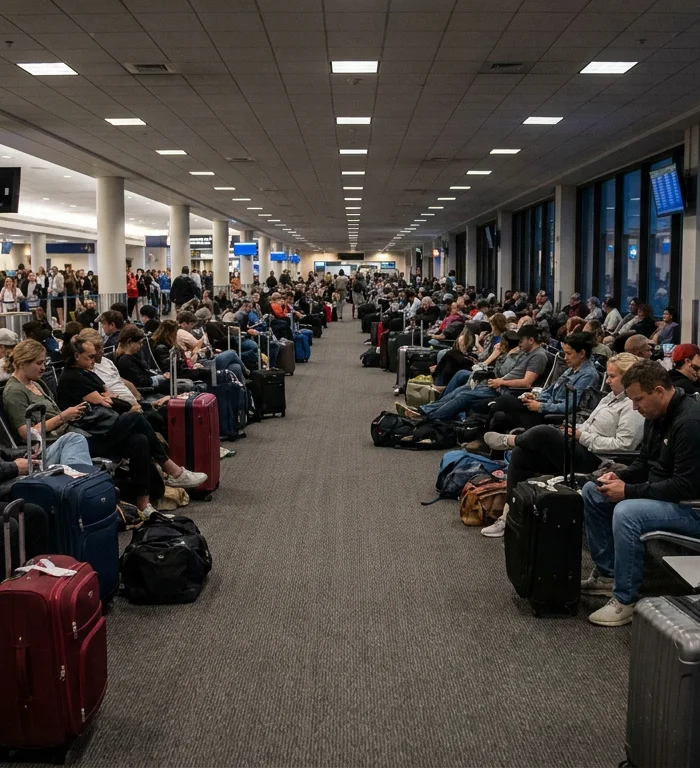
The FAA halted departures across the US on Friday after communications failed at multiple control centers, disrupting thousands of flights.
The Federal Aviation Administration imposed the restriction at 3:53 p.m. ET, citing safety and exceptional operating conditions. By 6:40 p.m., FlightAware counted more than 3,300 cancellations and over 10,200 delays among US flights, although those totals did not establish how many disruptions resulted from the outage.
Transportation Secretary Sean Duffy said on X that communications problems involved several air route traffic-control centers. These facilities oversee aircraft traveling at high altitudes across extensive areas, putting the disruption beyond the operations of any single airport.
Airborne flights face different restrictions
Aircraft already airborne could proceed to their intended destinations, an FAA spokeswoman said. The agency said it would assess international arrivals individually, distinguishing those flights from aircraft awaiting departure within the United States.
That distinction left airports facing a possible capacity constraint: arriving aircraft need space while grounded departures remain in place. If those conditions persisted, the accumulation of planes could limit airports’ ability to accommodate additional arrivals.
Cirium, the aviation data provider, recorded nearly 500 flights returning to their departure airports by 5:50 p.m. ET Friday. It also counted more than 100 diversions to alternative airports, showing that the operational disruption extended beyond flights waiting to take off.
Officials investigate telecommunications failure
Duffy said FAA technical staff were examining the communications problem. His statement identified the affected type of control facility but did not establish the underlying cause or provide a timetable for restoration.
Speaking to reporters at the White House, Homeland Security Secretary Markwayne Mullin characterized the incident as a telecommunications failure. He said officials had no indication of a malicious attack, either beforehand or at that point in the investigation.
Mullin nevertheless declined to exclude a cyberattack when questioned about that possibility. His comments left the cause unresolved: the absence of evidence of an attack was not a finding that one had been ruled out.
The extent of the technical failure was also unclear. The available account did not establish whether radar information used by controllers to maintain safe aircraft separation had been affected alongside communications.
Weekend cancellations complicate airline recovery
FlightAware already listed more than 300 cancellations for Saturday, alongside the larger Friday total. That advance reduction in the following day’s schedule showed that the disruption was no longer confined to Friday departures.
For airlines, restoring communications and rebuilding schedules are separate operational tasks. Aircraft that return to their starting points or land at alternative airports, together with displaced crews, can be unavailable where subsequent flights are scheduled to begin.
If communications recover promptly, departures could resume while airlines work through aircraft and crew positioning problems. If the interruption continues, limited airport space and further diversions could compound those scheduling difficulties, extending the consequences for domestic travelers and international connections.
The immediate unresolved issues are the failure’s cause, the scope of affected systems and the timing of an unrestricted restart. Officials had not provided a firm restoration deadline in the statements available, leaving passengers and airlines without a confirmed timetable for normal operations.
More stories
- Europe faces unity test as Trump revives Ukraine diplomacy
- Lutnick faces AI chip scrutiny as Bessent faults Commerce
- Senate Democrats face leadership fight after midterm gains
- T-Mobile agrees to drop 50 GB cap in New York broadband deal
- Iran threats put Bessent security alongside sanctions push
- Nvidia's Huang gets Trump backing as spy allegations widen
- Trump staff shake-up puts Miller in Wiles’ White House position
Latest news
- Democrats push AI regulation as two state veterans arrive
- AI investment boom binds global suppliers to US spending
- Trump extends Jones Act waiver for another 90 days: official
- Russia reports 1% growth as refinery output declines 18%
- North Korea changes flag as Kim reshapes national symbols
- Nvidia names Kress interim CEO after Huang exits in scandal
- Lutnick faces White House review over Nvidia AI exports