Trump uses US visas to pressure Latin America officials
President Trump's visa cancellations add pressure on Latin American officials as Washington backs regional allies and its Shield of the Americas agenda.
Sofia Reyes ·
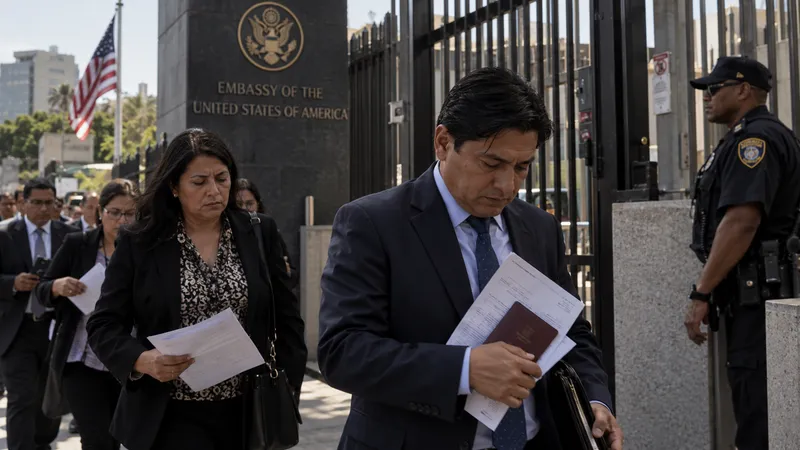
US visas for more than two dozen Latin American officials were revoked as Washington seeks leverage in regional security politics.
President Trump's administration canceled visas held by several senior officials in Latin America, widening a pressure campaign tied to Washington's ambitions in the Western Hemisphere. The measures reached current and former officials, rather than a single government or one narrow diplomatic dispute.
The action comes as leaders viewed as close to the White House have gained ground in recent regional elections. Many have promised support for the Shield of the Americas , a Trump administration security initiative aimed at drug smuggling.
Visas become regional leverage
Visa access has become a diplomatic tool for the White House as it tries to strengthen friendly governments and isolate officials seen as obstructing its regional agenda. The immediate consequence is personal and political: affected officials lose a privilege that matters for travel, finance, education and elite networks tied to the United States.
The tactic also gives Washington a way to act without announcing trade sanctions, asset freezes or military commitments. That makes it easier to apply pressure quickly, while leaving the targeted governments to decide whether to challenge the move publicly or absorb it quietly.
The cancellations fit a broader effort by the United States to reassert influence in Latin America at a time when China has expanded commercial and diplomatic ties across the region. The source material did not provide trade figures, investment totals or country-by-country exposure, so the size of that competition cannot be quantified here.
Bolivia case tests the tactic
Bolivia's attorney general was among the officials who lost US visa access. The official is leading an investigation into a political strategist described as “MAGA’s man” in Latin America, linking the visa action to a case with direct political sensitivity for Trump-aligned networks.
That makes Bolivia an early test of how far the visa tactic can travel beyond ordinary diplomatic signaling. If the attorney general's work continues without interruption, the measure may have limited operational effect; if it slows cooperation or chills related inquiries, it could strengthen figures aligned with Washington's preferred regional camp.
The legal basis for each cancellation was not specified in the material provided. That leaves an important uncertainty for targeted officials and their governments: whether the visa losses are administrative decisions, security determinations or political signals attached to broader negotiations.
Shield initiative binds new allies
The Shield of the Americas gives the administration a security framework around which friendly governments can organize their support. By defining drug smuggling as the target, the White House can link domestic US concerns to regional policing, border control and intelligence cooperation.
For governments close to Trump, supporting the initiative may bring political access in Washington and a clearer place in US regional strategy. For officials outside that alignment, visa exposure creates a personal cost that can outlast a single election cycle or cabinet reshuffle.
The wider sector most affected is not a traditional industry but the network around security policy, campaign consulting and cross-border political influence. Consultants, prosecutors, ministers and party officials may now treat US travel status as part of the operating risk attached to regional politics.
China contest frames the pressure
If the visa campaign helps consolidate pro-White House governments, the global effect would be a more US-centered security bloc in Latin America. That could narrow diplomatic room for China in areas where security cooperation overlaps with infrastructure, ports, telecommunications or policing.
If affected governments push back, the mechanism changes. Retaliatory visa limits or public investigations could turn a targeted pressure tool into a broader diplomatic dispute, raising costs for the attorney general's office in Bolivia and for officials across the region who depend on access to US institutions.
A third path is a mixed outcome: aligned leaders keep backing the Shield of the Americas , while targeted officials continue their work and avoid direct confrontation. In that case, the macro effect would be limited, but the regional political class would still absorb the message that US visas can be used as leverage in security and election-adjacent disputes.