Mecca defense pact opens first Istanbul committee talks
Turkey defense pact officials from Turkey, Saudi Arabia and Pakistan will meet in Istanbul to begin work on a three-way collective-defense accord.
Cuneyd Erdogan ·
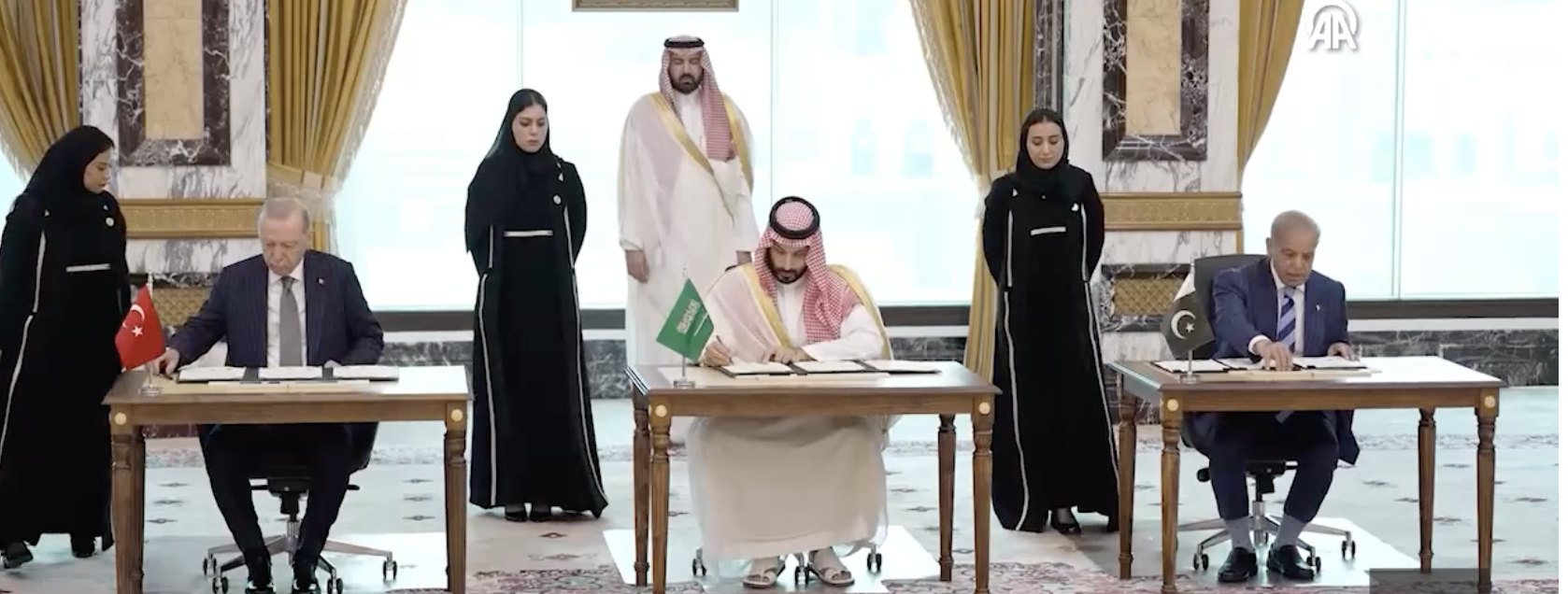
Turkey defense pact officials meet Monday in Istanbul, giving three US-aligned states their first committee session under a new deterrence accord.
Foreign and defense ministers from Turkey, Saudi Arabia and Pakistan are expected to attend, along with the three countries' chiefs of staff, a Turkish foreign ministry source said. The meeting is the first committee session under the Mecca Joint Defence Agreement, which the three governments signed on August 7.
Mecca accord links three militaries
The accord is designed to strengthen collective deterrence against aggression, according to the ministry source. Its central clause treats an armed attack on one member as an attack on all three, a structure the source compared with NATO's Article 5 collective-defense commitment.
The Istanbul meeting is expected to cover practical military coordination rather than only political language. The agenda includes stronger defense capabilities, greater interoperability among the armed forces and deeper defense-industrial cooperation, including joint production and development, the source said.
The composition of the meeting matters because it joins policy chiefs with operational commanders. Ministers can set the political mandate, while chiefs of staff can test whether the pledge can be converted into planning, exercises, procurement standards and command arrangements.
Iran war frames the timing
The pact follows a period of regional conflict in which Iranian missile fire has reached Gulf oil exporters, according to the account provided by the Turkish ministry source. The three governments also share concerns about the military postures of Israel and revolutionary Shi'ite Iran, the source said.
The source's account places the meeting six months after the US and Israel launched the war against Iran. Negotiations were described as stalled, while President Donald Trump's administration has intensified financial pressure on Tehran under a campaign it has called an economic D-Day.
The grouping brings together three states with different strategic assets. Turkey has NATO's second-largest military, Pakistan is nuclear-armed, and Saudi Arabia is described in the source material as a leading oil exporter, giving the pact military, nuclear and energy-security dimensions.
Those differences also create the operational challenge. A collective-defense promise is easier to sign than to execute when members have separate command systems, procurement channels, domestic political limits and outside alliances that cannot be ignored.
Egypt option signals expansion
Turkey has said the arrangement is open to additional members, with Egypt identified by the ministry source as a possible candidate. Ankara has also said the pact is not intended to replace existing alliances, a point that matters for Turkey's NATO role and for Saudi and Pakistani ties with Washington.
If the Istanbul committee produces a staff-level work program, the immediate effect would be institutional rather than battlefield-focused. For the global economy, a more credible Gulf deterrence framework could affect how policymakers and energy users assess supply risk; for the three-country pact, it would shift the agreement from political signal to planning process; for defense companies, it could create demand for compatible systems and joint-production lines.
If the talks remain broad, the pact would still carry diplomatic value but less military weight. In that case, the global effect would likely be limited to political signaling; Turkey, Saudi Arabia and Pakistan would retain the framework without proving interoperability; and the wider defense sector would wait for procurement decisions before treating the arrangement as a revenue opportunity.
If Egypt or another state moves toward membership, the bloc would gain geographic depth but face a harder coordination problem. The main open question is whether the three founding governments can define when the collective-defense clause applies, who commands any joint response and how new members would fit into existing alliance commitments.