

SpaceX catches Starship upper stage but loses its booster
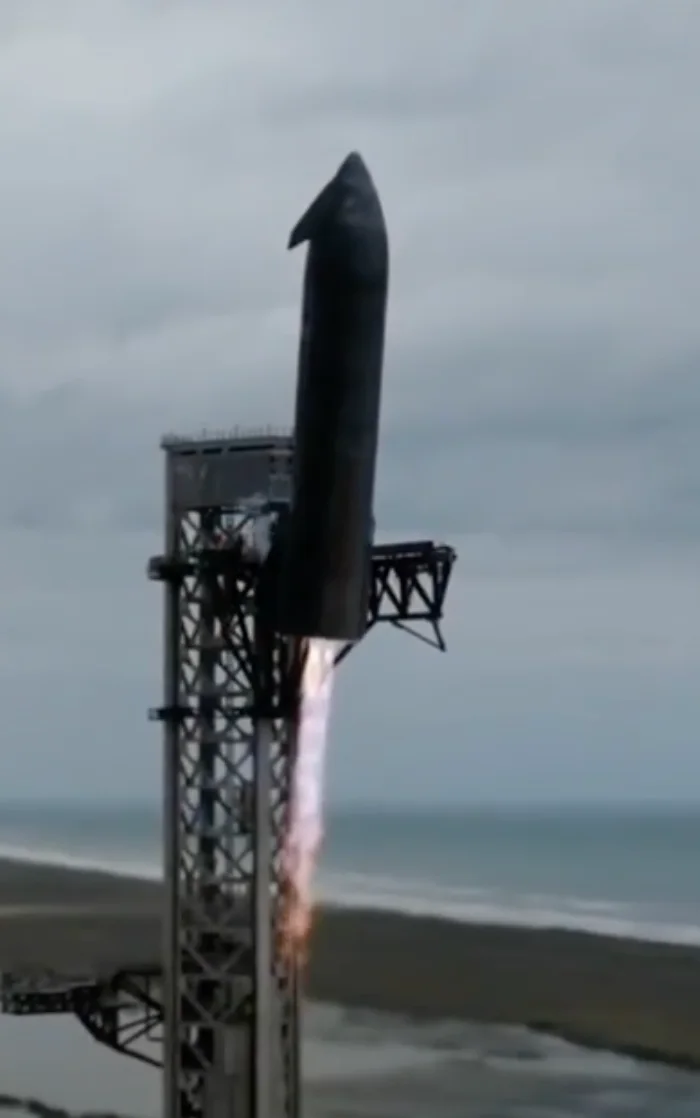
SpaceX reportedly caught Starship's upper stage from orbit for the first time, but a lost booster leaves full recovery unproven.
The spacecraft returned to Starbase, Texas, on November 14, 2026, where tower-mounted mechanical arms caught it, according to the flight account. The recovery followed 14 circuits of Earth and completed only one part of the mission's planned dual-stage retrieval.
For Elon Musk's aerospace company, the result separates a newly demonstrated recovery capability from the broader objective of making Starship fully reusable. Recovering the spacecraft does not establish that both stages can be retrieved consistently or prepared for another launch.
Booster loss limits recovery milestone
The mission, designated Test Flight 15, was SpaceX's first attempt to retrieve both stages using tower catches, according to the account. During the opening phase on November 13, the booster was diverted toward the Gulf of Mexico rather than recovered at the launch site.
The booster exploded before reaching the water, the same account reported. The spacecraft continued its orbital mission before returning to the tower, known as Mechazilla, the following day.
The supplied account does not establish what prompted the booster diversion or caused the explosion. Those unresolved details limit any assessment of whether the lost stage points to a recurring technical problem or a failure specific to this flight.
Starlink deployment adds commercial stakes
The flight also carried a commercial payload: 26 Starlink v3 satellites were deployed, according to the mission account. That compares with a maximum capacity of 60 such satellites per Starship launch, a figure attributed to SpaceX.
The deployment expanded a Starlink network that already numbered more than 11,000 satellites in low Earth orbit, according to the account. Starlink supplies satellite internet service, giving the rocket program a direct connection to an operating communications business rather than only future exploration missions.
SpaceX's stated capacity describes how many satellites a flight can carry, not how frequently launches can occur. If repeatable recovery enables more frequent missions, Starship could support further network expansion; if booster losses persist, spacecraft recovery alone would not deliver the intended fully reusable system.
The account also describes an expected NASA role for Starship: transporting astronauts and cargo between lunar orbit and the lunar surface. It provides no revised mission schedule or evidence that this test changes those plans, leaving the relationship between this recovery and lunar readiness unresolved.
Flight restrictions have separate causes
The Hawaii Department of Transportation temporarily paused some West Coast flights on November 13 over debris risk associated with the rocket mission, according to the account. A separate nationwide ground stop issued by the Federal Aviation Administration concerned telecommunications failures, not the Starship flight.
Both restrictions were subsequently lifted, the account said. Keeping the two events separate is essential to assessing the launch's effects on aviation without assigning unrelated disruption to SpaceX.
The next technical benchmark is whether SpaceX can repeat the spacecraft catch while also recovering the booster. If both become repeatable, the result would strengthen the practical case for full reuse; this flight, by itself, demonstrates a narrower achievement.
More stories
- Democrats push AI regulation as two state veterans arrive
- Japan & Asia: Zelda remake tops Japan boxed sales with 537,041
- Nvidia cloud access prompts Chinese overseas rental talks
- Pomerado targets browser agents with $0.03 task claim
- Nvidia board weighs Huang ouster after spy inquiry claims
- How Turkey's esports ecosystem works
- Activision will reportedly let Warzone players turn off the paid cosmetics that fund its empire
- Sony files a patent to turn the DualSense into a card reader, but friction has its uses
Latest news
- UN agencies seek aid for 30.3m facing DR Congo hunger
- Airlines face FAA outage reset after nationwide shutdown
- Hungary seizes nearly $20m in Orban-era corruption probe
- Fielding distances himself from Brand after 10-year sentence
- Children in England receive 341 GLP-1 prescriptions in four months
- MEPs seek EU cloud shift with US groups at 70% share
- Roche's Gazyva gains EU panel backing after 76.7% lupus response
- Singapore aid groups face Gaza delivery bottlenecks despite 200 daily trucks