Trump midterms blitz tests whether his voters transfer now
President Trump’s 32-day campaign swing aims to turn his 2024 coalition into midterm votes for Republicans in several competitive races.
Lauren Collins ·
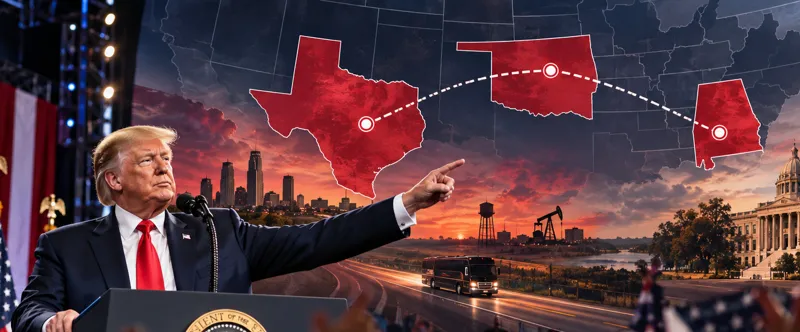
Trump midterms campaign puts President Trump at the center of a 32-day Republican push to move his 2024 voters into down-ballot races.
The president began the closing push Thursday in Denton, Texas, and Durant, Oklahoma, with Alabama scheduled for Friday before stops in Ohio and Nebraska. His message to Republicans was unusually direct: "Pretend I’m running please."
The itinerary starts in states that look safe on a presidential map but contain races and media markets that matter for November 3. Oklahoma gave Trump more than 66% of its vote in 2024, while Alabama remains reliably Republican, yet both stops can reach voters beyond state lines.
Denton starts a 32-day map
Republican officials describe the early geography as a turnout operation rather than a persuasion tour. Durant sits near Texas, and Mobile, Alabama, reaches audiences across the Gulf Coast, giving Trump a way to address voters in nearby competitive territory without abandoning friendly crowds.
The test is whether a coalition built around Trump personally can be transferred to candidates whose names are on the ballot. Pew Research Center found that eligible voters who skipped 2020 but voted in 2024 backed Trump by 54% to 42%, an advantage among voters who are by definition harder to count on in lower-turnout races.
Pew also found that 89% of Trump’s 2020 voters participated again in 2024, compared with 85% of Joe Biden’s 2020 voters. That pattern gives Republicans a large reservoir of Trump-aligned voters, but not an automatic mechanism for getting them back two years later.
Infrequent voters shape the test
The party has been here before, and the comparison is not flattering for Republicans. During Trump’s first term, Republicans lost 41 House seats in the 2018 midterms, while a Brookings Institution review found Republican House candidates drew nearly 12 million fewer votes than two years earlier.
Democratic House voting fell by less than one million over the same period, according to the review, giving Democrats control of the chamber. The numbers point to a midterm problem that was less about ideology than participation: Republican presidential voters did not show up at the same scale when Trump was not the candidate.
Texas shows why the red-state label can be misleading in 2026. Trump visited the Peterbilt truck plant in Denton to promote tariffs and manufacturing policy, while Republicans also defend a Senate race in the state featuring Ken Paxton against Democrat James Talarico.
Factories meet fuel prices
The White House says truck tariffs helped PACCAR, Peterbilt’s parent company, add more than 2,000 jobs nationally, including about 1,000 in Texas. For Trump, the plant visit turned an abstract trade policy into a claim about visible factory employment.
The economic setting is less tidy outside the factory gate. Texas diesel was recently reported at a record $5.97 per gallon, while gasoline averaged $3.92, nearly 44% above a year earlier, as the Iran war disrupted energy markets and complicated the administration’s cost-of-living message.
That tension gives Democrats an opening and forces Republicans to decide how closely to tie themselves to the White House on tariffs, energy and the Iran war. Some Republican candidates have already shown more distance on the conflict and on power-intensive data centers, where local costs can collide with national industrial policy.
Midterm history favors the opposition
The president’s party has lost House seats in 20 of the past 22 midterm elections since 1938, according to the Brookings review. The two modern exceptions came under Bill Clinton in 1998 and George W. Bush after the September 11 attacks in 2002.
If Trump can reproduce presidential-year turnout, Republicans would have more room to defend tariffs, energy policy and Senate control, while PACCAR and the truck sector would remain central examples in the manufacturing argument. If turnout slips, Congress could become a stronger check on the White House, candidates may put more distance between themselves and Trump, and manufacturers tied to tariff policy would face a less certain political environment.
The open question is not whether Trump can dominate Republican attention; the rallies suggest he can. The harder question is whether voters who appeared for him in 2024 will treat November 3 as if he were on the ballot.