

San Antonio faces scrutiny over 50,000-hog farm approvals
Residents are challenging whether irrigated rice land and tenant-farmer rights were properly protected before a Quezon livestock project advanced.
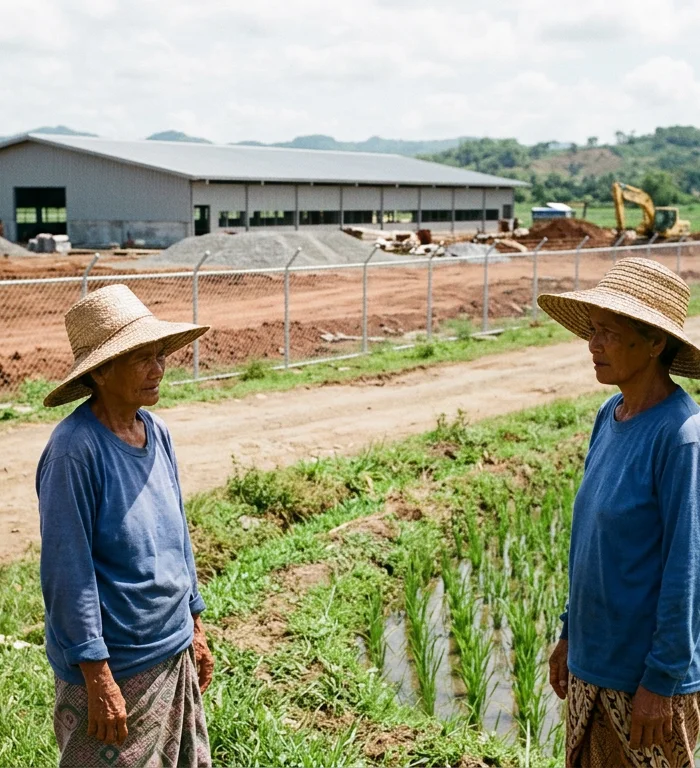
San Antonio’s local government faces resident scrutiny over approvals for a 50,000-hog livestock farm on 12 hectares in Quezon province, Rappler reported on Nov. 20, 2026.
The dispute matters because the site was formerly rice land, and the project’s environmental certificate allows up to 50,000 pigs at any given time, according to the Rappler news report.
Emma Alday, a resident in her eighties whose farm is about 250 meters from the development in Barangay Callejon, has sought answers from government agencies for more than two years, Rappler reported. She and other residents sent an appeal to President Ferdinand Marcos Jr. with about 300 signatures.
Alday told Rappler residents did not know the property would become a piggery when it was bought about two years before construction. “They removed the irrigation system. The people had no idea it was going to be a piggery,” she said in Filipino, according to the report.
The project, Mighty Livestock Farms, sits at the center of a dispute over agricultural land protection, local reclassification powers and tenant-farmer rights. Alday said the Department of Agrarian Reform referred her in May 2025 to the National Irrigation Administration to verify whether the land was included in an irrigation plan.
She told Rappler the land was part of an irrigated area. She also alleged that Department of Agrarian Reform personnel encouraged tenants to surrender their rights “in exchange for any amount.” The circumstances of the tenants’ departure from the property have not been clarified in the report.
San Antonio officials disputed the suggestion that the project lacked a legal basis. Sangguniang Bayan Secretary Carlo Katigbak told Rappler that Municipal Ordinance No. 112, passed in 2022, reclassified the property from agricultural to agro-industrial use.
“The local council has authorized the reclassification of that lot from agricultural to agro-industrial use which carries with it the authority to build a piggery or feedmills,” Katigbak said, according to Rappler.
Katigbak cited Section 20 of the Local Government Code of 1991, which allows local governments to reclassify agricultural land within legal limits. He said San Antonio, as a third-class municipality, had not exceeded the applicable 10% cap, based on information from the municipal planning office.
“All requirements have been complied with at both local and national levels,” Katigbak told Rappler, referring to local and provincial approvals and the Department of Environment and Natural Resources. He said there was “no controversy yet, no cause of action.”
Rappler reported that the ordinance requires certification from the National Irrigation Administration that the land is not irrigated or covered by a funded irrigation project. It also requires certification from the Department of Agrarian Reform on whether the property is covered by the Comprehensive Agrarian Reform Program.
Katigbak said the presumption was that those documents had been submitted because the ordinance was approved at the provincial level. The contents of the certifications were not detailed in the report.
A separate issue involves how the project was described in government documents. Rappler said Section 2 of Municipal Ordinance No. 112 states the land shall be used exclusively for a feed mill initiated by Mighty Livestock Farm Inc.
The Environmental Compliance Certificate issued by the Department of Environment and Natural Resources–Environmental Management Bureau on Oct. 24, 2023, describes the project as a livestock farm with a maximum capacity of 50,000 pigs at any given time. It covers 113,973 square meters, or about 12 hectares.
The ordinance also contains a self-repealing clause saying failure to implement its stated purpose automatically invalidates the authority granted and restores the land to its original classification. Rappler said the differing project descriptions do not by themselves establish a legal violation, but require explanation from the agencies involved.
The case places local land-use authority against national protections for irrigated and agrarian-reform land. The Agriculture and Fisheries Modernization Act restricts conversion of irrigated and irrigable land, while the Comprehensive Agrarian Reform Law sets requirements for agricultural land conversion.
Rappler described the article as the first of two parts.
Source: news report, Rappler, Nov. 20, 2026
More stories
- Baird seeks 2 trade bills to ease Ethiopia-Eritrea tensions
- Indonesia seeks Google explanation for 19,372 YouTube removals
- ICJ holds Myanmar responsible for Rohingya genocide
- Pakistani authorities detained 130 Malaysians in scam-centre raid
- Panetta says Italy inflation threatens purchasing power
- Elon Musk says MAGA spending left him foolish after losses
- Trump, Putin and Xi to hold historic trilateral in Shenzhen
- UK and EU seek 3 deals in Burnham reset
Latest news
- Congress clears 25-business-day holds for vulnerable investors
- Aberdeen Royal Infirmary faces police inquiry call over 19 deaths
- Kenya women farmers out-earn men by 18% per hectare
- Anoop Lokkur seeks backers for $1.3m Bengaluru dark comedy
- Bariatric surgery group loses 28.2% after GLP-1 use
- TOFA boosts mouse energy use 18% while preserving muscle
- ICO probes NHS therapy notes accessible to up to 140,000 staff
- Cognition runs Devin Mac workspaces on EC2 in 6 AWS regions