

ICJ holds Myanmar responsible for Rohingya genocide
The final ruling orders compensation and safe return guarantees, while Myanmar denies genocide and enforcement options remain limited.
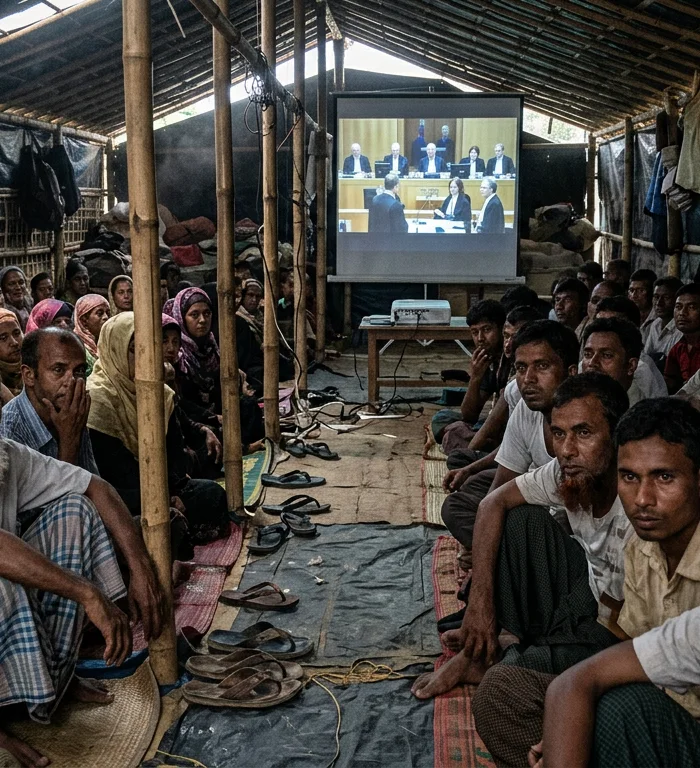
International Court of Justice ruled on Nov. 19 that Myanmar committed genocide against the Rohingya in 2017, adopting a finding of at least 10,000 deaths in a final judgment.
The ruling, in a case filed by Gambia seven years earlier, was the first time the court held a state responsible for genocide. It ordered compensation and guarantees for Rohingya displaced during an offensive that drove at least 700,000 people from Myanmar.
Presiding Judge Yuji Iwasawa said Myanmar’s security forces “killed thousands of Rohingya civilians” and committed “widespread acts of sexual violence” and “acts of extreme violence against children.”
The panel found “that the Republic of the Union of Myanmar has committed genocide against the Rohingya group in Northern Rakhine State.” The court said Myanmar’s actions could only reasonably be explained by an intent to destroy a substantial part of the Rohingya population in northern Rakhine State.
Judges said Myanmar’s military carried out executions of men and boys, raped Rohingya women and burned or razed hundreds of villages during clearance operations. They also said the military spread hate speech targeting the Rohingya.
The legal finding is rare. International courts had previously recognized genocide in Rwanda in 1994, the 1995 Srebrenica killings in Bosnia and atrocities by Cambodia’s Khmer Rouge in the late 1970s.
The International Court of Justice settles disputes between states and rules on alleged treaty breaches. Genocide cases are difficult because the legal test requires proof of a specific intent to destroy, in whole or in part, a protected national, ethnic, racial or religious group.
In Bangladesh’s Cox’s Bazar refugee settlement, where 1.2 million Rohingya live in exile, more than 1,000 people cheered as the verdict was shown on a screen. Wai Wai Nu, executive director of the Women’s Peace Network and a former political prisoner, said the ruling “permanently shattered” Myanmar’s denial of Rohingya identity and suffering.
Myanmar’s government has denied genocide, saying its forces were responding to a violent insurgency. It did not immediately respond to a request for comment on the ruling, according to the report.
The judgment is final and cannot be appealed, but the court has limited enforcement powers. The ruling said compensation for Rohingya victims would be set later and said Myanmar must allow safe and dignified return and family reunification for those displaced by its wrongful acts.
The case may be studied beyond Myanmar because it is the court’s first major ruling in more than a decade on the 1948 Genocide Convention. South Africa filed a 2023 case accusing Israel of genocide in Gaza; Israel denies genocide and says its forces responded legitimately to attacks by armed groups.
Britain said on Nov. 19 that it was expelling Myanmar’s defense attache and would set out further steps in coming days. Two British lawmakers urged the government to seek a United Nations Security Council resolution to compel enforcement action.
Source: Reuters report via Rappler, Nov. 19, 2026.
More stories
- Baird seeks 2 trade bills to ease Ethiopia-Eritrea tensions
- Indonesia seeks Google explanation for 19,372 YouTube removals
- San Antonio faces scrutiny over 50,000-hog farm approvals
- Pakistani authorities detained 130 Malaysians in scam-centre raid
- Panetta says Italy inflation threatens purchasing power
- Elon Musk says MAGA spending left him foolish after losses
- Häkkänen blames US politics for Ukraine Patriot delay
- Cape Town faces appeal over Equinix data-centre zoning
Latest news
- Congress clears 25-business-day holds for vulnerable investors
- Aberdeen Royal Infirmary faces police inquiry call over 19 deaths
- Kenya women farmers out-earn men by 18% per hectare
- Anoop Lokkur seeks backers for $1.3m Bengaluru dark comedy
- Bariatric surgery group loses 28.2% after GLP-1 use
- TOFA boosts mouse energy use 18% while preserving muscle
- ICO probes NHS therapy notes accessible to up to 140,000 staff