

Kenya women farmers out-earn men by 18% per hectare
The FtMA review points to stronger returns for women farmers but shows financing, equipment and buyer contracts still lag across the network.
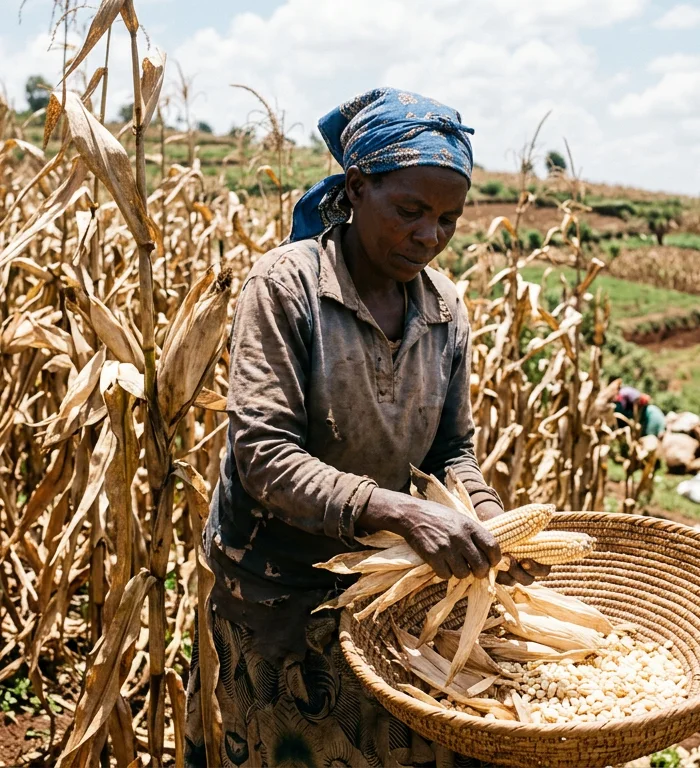
Women in Kenya's Farm to Market Alliance recorded main-season revenue of KES 82,494 a hectare, 18% above men, according to a nine-year evaluation released in Nairobi on Nov. 20.
The evaluation said male participants made KES 69,833 a hectare in the same season, while women farmed 1.9 acres on average against 2.8 acres for men, underscoring productivity gains despite smaller holdings.
Women in the programme also faced steeper education barriers. The review said 45% of surveyed women had no formal schooling, compared with 26% of men.
"The data from our nine-year journey proves beyond doubt that when women and young farmers are connected to reliable inputs, agronomic training, and structured markets, they deliver the highest returns per acre in Kenyan agriculture," said George Njoroge, FtMA Kenya Country Coordinator.
Njoroge said the programme should focus not only on higher output but on whether farmers can "produce profitably, market competitively, and build resilient livelihoods."
FtMA has been implemented on the ground since 2017 by the Cereal Growers Association, with support from the World Food Programme and other partners. The programme has expanded from two counties to 13, operates through 2,126 Farmer Service Centres and has reached about 401,955 farmers.
The centres act as rural hubs for inputs, training, aggregation and market links. Agriculture supports more than 70% of rural livelihoods, making the commercial durability of such hubs central to farm incomes and food-system resilience.
The evaluation said farmers using Conservation Agriculture, a set of practices aimed at improving soil health and water retention, recorded a 60% rise in main-season maize yields, from 2.83 tonnes to 4.53 tonnes a hectare. The network has marketed 664,009 metric tonnes of produce.
The main weakness is sustainability. The evaluation projected that about 70% of Farmer Service Centres would remain viable once programme support ends, but WFP Kenya Deputy Country Director Bai Mankay Sankoh said that figure was not proof of survival.
"The ultimate test of our work is not whether a programme can function while we are funding it. It is whether the people, businesses and institutions we have supported can continue to succeed when that funding ends," Sankoh said.
Women-led centres showed sharper constraints than male-led centres. They owned an average of two pieces of equipment, compared with 3.2 for male-led centres, and reported average annual profits of KES 143,989, against KES 515,253 for male-led centres.
Finance remains a bottleneck. The evaluation said 70% of centres lacked formal institutional credit, even though 97% of centres and 89.4% of farmers had bank accounts. Informal borrowing carried interest rates of about 20%, while buyer or input-supplier credit reached only 1%.
Market access was also narrow. Although 88.9% of farmers sold produce, only 3.8% had formal off-taker contracts, meaning agreements with buyers, and 18.5% were paid promptly.
Youth participation is growing through agricultural service businesses. The review said farmers under 35 made up 10% of the surveyed sample, while 1,015 youth-run centres each employed an average of 6.1 young people in services including mechanisation, spraying, aggregation and digital support.
Agriculture Cabinet Secretary Mutahi Kagwe, represented at the forum, called for stronger business standards, performance monitoring, private-sector investment, digitalisation and support for women- and youth-led agribusinesses. FtMA and its partners called for asset financing, collateral-free supply-chain credit, affordable data access and integration of the centres into county extension systems.
Source: nine-year evaluation reported by Capital FM via AllAfrica, Nov. 20.
More stories
- Investors value Anthropic at $2 trillion on Nasdaq debut
- Ubisoft H1 bookings fall 16.5% as it cuts 166 Canada jobs
- Iran caps subsidized bread at 8kg a month in three provinces
- Binance keeps Asia licence push after $6.3bn hack
- Investors get Anthropic shares at $83 as IPO grows larger
- Liberia to cut port charges, add 30 days of free storage
- WisdomTree beats EPS estimates with $171bn in assets
- Analysts' top S&P 500 picks trail least-recommended stocks by 13%
Latest news
- Congress clears 25-business-day holds for vulnerable investors
- Baird seeks 2 trade bills to ease Ethiopia-Eritrea tensions
- Aberdeen Royal Infirmary faces police inquiry call over 19 deaths
- Indonesia seeks Google explanation for 19,372 YouTube removals
- San Antonio faces scrutiny over 50,000-hog farm approvals
- Anoop Lokkur seeks backers for $1.3m Bengaluru dark comedy
- Bariatric surgery group loses 28.2% after GLP-1 use
- TOFA boosts mouse energy use 18% while preserving muscle