

Iran caps subsidized bread at 8 kg a month in three provinces
The measure raises the marginal bread price more than fivefold after the quota, sharpening pressure on low-income households as officials cite subsidy abuse.
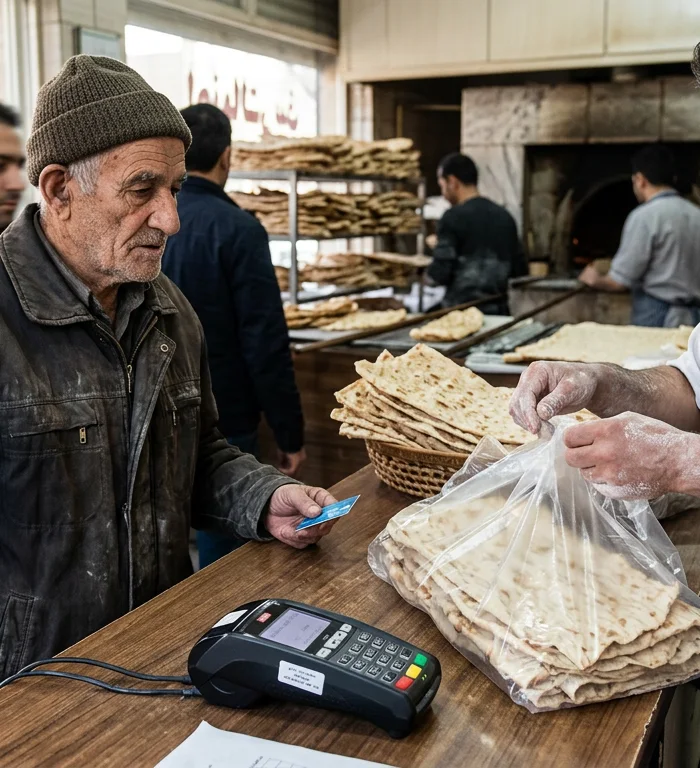
Iranian authorities have capped subsidized bread purchases at about 8 kilograms of flour a person each month in Markazi, Khuzestan and Zanjan provinces, RFE/RL’s Radio Farda reported in a Nov. 19 news report.
The change matters because bread bought beyond the monthly allowance is charged at 126,500 rials a kilogram, compared with the subsidized 23,000 rials a kilogram, more than five times the controlled price.
RFE/RL reported that the Interior Ministry’s program, called “bread purchase management,” was activated through bakery card readers without a public rollout or advance briefing for bakers and customers. Iranian media reported the activation on Nov. 18.
The measure has drawn rare public criticism from outlets across Iran’s political spectrum. The hard-line daily Keyhan, whose editor is appointed by the supreme leader, accused President Masud Pezeshkian’s government on Nov. 16 of the “secret and suspicious implementation of bread rationing.”
The conservative Tabnak website wrote that “consuming more bread is a sign of poverty, not abuse,” in response to official concern over higher bread demand. The reformist daily Sharq also criticized what it described as the government’s quiet implementation of the scheme.
Pezeshkian defended tighter controls on Nov. 18 by pointing to alleged misuse of subsidized goods and energy. He cited repeated fuel purchases in one day, cryptocurrency miners using subsidized electricity and people who “bought up to 18 tons of subsidized bread a month.”
The pricing looks small in dollar terms because of the rial’s weakness. RFE/RL reported that the dollar trades at around 2.7 million rials on the open market, while the monthly minimum wage of about 166 million rials is worth roughly $61.
The policy is politically sensitive because bread is a staple for poorer households, especially when other food prices become harder to absorb. The debate over whether the system is rationing also reflects the government’s effort to control subsidy costs without formally acknowledging a scarcity regime.
Ahmad Alavi, a Sweden-based Iranian economist, told RFE/RL’s Radio Farda that the policy follows a familiar fiscal pattern. “First goods are rationed, then the ration is cut and the consumer is sent to the free market,” Alavi said.
Alavi said a flat per-person quota fails to account for differences among households and can misdirect aid. “Bread is a public good,” he said. “Everyone should be able to obtain it quickly and at a low price, and there should be no discrimination in it.”
He also argued that controlling consumption at the retail end of the supply chain is administratively easier for the state because of Iran’s large informal economy, but warned the costs could emerge later through deeper poverty, poorer nutrition and higher health-care burdens.
Officials have given conflicting accounts of the measure, RFE/RL reported, and Iranian media have not settled on a common description for it. Some outlets call it rationing, while others reject that label.
Source: news report, RFE/RL’s Radio Farda, Nov. 19, 2026
More stories
- Binance keeps Asia licence push after $6.3bn hack
- Investors get Anthropic shares at $83 as IPO grows larger
- Liberia to cut port charges, add 30 days of free storage
- Ethiopia faces 905,000-person poverty risk in IFPRI scenarios
- Nvidia investigation puts SEC focus on investor disclosures
- G7 economic optimism falls to 22% despite steady growth
- Crypto tokens rally as SEC expands onchain stock markets
- Strait of Hormuz traffic falls as Gulf risks persist for oil
Latest news
- 30-year mortgage APR falls 8bp to 7.19%
- Vehicle service contracts can cost several thousand dollars a year
- Tumaini trial to test 2 Bundibugyo Ebola vaccines in DRC
- South Africa recycles 301,000 tonnes of plastic waste
- Jeff Buckley track tops 500,000 TikTok uses this year
- Iraq hits suspected ISIS sites with 2 strikes after US exit
- Singapore charges 2 men over 19 deregistered vehicles
- Kenya construction regulators face scrutiny after 84 collapses