

Ethiopia faces 905,000-person poverty risk in IFPRI scenarios
The model links a possible strong El Niño and fuel-price shock to lower GDP, weaker farm output and deeper food insecurity in 2027.
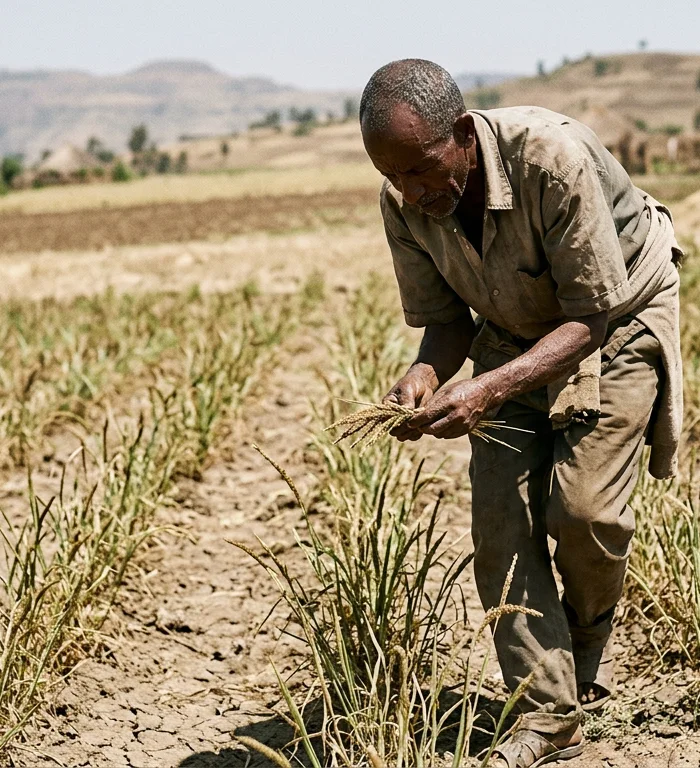
Ethiopia faces 905,000 additional people in poverty and 2.8 million in undernourishment in 2027 under shock scenarios in an IFPRI analysis published Nov. 17.
The International Food Policy Research Institute analysis said overlapping effects from a potentially exceptionally strong El Niño and higher global fuel prices linked to the Iran war could cut Ethiopia's GDP by 0.4% to 1.1% below its baseline, averaging 0.8%. Agricultural GDP would contract 2% in the average scenario, a larger hit than the economywide estimate.
IFPRI researchers Emerta Aragie and Chris Hillbruner used the Rural Investment and Policy Analysis model, known as RIAPA, to examine effects on farm output, growth, incomes, prices, poverty and nutrition. They based the projections on three scenarios for the 2026 meher harvest, Ethiopia's main October-to-December harvest period.
"Using the above 2027 economic outlook as a baseline, the model suggests it is El Niño's impacts that are likely to slow Ethiopian economic performance, particularly in agriculture, with reverberating effects on household spending, food security, and nutrition," the researchers said.
The meher harvest accounts for more than 95% of Ethiopia's annual agricultural production, making rainfall shortfalls especially important for food supply and rural incomes. Under IFPRI's moderate El Niño scenario, national agricultural productivity falls 2%, compared with 1% in the mild case and 3% in the severe case.
The projected losses are uneven. IFPRI said output in dry highland areas could decline 9.6%, while dry lowland areas could lose 6.5%. Moist highland and lowland systems would face smaller effects, according to the analysis.
The researchers measured poverty against the international $3-a-day threshold. They classified people consuming less than about 1,850 kilocalories per adult equivalent per day as undernourished.
Household pressure would come through prices and income. IFPRI projected agricultural commodity prices could rise 0.3% to 1% under the El Niño scenarios, while real household expenditure could fall by an average 1.9%. Urban households would face a 2.8% drop, compared with 1.5% for rural households.
The fuel-price shock has a smaller effect on farm production and national GDP than El Niño in the model, but IFPRI said it could account for about 472,000 of the additional people falling into poverty and 699,000 of those becoming undernourished. The researchers linked that shock to higher global fuel prices associated with disruptions to shipping through the Strait of Hormuz.
IFPRI cautioned that climate projections carry more uncertainty than global market-price assumptions, especially without large-scale crop assessments. The researchers said the scenarios are not definitive forecasts, and that the final impact will depend on rainfall patterns, harvest performance, where crop losses occur and the course of ongoing conflicts.
The findings come against existing pressure on Ethiopian households. The World Food Program's September 2026 country brief identified food inflation of about 15%, insecurity and climate shocks as factors eroding household resilience.
The Food and Agriculture Organization appealed for $50 million to assist 4.66 million people across 114 priority woredas between June 2026 and March 2027. IFPRI said emergency food-assistance needs could peak between June and August 2027, even after accounting for food and cash transfers typically provided through Ethiopia's Productive Safety Net Program.
Source: IFPRI analysis, Nov. 17; Addis Standard via AllAfrica, Nov. 18.
More stories
- Liberia to cut port charges, add 30 days of free storage
- Nvidia investigation puts SEC focus on investor disclosures
- G7 economic optimism falls to 22% despite steady growth
- US challenges Airbus financing over $3.4bn EIB loan
- Deutsche Bank shares fall 6.4% after leaked-file reports
- G7 governments face Italian-style surplus test
- US jobless claims decline as benefit rolls reach 2024 low
- Wall Street gains as Brent slips below $102 level
Latest news
- Average 30-year mortgage APR falls 21bp to 7.13%
- Home insurers charge low-score homeowners nearly $2,000 more
- Ruto pledges police reforms after 127 protest deaths
- Botswana ranks last for feeling safe after dark at 28%
- Connected Advocacy and 7 partners seek local climate finance control
- German founders need 3,942 hours to open small business
- Türkiye Desk: GTA 6 puts console access and network demand in focus
- EU methane rule faces three-year delay push by gas groups