

Ruto pledges police reforms after 127 protest deaths
The promise puts police command, training and prosecutions at the centre of a constitutional dispute over protest rights.
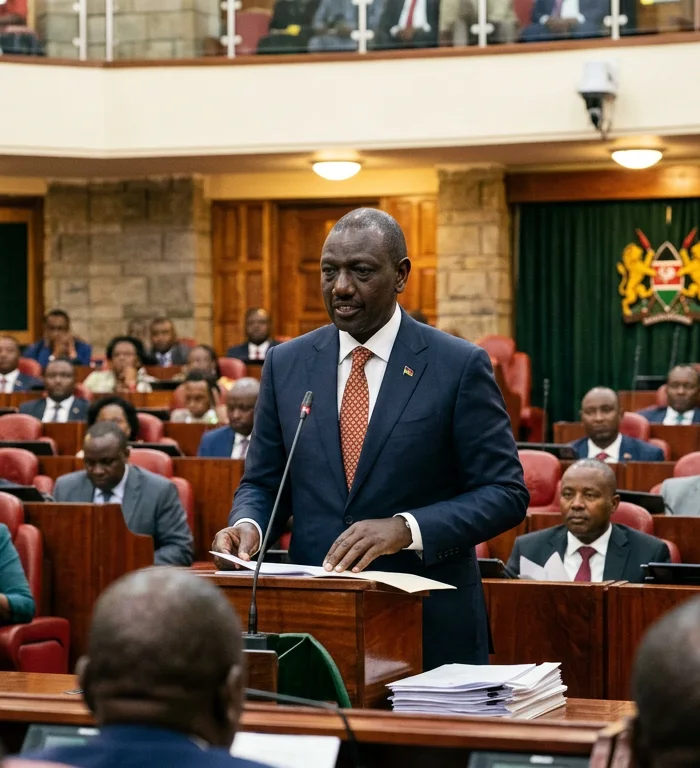
Kenyan President William Ruto pledged police public-order reforms on Nov. 18 after the Independent Policing Oversight Authority reported 127 deaths across three protest periods since 2024.
In his State of the Nation Address, Ruto also put redress before Parliament, saying a compensation panel had paid 1.2 billion shillings to 1,476 verified beneficiaries by July 2026 against a 2 billion-shilling allocation.
Ruto told a joint sitting of the National Assembly and Senate that the government was changing how protests and crowd-control operations are handled. “We are now strengthening the systems through which public order is managed. This includes improved training, professional standards, officer welfare, appropriate equipment, clear operational command, de-escalation procedures and stronger oversight,” he said.
The address followed sustained scrutiny of police conduct during the June 2024 anti-Finance Bill protests and later demonstrations. Ruto acknowledged that Kenyans had died, others had suffered serious injuries and families had experienced lasting trauma.
The president also cited the breach of Parliament, attacks on public institutions including the Judiciary, and looting of businesses. He said those events showed why stability mattered to Kenya’s economic progress.
Ruto said security agencies have a constitutional duty to protect life and property, but that state power is constrained by law. “Where security officers use unlawful force or exceed their authority, wrongdoing must be acknowledged and those responsible must be held accountable in accordance with the law,” he said.
IPOA reported 62 deaths during the 2024 anti-Finance Bill demonstrations, 27 during the June 2025 protest commemorations and 38 during the July 2025 Saba Saba demonstrations, which mark July 7. Separately, Missing Voices, a rights alliance, documented 24 police-related killings in May 2026, including 21 linked to protest policing.
Ruto invoked Article 37 of Kenya’s Constitution, which protects peaceful assembly, demonstrations, picketing and petitions to public authorities by people who are peaceful and unarmed. “We must always protect that right. Kenyans must remain free to express disagreement and criticise their Government,” he said.
The compensation figures carry their own accounting question. The breakdown cited in the address listed 1,036 civilian victims and 356 police officers injured in the course of duty, a total of 1,392 rather than the stated 1,476 beneficiaries.
Ruto said compensation did not remove the need for criminal accountability. “Investigations must continue, and prosecutions must follow for violations of the law, wherever the evidence warrants,” he said.
The pace of such cases has drawn scrutiny. IPOA has previously cited forensic constraints, including bottlenecks at the National Forensic Laboratory and Government Chemist, as well as evidentiary challenges in police-death investigations.
By June 2026, IPOA had reported three cases before courts and three others forwarded to the Office of the Director of Public Prosecutions. The Kenya National Commission on Human Rights also condemned a February 2026 shoot-to-kill directive by Coast Regional Police Commander Ali Nuno as unconstitutional, while Inspector General Douglas Kanja warned in August that commanders would be held responsible for custody deaths and misconduct by rogue officers.
Source: news article, Capital FM via AllAfrica, Nov. 18, 2026
More stories
- Botswana ranks last for feeling safe after dark at 28%
- Connected Advocacy and 7 partners seek local climate finance control
- EU methane rule faces three-year delay push by gas groups
- Russian strikes leave many Kyiv homes with 4 hours of power
- Cebu groups seek probe into protest dispersal with more than 20 hurt
- Malaysia AG warned Najib house arrest risked stability
- Machado returns to Venezuela, testing Rodríguez’s opening
- Portugal police remove 171 housing protest structures
Latest news
- Average 30-year mortgage APR falls 21bp to 7.13%
- Home insurers charge low-score homeowners nearly $2,000 more
- German founders need 3,942 hours to open small business
- Türkiye Desk: GTA 6 puts console access and network demand in focus
- Liberia to cut port charges, add 30 days of free storage
- Leaked Deutsche Bank files test Sewing's reform narrative
- CMS raises Medicare Part B premium $6.50 for 2027