New Zealand social media ban stalls before election vote
New Zealand's proposed under-16 social media ban faces uncertain passage after two coalition partners opposed it before Parliament's October 1 dissolution.
Sofia Reyes ·
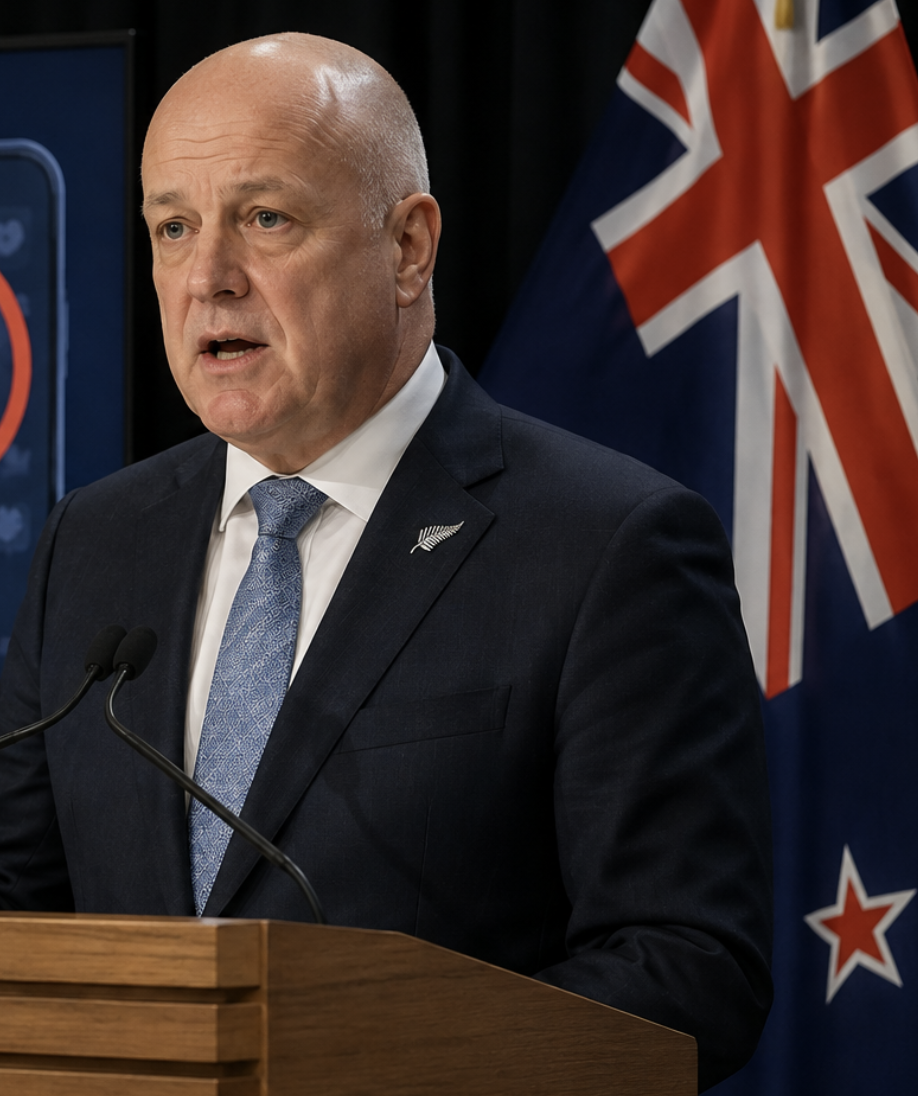
The New Zealand social media ban proposed by Prime Minister Christopher Luxon would bar users under 16, but its path through Parliament is uncertain.
Luxon presented the bill on Monday as a response to what he described as harm to young people from online platforms. The measure would put New Zealand among governments seeking age restrictions on social media use, though its prospects depend on votes his coalition does not currently control.
Luxon seeks an under-16 cutoff
The proposal would prohibit children younger than 16 from using social media platforms, according to Luxon's announcement. He cited 2025 research which he said showed one-third of New Zealand teenagers spent at least five hours a day on social media.
The bill has not secured enough support to pass in its current form. Two of the three parties in Luxon's coalition government plan to vote against it, leaving the prime minister reliant on opposition lawmakers who have not said how they would vote.
That arithmetic matters because New Zealand bills normally need three rounds of voting before becoming law. Luxon said there was not enough time for lawmakers to vote on the measure before Parliament dissolves on October 1 ahead of November's election.
Coalition split narrows the route
The proposal therefore sits at the intersection of child-safety policy and election-year parliamentary timing. Luxon has tied the bill to a possible next term, saying he would seek to advance it if reelected.
Opposition support would be the immediate test if the measure returns after the election. Without it, the bill would remain a campaign position rather than a legislative change for technology platforms, schools and families.
The split inside the governing bloc also limits how confidently the proposal can be treated as government policy. A bill backed by the prime minister but opposed by coalition partners carries a different legislative risk than one introduced with unified governing-party support.
Age bans spread across capitals
New Zealand would not be acting alone if lawmakers eventually approve the measure. Luxon's proposal follows moves by dozens of countries that have introduced, considered or debated age limits for social media platforms.
The policy trend reflects a shift in how governments frame platform regulation. Earlier debates centered on content moderation and competition; newer proposals increasingly focus on age verification, child safety and the amount of time young users spend online.
For platforms, the central operational issue would be enforcement. An under-16 ban would require companies to determine users' ages more reliably, which could add compliance costs and expose them to penalties if lawmakers attach enforcement rules to the final bill.
For New Zealand families, the policy would move responsibility from parental supervision alone toward a statutory rule. The practical effect would depend on how the law defines social media platforms, what verification tools are allowed and whether exemptions are written into the legislation.
Election decides the next step
If Luxon is reelected and opposition lawmakers support the bill, New Zealand could join the group of countries using age thresholds as a direct regulatory tool for online safety. The mechanism would be legal access control: platforms would have to screen younger users out rather than rely mainly on user settings or parental controls.
If the coalition split holds and opposition parties withhold support, the bill would likely remain stalled even after the election. That outcome would leave social media companies operating under existing rules in New Zealand while watching similar measures overseas for compliance models.
A third path is amendment. If lawmakers narrow the bill, delay enforcement or change the age-verification requirements, the policy could move from a strict ban toward a phased regime that gives platforms more time to adapt.
The global effect is regulatory rather than macroeconomic at this stage. If more countries adopt age bans, large platforms could face fragmented national rules; if proposals fail in parliaments, the industry may continue to face pressure through guidance, school policies and parental-control requirements instead.
The main open question is whether November's election changes the vote count enough to revive the bill. Until then, the proposal is a clear political signal from Luxon, but not yet a law that platforms must implement.