Fairford terror suspects freed on bail as Trump questions British handling
Five young Londoners arrested near a US bomber base have been released while detectives examine whether a hostile state used them as proxies
Claire Dubois ·
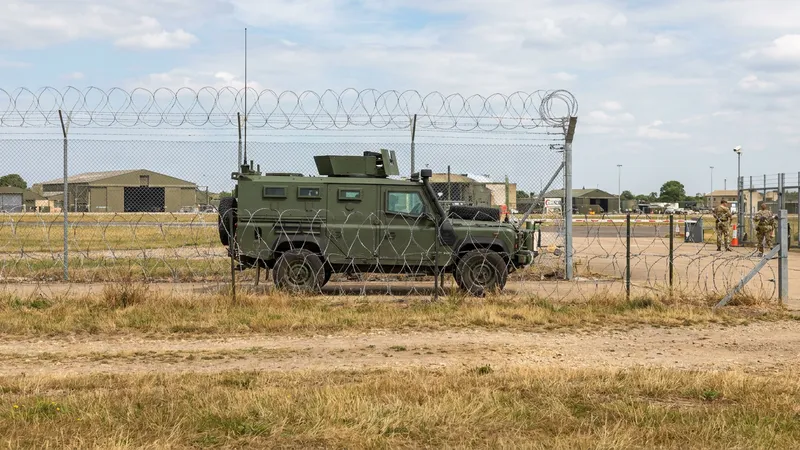
Five young men arrested in the early hours of Sunday near an airbase used by American bombers have been released on police bail. The decision drew public criticism from Donald Trump and exposed a widening gap between what British detectives are prepared to say and what Washington is already asserting.
The men, all Britons in their early twenties from inner London, were detained in the Gloucestershire village of Whelford, less than half a mile from RAF Fairford. They have not been named or charged. Counter-terrorism officers insisted that the suspects "absolutely remain under investigation", but their release after little more than a day has fuelled questions about what, if anything, was planned.
A call after midnight
The alarm was raised at about 12.45am on Sunday. Police received a call about three suspicious vehicles travelling towards the base. Armed officers responded, and five men were arrested on suspicion of offences under the Explosives Act, then further arrested on suspicion of preparing a terrorist act. According to British media reports, the caller was a farmer driving home from a party who found three white vans blocking a road a few hundred yards from the base.
A major incident was declared. Armed police manned a cordon around Whelford, and about 85 households were evacuated before being allowed home on Monday evening. Helicopter footage broadcast by the BBC showed a wheeled bomb-disposal robot working beside three parked white vans.
The suspects are a 24-year-old from Camden, three men aged 23, 24 and 25 from Westminster, and a 24-year-old from Willesden.
Nothing viable found
The case appears to have lost much of its initial urgency. The Press Association reported, without citing sources, that police had not found viable explosives. Police have not confirmed this. Assistant Commissioner Laurence Taylor, head of Counter Terrorism Policing, said the men would be subject to stringent bail conditions. He added that detectives were considering "every possible angle", including the possibility that the men were proxies working on behalf of a foreign state, knowingly or unknowingly.
The speed of the release matters. Under British terrorism law, suspects can be held for up to 14 days without charge, with judicial approval. A release after about 36 hours does not clear the men, but it suggests detectives did not yet have the evidence to charge them or to justify further detention.
The American dimension
The base's role explains the level of alarm. When the American-Israeli war on Iran began on February 28, the British government allowed the US military to use Fairford for strikes on Iranian missile sites. Iran has since indicated that any base used to attack its territory is a legitimate target. The Islamic Revolutionary Guard Corps made that threat explicit in July.
That link to the war helps explain why American officials have spoken far more freely than British police. Speaking in Chicago on Sunday, Trump said the men had been planning to do major damage and that US authorities had helped the British police. He claimed they had been watched "for a long time" before being caught. Told of their release, he was blunt: "I'm surprised they released them, I wouldn't have." He said the case "might be" linked to Iran but declined to elaborate.
Marco Rubio, the US secretary of state, went further. He said the incident "clearly involves the hands of a foreign actor", though he did not name a country. The US embassy in London advised Americans to be mindful of their personal security.
Tehran has rejected the accusation. Its London embassy said it "categorically rejects and strongly condemns" speculation linking it to the arrests, which it said would feed "Iranophobia propaganda" in Britain. Investigators have not concluded whether the incident was state-backed and are examining possible links to Iran, Russia or non-state militant groups.
Downing Street treads carefully
In Whitehall, the tone has been more cautious, if not entirely consistent. Andy Burnham, the prime minister, urged the public not to speculate while the authorities established the facts. He chaired a meeting of Cobra, the government's emergency committee, on Monday. Wes Streeting, the defence secretary, said bail decisions were operational matters for police and prosecutors. In the same remarks, however, he said that Iran and its proxies wanted to harm Britain. Ed Miliband, the foreign secretary, spoke more combatively: "We will act against the proxies of Iran."
Counter-terrorism police have asked for patience. A spokeswoman acknowledged the speculation and the geopolitical questions being raised, but urged that investigators be "given the space to work carefully".
A familiar target
Fairford has long been a focus for both protest and suspicion. It was built in 1944 as a joint British-American base. During the Cold War, units of the US Air Force's Strategic Air Command were stationed there as part of Nato's deterrent against the Soviet Union. Its long runway makes it the main forward base in Europe for American heavy bombers. In 2003, at the start of the Iraq war, five protesters broke into the base and damaged equipment to disrupt operations. They became known as the "Fairford Five".
The base has faced more recent threats. In November 2024, unauthorised drones were reported over or near four US Air Force bases in England, including Fairford. The following June, two Voyager aircraft were sprayed with paint during a break-in at RAF Brize Norton, an attack claimed by Palestine Action. The group was later banned as a terrorist organisation. Residents say security around Fairford had already been visibly tightened in recent days.
The proxy problem
The line of inquiry Taylor described is not new, and MI5 knows the pattern well. Last October, Ken McCallum, the director-general of MI5, said the agency had tracked more than 20 potentially lethal Iran-backed plots in the previous year alone. Officials have investigated a rising number of sabotage, stabbing and suspected bombing plots. Many allegedly involved criminal networks, or people recruited online who may not have fully understood that Iran was behind them.
The record includes the 2024 stabbing in London of a British journalist of Iranian origin who worked for Iran International. In March this year, four men were arrested in an investigation into alleged surveillance, on behalf of a foreign intelligence service, of people and places linked to London's Jewish communities. Russia uses similar methods.
In 2025, a group of young British men were convicted over an arson attack in east London the previous year, commissioned by the Wagner Group and targeting a warehouse linked to Ukraine. They were recruited over messaging apps.
That background gives weight to the proxy theory. It also argues for caution. Recruits of this kind are often poorly briefed, poorly equipped and paid in small sums. Their handlers may be several steps removed. Proving intent, let alone state direction, in court can take years.
What comes next
Three questions will decide how this story ends. The first is what forensic examination of the vans shows. The second is whether prosecutors find grounds to charge any of the men, and under which legislation. The third is whether Washington's confident claims of a foreign hand are backed by evidence shared with British investigators, or quietly allowed to fade.
For now, the residents of Whelford are home, and the five men are at liberty under strict conditions. The two allies are still telling rather different stories about what happened in a Cotswold lane on Sunday night.