Ukraine forces retake 51 sq km in northern Donetsk push
Ukraine said its forces retook 51 square kilometers in northern Donetsk, part of a wider operation aimed at disrupting Russia's pressure on eastern cities.
Claire Dubois ·
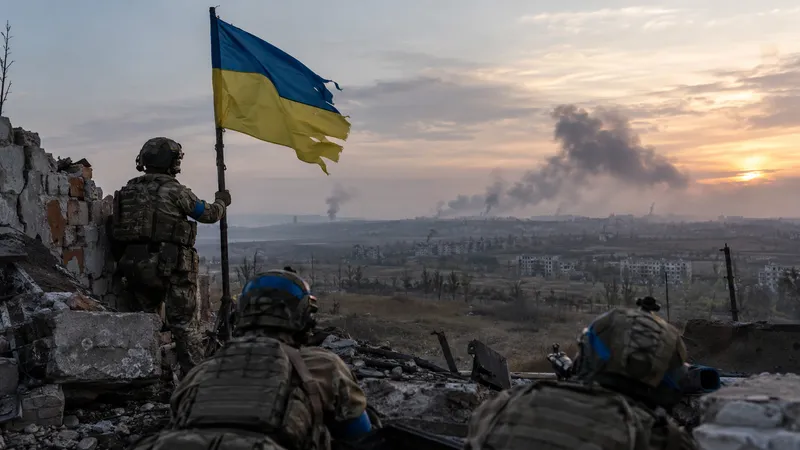
Ukraine said its Third Army Corps retook 51 square kilometers in northern Donetsk, in an operation aimed at complicating Russia's eastern advance.
Biletskyi puts Vivaldi at 176
Brigadier-General Andrii Biletskyi, who has commanded operations in the area since last month, said the latest gain covered about 20 square miles. He said Operation Vivaldi has now recovered 176 square kilometers in northern Donetsk, including three additional villages and two other villages where Ukrainian control was restored.
The figures are the Ukrainian commander's account of battlefield changes in one of the war's most contested regions. Russia has not been cited with a competing territorial figure in the same account, leaving the scale of the shift dependent on Kyiv's military reporting.
Biletskyi framed the operation as a way to make Russia's assault on Ukraine's eastern strongholds more difficult. The Institute for the Study of War described that effect as an "operationally-significant" objective, saying the push disrupted Moscow's attempt to conduct a wider encirclement of Ukraine's so-called fortress belt of cities.
Kostiantynivka pressure remains central
The immediate focus is the northern Donetsk front, where geography matters as much as the number of square kilometers. Ukrainian-held cities in the area form part of a defensive line that Russia has tried to pressure from the south while probing deeper toward Kostiantynivka.
Russia's overall frontline gains have slowed this year, according to the battlefield account, but its forces have continued to press the eastern campaign. That makes even limited Ukrainian advances relevant if they force Russia to adjust routes, redeploy units or spend more time securing approaches to urban positions.
Donetsk has been one of the war's hardest-fought regions since Russia widened its invasion in 2022. Ukraine still holds about 20% of the region, while Moscow has made full control of Donetsk its main territorial demand in negotiations that have stalled.
Donetsk claims shape talks
The diplomatic setting gives the battlefield report a second audience beyond the front line. The US wants negotiations restarted, but the status of Donetsk remains a central obstacle because Russia is seeking control of the entire region and Ukraine still holds key cities there.
The latest claim also follows Ukraine's earlier push in the southeast, where Kyiv said it regained more than 700 square kilometers during a counterattack that lasted several months. Set against that earlier figure, the 51-square-kilometer Donetsk gain is smaller, but it is located on a front tied directly to Russia's main territorial demand.
If the 51-square-kilometer gain holds, the global macro effect would probably remain indirect, running through war-risk pricing, sanctions policy and expectations for negotiations rather than immediate output data. For Ukraine's military, the mechanism would be tactical: more room around northern Donetsk could reduce pressure on the fortress belt. For the wider defense sector, a more mobile front would sustain demand for reconnaissance, engineering and ammunition support.
If Russia offsets the gain by deepening pressure toward Kostiantynivka, the macro channel would shift back toward prolonged-war assumptions and slower diplomatic momentum. For Ukraine's forces, the burden would move from exploiting recovered ground to holding it under renewed assault. For the industry around the war, attrition would keep priority on replacement equipment, repairs and supply logistics rather than a rapid drawdown.
The main open question is whether Ukraine can hold the villages and ground Biletskyi said were recovered. A second uncertainty is whether Russia can redirect units quickly enough to restore pressure on the encirclement plan that the Institute for the Study of War said Operation Vivaldi had disrupted.