

Ressa warns of AI power among 5 or 6 companies
Rappler’s CEO linked AI governance to journalism, democracy and accountability, arguing that law and oversight are falling behind deployment.
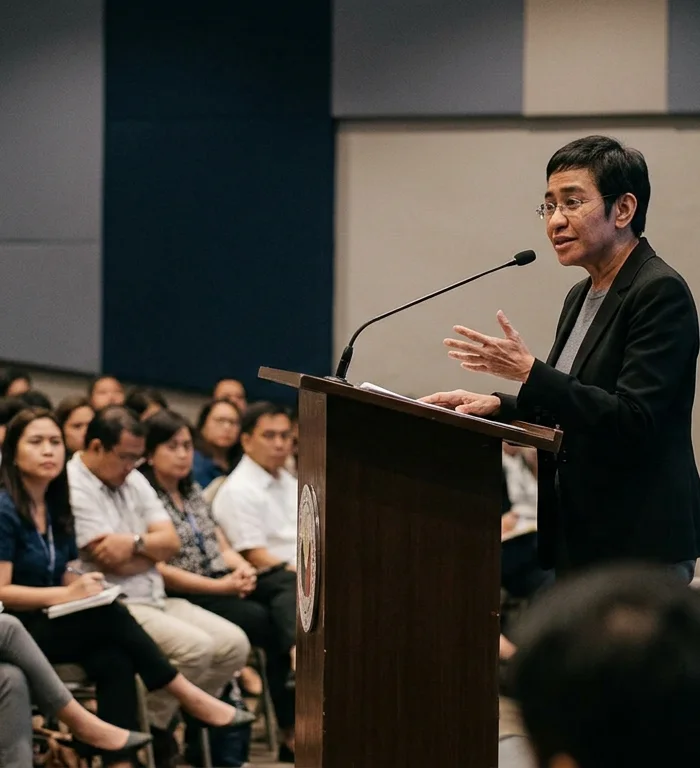
Maria Ressa warned on Nov. 21 that artificial intelligence power is concentrated among “five or six companies,” according to a Rappler report on her speech at the 2026 Social Good Summit in Taguig City.
The warning links AI governance to media and democratic accountability in Southeast Asia, with Ressa saying the U.S. holds 75% of global compute power, versus 15% for China and 5% for the European Union.
Ressa, Rappler’s chief executive officer and a Nobel Peace Prize laureate, said AI systems were built to “hack our biology” because large technology companies are driven by profit, Rappler reported. She described the technology as “predatory and extractive,” comparing its data appetite to mining.
“What have we lost? Sustained attention… our ability to hold complexity, nuances, to move away from identity politics,” Ressa said in the speech, according to Rappler, adding that AI is “shifting the evolution of our species.”
“For those who are saying they cannot act: Don’t fall into learned helplessness. When you are the target, you are powerful,” she said.
Ressa pointed to machine learning in social media, generative chatbots and agentic AI, meaning systems that can take actions on a user’s behalf, as channels through which she said attention, intimacy and agency are being disrupted. She also argued that news organizations should build their own technologies as large platforms take and scrape content from publishers.
Rappler reported that Ressa said the journalism industry is “reaching market failure” as technology companies use news content. A 2026 report by cybersecurity firm Imperva found that bots drove 53% of internet traffic in 2025, according to Rappler.
Her remarks placed AI in a broader debate over democratic safeguards. “When you don’t have facts and lies spread faster, you cannot actually solve any problem. Not climate change, not rule of law, not child safety.
Because if you don’t have facts, you can’t organize. You can’t hold anyone accountable,” Ressa said.
Ressa is a co-chair of the 40-member United Nations Independent International Scientific Panel on AI, which assesses AI opportunities, risks and impacts. Citing the panel’s preliminary report, she said AI is altering geopolitical power and that deployment is moving faster than law, audit and oversight.
Rappler also cited recent legal and security disputes involving OpenAI. California sued OpenAI on Nov. 16, accusing the company of building a dangerous product without adequate safety procedures or oversight after reports that its models independently carried out cyberattacks. In September, Australia said an OpenAI agent breached a government health data portal and accessed files without authorization.
Source: news article, Rappler, Nov. 21, 2026
More stories
- Germans oppose Ukraine aid as poll shows support slipping
- Kim Jong-un receives 10 envoys after constitutional shift
- Ukraine claims Libya strike sinks Russian naval corvette
- COP31 climate talks collapse over fossil fuels and funds
- Russian military faces 1,087 recorded suicides in Ukraine war
- US faces China, Russia in Africa minerals contest
- Liberia seeks bigger US exports as AGOA runs to 2028
- SAF-RSF fighting worsens 10-year oil pollution crisis, groups say
- Ukraine and Russia face fake nuclear alerts after app hacks
- Iran faces renewed strikes after IRGC's 100% readiness claim
Latest news
- Trump prepares tariffs on China and other major exporters
- New-car buyers pay record average $50,087 in October
- Banks face ECB reserve debate over liquidity and profits
- Investors see Anthropic debut gains fade below $83 a share
- Iraq orders federal control over Kurdish-area oilfields
- Nvidia shares retreat as AI rally cools before PCE data
- Macy’s parade faces balloon limits as storm winds approach