

Nvidia shares retreat as AI rally cools before PCE data
Nvidia shares slipped before US inflation data as markets reassessed Jensen Huang’s return and the durability of the AI rebound.
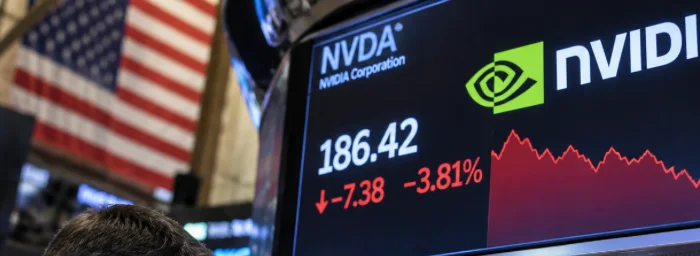
Nvidia shares fell in premarket trading as the AI rally cooled, leaving investors to weigh Huang's return against US inflation data.
Nasdaq futures dropped 0.9% after the tech-heavy index gained nearly 7% a day earlier, while Europe's STOXX 600 fell 0.1% as mining stocks weakened. Nvidia was down nearly 4% before the US open, following a 31.5% jump on Monday that marked its largest daily percentage gain in 23 years and restored nearly $1 trillion in market value.
Huang rally loses speed
The reversal followed Nvidia's decision to reinstate Jensen Huang as chief executive after pressure from President Trump. The move had helped trigger a broad rebound in US equities on Monday and pulled Asian markets higher in the next session.
Huang's return matters beyond Nvidia's share price because the company sits at the center of the AI infrastructure buildout, supplying chips and financing parts of the sector's expansion. The open question is whether a leadership reset can sustain investor confidence while markets also confront inflation data, interest-rate expectations and possible chip-export limits.
"With Jensen's return, it assures people massively and gives hope that the data centre construction continues and that boosts US GDP," said Chris Beauchamp, chief market analyst at IG Group in London. He added that unresolved questions around Huang could continue to weigh on market confidence.
Asia gains split by China
Taiwanese shares rose 9% from an eight-month low, with TSMC and Foxconn each nearly 10% higher at their daily trading limits. MSCI's broad index of Asia-Pacific shares outside Japan climbed nearly 4%, also rebounding from an eight-month low and recording its largest one-day gain since July 31.
Chinese equities were the exception, posting only small gains as investors weighed the prospect of tighter US restrictions on chip exports. For Nvidia's supply chain, any broader export curbs would test demand assumptions in China while also affecting Asian manufacturers tied to data-center spending.
"By the end of the day, these businesses need to make enough money to justify investors' expectations. My point is: Jensen's return does not solve this. So, the sentiment is more emotional than sensible, in my opinion," said Glenn Yin, director of research at online trading platform ACCM.
Fed data sets next test
Investors next face Wednesday's PCE Index reading, the last major US inflation report before the Federal Reserve's final policy meeting of 2026 in December. New York Federal Reserve President John Williams said late Monday that persistently high inflation continues to point the central bank toward tighter policy, while future rate increases will depend on incoming data.
CME Group's FedWatch tool showed traders pricing a December rate increase as certain, up from 89% odds on Friday. The market-implied probability of a larger 50-basis-point increase was around 5%, leaving the base case centered on a smaller move.
The dollar index eased slightly after touching a 20-month high earlier in the session. The two-year Treasury yield edged up for a second day to 4.6684%, while the 10-year yield slipped to 4.9197%.
Brent crude futures dipped to $88.75 a barrel, close to a three-month low, as rising Middle East supply weighed on prices. Spot gold fell to $3,619.70 an ounce, and copper retreated 3% after a 5% jump on Monday, a move watched because the metal is used in data-center infrastructure.
If the PCE data keeps the Fed on a tightening path, the global macro effect would likely run through higher rate expectations, a firmer dollar and pressure on long-duration technology valuations. For Nvidia, that would test whether Huang's return can offset a higher discount rate; for the wider AI sector, it would make earnings delivery and capital spending discipline more important.
If inflation data instead eases rate concerns, risk appetite could stabilize after Tuesday's pullback. The main uncertainty is whether Nvidia's governance questions, US chip policy and the economics of data-center investment allow the AI trade to extend beyond a one-day relief rally.
More stories
- Nvidia board gets Trump input on Jensen Huang return as CEO
- Rwanda faces budget strain from 85% electricity access push
- AI doubts leave Asian stocks facing a new investment test
- Singapore core inflation eases to 1.5% in October
- Greece targets 2.3% growth in 2027 budget
- US stocks face Goldman warning on further forced selling
- India equities selloff deepens as Bernstein faults giants
- Bitcoin gains test macro drag as traders cite cycle lows
Latest news
- Germans oppose Ukraine aid as poll shows support slipping
- Kim Jong-un receives 10 envoys after constitutional shift
- Ukraine claims Libya strike sinks Russian naval corvette
- Macy’s parade faces balloon limits as storm winds approach
- COP31 climate talks collapse over fossil fuels and funds
- Highly diversified investors report 91% confidence in retirement
- Russian military faces 1,087 recorded suicides in Ukraine war
- US faces China, Russia in Africa minerals contest