India equities selloff deepens as Bernstein faults giants
Foreign investors have sold nearly $26 billion of India equities this year as Bernstein says large caps lack growth to justify valuations.
Raj Patel ·
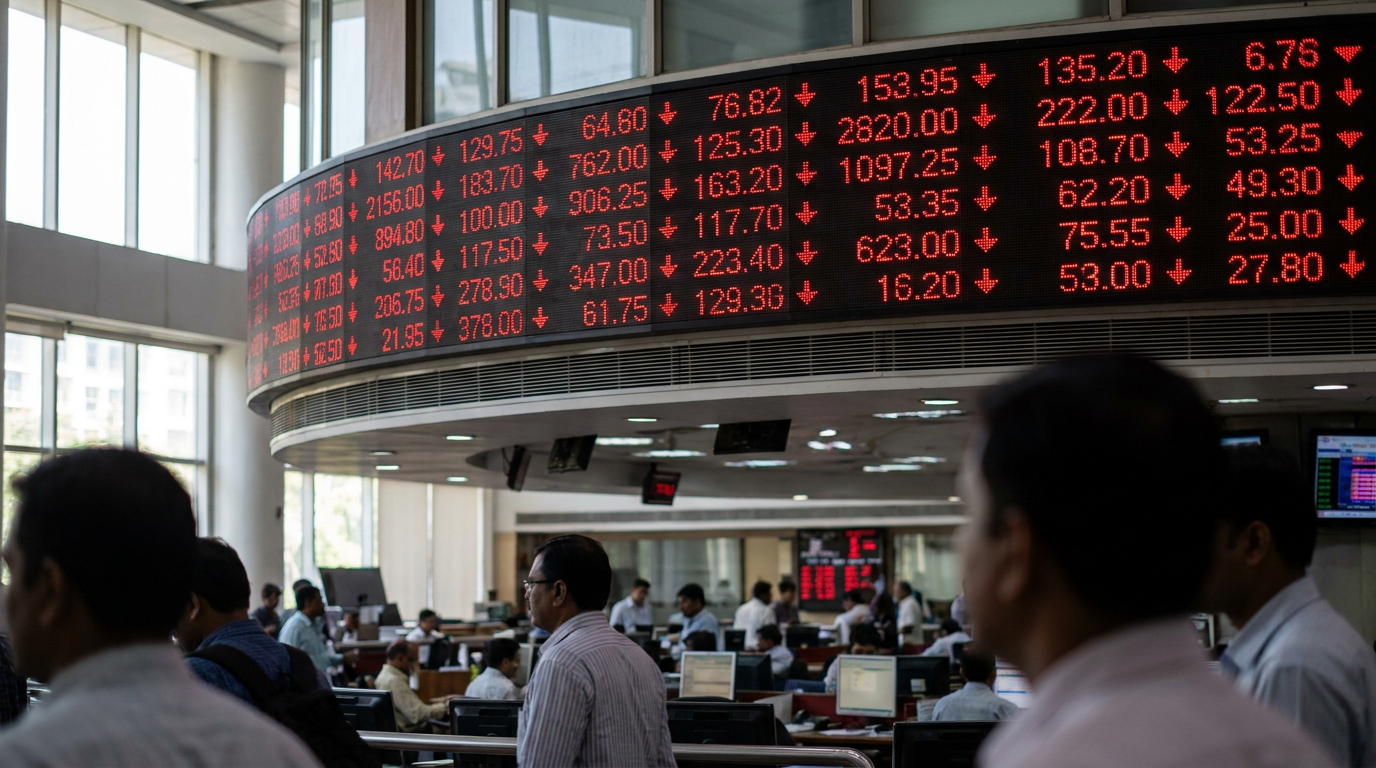
Foreign investors sold $1.7 billion of India equities in September, extending a record annual withdrawal as Bernstein questioned large-cap growth.
Bernstein faults large caps
The global brokerage said Monday that overseas investors had limited incentive to increase exposure to India while many of its biggest listed companies remain tied to older business models. Bernstein said many large caps represent a "bygone economic era" and do not deliver the growth needed to support elevated market valuations.
The report framed the issue as a capital-allocation problem rather than a short-term trading setback. Bernstein said large corporates were consolidating existing businesses and often expected policy protection while hesitating to fund emerging areas such as electric vehicles and semiconductors.
Those sectors require long investment cycles, technical capacity and scale before they can change a market index. Bernstein said the companies with the deepest balance sheets were not supplying enough of the capital India needs to build that scale.
$26 billion leaves Indian shares
Data from depository firm NSDL showed foreign portfolio investors sold $1.7 billion of direct Indian equities so far in September, after a pause in July and August. The selling has taken 2025 outflows to nearly $26 billion, the highest annual total in the data cited.
The benchmark Nifty 50 has fallen more than 10% since January, an anchor that has sharpened the gap between India’s economic narrative and its main equity benchmark. The index is dominated by established banks, energy companies, consumer groups and information-technology exporters rather than many of the newer businesses attracting domestic growth capital.
Ambit Capital data cited in the source showed average earnings growth of Nifty 50 companies at 11% in the June quarter, compared with 31% for mid-cap companies from a year earlier. Mid-cap and some small-cap stocks have greater exposure to manufacturing, fintech, consumer technology and other areas gaining a larger share of activity.
Bernstein said that promise has limits for large global funds. Smaller companies may offer faster earnings growth, but the brokerage said many remain sub-scale, with low free floats, limited liquidity and thinner analyst coverage.
Reliance and HDFC trade low
LSEG data showed Reliance Industries and HDFC Bank, two of India’s most watched large-cap names, trading near their lowest levels in 52 weeks. Their weakness matters for benchmark investors because both companies carry heavy weight in institutional portfolios and influence index-level returns.
Information-technology companies, which account for more than 8% of the Nifty 50, are also facing revenue and margin pressure as clients adopt artificial intelligence. Bernstein said India is widely viewed as an anti-AI trade, with no local artificial-intelligence champion and an IT services industry exposed to automation.
The Tata Group faces a separate governance test, with a boardroom battle that could affect its ability to invest in India’s first semiconductor fabrication plant, according to the report. Chip manufacturing needs long-dated capital commitments, so corporate uncertainty can slow execution even when government policy is supportive.
Three paths for foreign capital
If large-cap earnings continue to trail mid-cap growth, overseas portfolio flows are likely to remain concentrated away from India’s most liquid shares. In that scenario, the global macro effect would be a narrower foreign-capital channel into India, while companies such as Reliance and HDFC Bank face tougher valuation support and the wider market keeps rewarding smaller industrial and technology-linked names.
If large corporates increase investment in electric vehicles, semiconductors or AI-linked services, foreign institutions would have a clearer route into India through liquid stocks. That path would support the Nifty 50, improve the case for large-company capital spending and reduce the split between old-economy index leaders and newer growth sectors.
If the global AI trade weakens or geopolitical stress in the Middle East eases, Bernstein said foreign money should not be assumed to return automatically. "It would be a folly to think that it’s just a matter of time, and once the AI trade settles and the Middle East crisis resolves, foreign money is just waiting to be parked into India," the brokerage said.
The open questions are whether September selling continues, whether Nifty 50 earnings close the gap with mid-caps, and whether India’s largest business groups commit capital to technology sectors at scale. Until those answers improve, the report suggests foreign investors may keep separating India’s growth story from its largest listed companies.
Persistent capital flight from India's benchmark equities is likely to force both policymakers and conglomerate leaders to re-evaluate structural growth strategies and corporate capital allocation. In response to sustained foreign institutional selling, domestic capital may be required to shoulder an increasing share of market liquidity, while corporate boards face mounting pressure to accelerate capital deployment into advanced manufacturing and next-generation technologies.
The primary risk lies in a prolonged valuation divide, where liquid blue-chip indices lag behind smaller, less liquid growth companies, potentially heightening market fragility if domestic retail inflows taper off. Historical capital rotation patterns across major emerging markets suggest that international portfolio inflows rarely resume at scale until primary equity benchmarks evolve to reflect modern economic growth drivers.
Conversely, this sustained pressure could serve as a constructive catalyst, compelling established business groups to unlock shareholder value through corporate spin-offs and aggressive capital expenditure in high-yield sectors.
Over the medium term, while India's macroeconomic fundamentals remain exceptionally strong, a sustainable market turnaround will ultimately depend on whether its largest listed firms can successfully modernize their growth models and narrow the earnings gap with dynamic middle-tier enterprises.
Looking ahead, global asset allocators will likely monitor upcoming quarterly earnings reports and capital expenditure announcements for signs that Indian blue-chip corporates are shifting away from defensive strategies.
If index heavyweights fail to demonstrate tangible progress in high-growth digital and industrial sectors, foreign portfolio flows may remain constrained throughout the upcoming fiscal cycles, further solidifying the performance wedge between benchmark equities and the broader economy .