

AI doubts leave Asian stocks facing a new investment test
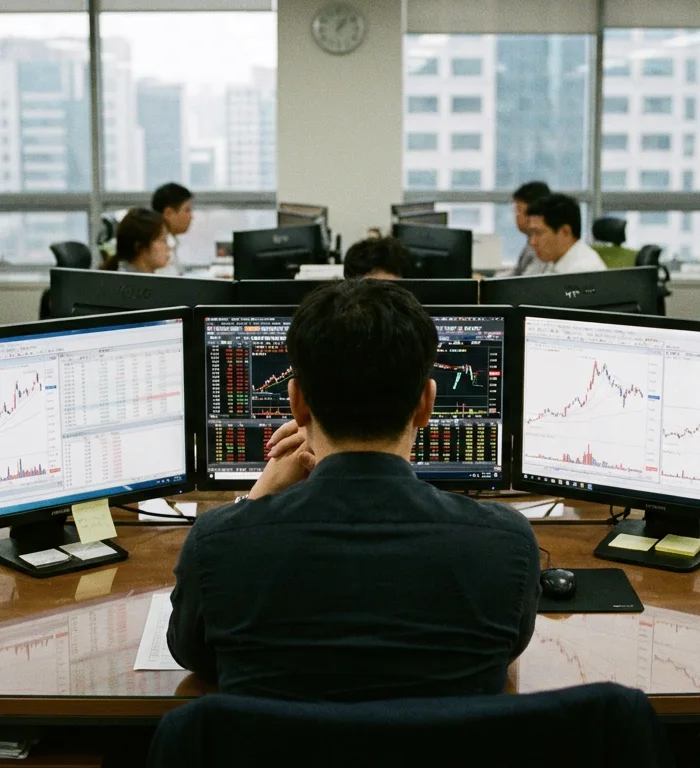
Asian stocks diverged Monday as Seoul's benchmark fell 3.3%, while rising US equity futures pointed to a possible Wall Street recovery.
South Korea's Kospi finished above its session low, having lost as much as 5.8% earlier. Samsung Electronics declined 3.1% and SK Hynix lost 2.5%, leaving two major suppliers of memory chips exposed to artificial intelligence spending among the day's declining stocks.
The regional picture was less uniform than Friday's retreat. Taiwan's Taiex reversed opening losses to finish 2.2% higher, while mainland China's CSI 300 gained 0.1% after falling more than 1% earlier in the session.
Seoul losses contrast with Taiwan recovery
Hong Kong's Hang Seng ended 0.1% lower, narrowing an earlier decline approaching 2%. Japanese exchanges were shut for Labour Thanksgiving Day, leaving Tokyo's market without a Monday session in which to respond to Friday's US losses.
The previous session had produced broader declines: Seoul, Tokyo and Taipei benchmarks finished Friday with losses ranging from 5.1% to 6.2%. Hong Kong's benchmark fell 1.9% that day, making Monday's smaller decline a moderation rather than a reversal.
In the United States, the S&P 500 lost 3.7% on Friday and entered correction territory, defined as a decline of at least 10% from a recent peak. The Nasdaq Composite fell 5.3%, wiping out its gains for 2026.
Monday's futures offered a different signal ahead of the US reopening: S&P 500 contracts gained 2.2%, while Nasdaq futures rose 2.9%. Those moves indicated a possible recovery, not a completed rebound in the underlying stock indexes.
AI spending faces a financing test
Rajat Agarwal, an Asia equity strategist at Societe Generale, said investors were assessing whether the correction had "gone too far" after the previous week's losses. His assessment distinguished the immediate search for market stability from the longer-term debate over AI investment.
Technology research company Gartner projects global AI-related investment of $2.7 trillion in 2026, rising to $3.6 trillion in 2027. Those forecasts describe anticipated spending, not realized returns for the companies financing or supplying the infrastructure.
The investment debate centers on whether technology companies can sustain the commitments needed to build and operate AI systems. For Samsung Electronics and SK Hynix, the relevant uncertainty is whether customers maintain that spending, rather than whether share prices recover over a single session.
Futures gains leave demand unresolved
If AI infrastructure commitments hold, continued equipment purchases could support demand for memory chips and other suppliers. At the global level, that scenario would sustain this channel of capital investment even if equity valuations remained under pressure.
If financing constraints instead force customers to defer projects, Samsung Electronics and SK Hynix could face weaker demand from those buyers. The same mechanism could affect other infrastructure suppliers and reduce AI-related investment relative to Gartner's projected path.
Khoon Goh, head of Asia research at ANZ, said: "AI-related concerns will continue to dominate this week, as investors try to determine if the bottom is near." The immediate test is whether stronger US futures translate into gains when regular trading resumes; the spending question extends beyond that session.
More stories
- Singapore core inflation eases to 1.5% in October
- Greece targets 2.3% growth in 2027 budget
- US stocks face Goldman warning on further forced selling
- Bitcoin falls below $57,742 as investors seek other bets
- Nvidia SEC probe examines chipmaker’s accounting issues
- Rwanda women-owned exports fall 51% from 2021 peak
- France faces election strain after 2,000 protest arrests
- Malaga leads Andalucía euthanasia cases with 13 in 2025
Latest news
- ICE arrests at Seattle airport draw protests and scrutiny
- EU rejects COP31 deal as fossil fuel divisions block pact
- Deal Sheet: Fortis shutdown costs over 400 jobs
- Germany to pay about $11 a month into child pension accounts
- Monrovia mayor-designate seeks $14.5m city budget
- Laura Brand curbs prison messages after YouTube dispute
- Nigeria's family-planning budget falls 97%
- Peter Attia reviews cold therapy claims on longevity