

EU rejects COP31 deal as fossil fuel divisions block pact
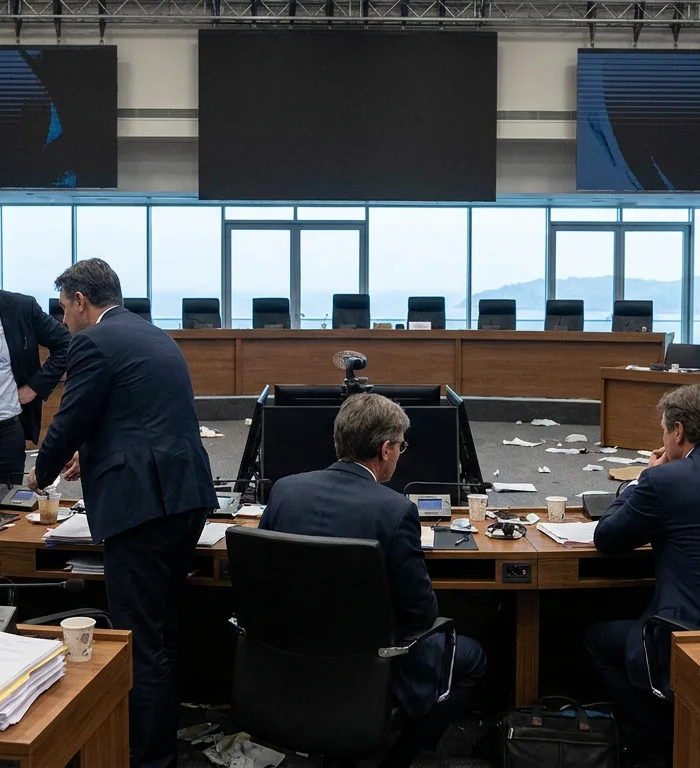
The European Union rejected a COP31 deal in Antalya, Turkiye, saying it offered too little to address fossil fuels and warming.
The conference ended without agreement on Sunday, leaving unresolved both the direction of energy policy and financial assistance for developing economies. Negotiators failed to settle disputes over reducing fossil-fuel dependence, financing cleaner energy and supporting countries confronting natural disasters.
Fossil fuels divide the negotiations
The final proposal omitted fossil fuels while endorsing carbon capture. The EU and several climate-vulnerable countries rejected that approach, arguing that an agreement could not leave out the principal source of global warming.
About 130 countries had written to the conference presidency seeking language establishing a route beyond fossil fuels. Their demand did not appear in the revised proposal presented early on Sunday, exposing the distance between support for that objective and the consensus needed to adopt it.
Cosima Cassel, who leads Climate Diplomacy and Geopolitics work at environmental think tank E3G, attributed the impasse to resistance from petroleum-exporting states. She said: "A small group of blockers set the outcome against the clear position of a large majority."
The dispute reopened an issue negotiators had addressed at COP28 in Dubai, United Arab Emirates. That conference secured an agreement to move energy systems beyond fossil fuels, although its wording did not require their complete phase-out.
Climate finance remains unresolved
Developing countries also left without progress on funding for changes to their energy systems or responses to natural disasters. The Paris Agreement, adopted in 2015, requires developed nations to provide financial assistance to developing countries.
Sebastien Duyck, senior attorney at the Center for International Environmental Law, argued that wealthy countries opposing obstruction by fossil-fuel exporters also needed to meet their own financial responsibilities. "You cannot demand a just transition from others while failing to pay your fair share of its costs," he said.
The two disputes leave distinct tests for subsequent negotiations: whether countries can agree on the direction of energy policy, and whether financial commitments can support implementation. An agreement on fossil-fuel language alone would not resolve the funding question that developing countries brought to Antalya.
Consensus faces an implementation test
Cassel defended the universal participation offered by the UN negotiations while pointing to cooperation outside the formal bargaining process. The Global Climate Action Agenda provides a voluntary channel involving businesses, financial institutions, regional authorities, cities and civil society.
That approach offers a separate route for implementation, rather than a replacement agreement among governments. If participating institutions advance projects through it, cooperation could continue despite the diplomatic impasse; it would not, by itself, settle disputes over national commitments or international finance.
Joeri Rogelj, professor of climate science and Policy at Imperial College London, said negotiators could have reaffirmed the Dubai commitments. Those included expanding worldwide renewable capacity threefold and doubling the global annual pace of energy-efficiency improvement by 2030.
Rogelj warned that the failure risked postponing emissions cuts, with poorer and more exposed communities facing the greatest consequences. Before COP32, the practical tests remain whether governments fulfill existing financial commitments and turn previously agreed energy objectives into implementation.
More stories
- ICE arrests at Seattle airport draw protests and scrutiny
- Staff notice in Commission cyberattack tests EU response
- Britain-EU deal eases food checks and youth travel rules
- European troops in Poland drill near reported missile crash
- Brooklyn collapse kills eight as city orders site sweeps
- Massie revives Hegseth impeachment bid over war authority
Latest news
- AI doubts leave Asian stocks facing a new investment test
- Deal Sheet: Fortis shutdown costs over 400 jobs
- Germany to pay about $11 a month into child pension accounts
- Monrovia mayor-designate seeks $14.5m city budget
- Laura Brand curbs prison messages after YouTube dispute
- Nigeria's family-planning budget falls 97%
- Peter Attia reviews cold therapy claims on longevity
- Singapore core inflation eases to 1.5% in October