

SAF-RSF fighting worsens 10-year oil pollution crisis, groups say
RSF still controls an estimated 85% to 90% of West Kordofan, including oil hubs, as residents report leaks, damaged wells and weak oversight.
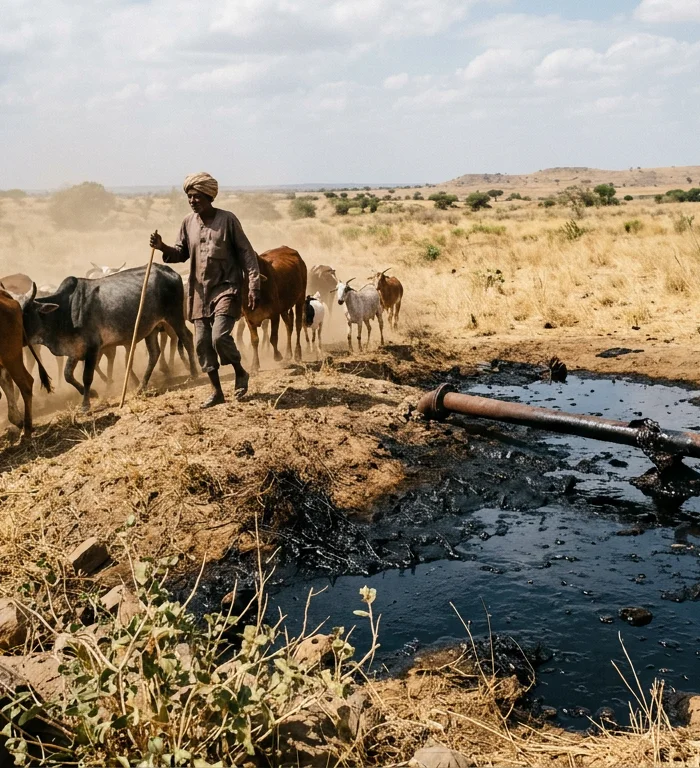
Fighting between the Sudan Armed Forces and Rapid Support Forces in oil-rich West Kordofan intensified from late October, worsening a nearly decade-old pollution crisis, local groups said in a Nov. 20 Ayin Network report.
The stakes extend beyond the battlefield: the RSF controls an estimated 85% to 90% of the state, including major oil hubs, while residents told Ayin that pipeline damage, poor maintenance and weak oversight have worsened conditions.
“We have observed a severe deterioration in the situation since the war began,” one local civil society actor documenting the issue told Ayin. The source requested anonymity for security reasons.
The same source said there was “no maintenance” and cited “deliberate destruction, theft, and--in many areas--explosions at the oil wells.” Civil society workers, industry experts and aid workers told Ayin that safeguards used before the war began in April 2023 have largely disappeared.
Ayin reported that SAF and allied groups began a multi-pronged offensive from El-Obeid on Nov. 5, returning to West Kordofan after more than a year. By Nov. 13, the SAF coalition had recaptured Al-Khuwai and nearby villages, ending RSF control there that had been in place since May 2025, according to the report.
The RSF continues to hold major locations including Al-Fula, Abu Zabad, Babanusa, Al-Muglad and the Heglig complex, Ayin reported. Local news reports cited by Ayin said the RSF had sent a technical delegation to inspect the Neem, Defra and Kanar oilfields as part of preparations to restart production at three sites.
Local organisations identified residential areas near Heglig, including Al-Barzaya and Al-Zurga, as areas of particular concern. One civil society actor cited high oil flows, damaged wells and broken pipelines as reasons those communities face greater risk.
The health claims remain difficult to verify. A local civil society organisation told Ayin it had documented oil-well explosions and ruptured pipelines and said it saw a correlation between pollution and worsening public health, including fetal deformities, infertility and some cancers. It also said insecurity has prevented definitive testing.
A humanitarian worker told Ayin that local groups have investigated suspected environmental damage since 2016. After Sudan’s 2019 revolution, activists protested outside the Ministry of Oil, and a committee later surveyed 17 oil-processing sites, including Sharaf, Helaid and Baleela, according to the worker.
That committee documented congenital abnormalities, skin conditions, eye irritation among children, sexual health problems among men and infertility, the humanitarian worker said. Ayin reported that those accounts raised serious public-health questions but did not prove a direct link to oil operations, which would require medical, environmental and epidemiological evidence.
Industry specialists offered a more cautious view. An environmental quality-control expert with experience in Sudanese refineries told Ayin the sector has monitoring, reporting and remediation systems, though implementation varies between companies and official inspections may be infrequent.
Mohamed Ibrahim, an oil supply chain and operations management expert, told Ayin that Sudan’s petroleum contracts often use broad environmental language. “This raises questions about whether petroleum agreements clearly define companies' environmental obligations,” he said.
Ibrahim also pointed to produced water, toxic underground water brought to the surface during extraction, and gas flaring as environmental risks requiring controls. He said flaring should be assessed through “specific studies and measurements” conducted by an independent third party.
Images and footage shared with Ayin showed visual evidence of oil leaks in parts of West Kordofan, the report said. The scope of contamination, its origins and its effect on nearby communities have not been established.
Source: news report, Ayin Network via AllAfrica, Nov. 20, 2026
More stories
- Liberia seeks bigger US exports as AGOA runs to 2028
- Spain opens 200m-voter test for Europe's right
- Saudi event season faces EASA airspace warning to Jan. 31
- EU housing costs outpace incomes after home prices rise 70%
- Middle powers pursue trade links beyond Trump diplomacy
- South Africa's preschool subsidies face repair-cost barrier
- Paraguay president falls as Ueno Bank customers queue up
- Pedro Alliana takes Paraguay presidency after bank crisis
Latest news
- Fidelity bars Anthropic IPO flippers for six months
- Paul seeks 20%-30% federal credit for U.S. film shoots
- Rwanda women-owned exports fall 51% from 2021 peak
- Strictly expands stage for 8 couples in Blackpool return
- TikTok dementia videos mislead in 66.4% of sample, researchers say
- Staff notice in Commission cyberattack tests EU response