

South Africa’s preschool subsidies face repair-cost barrier
An op-ed says simplified registration and a R24 daily subsidy still leave some township preschool operators unable to fund safety upgrades first.
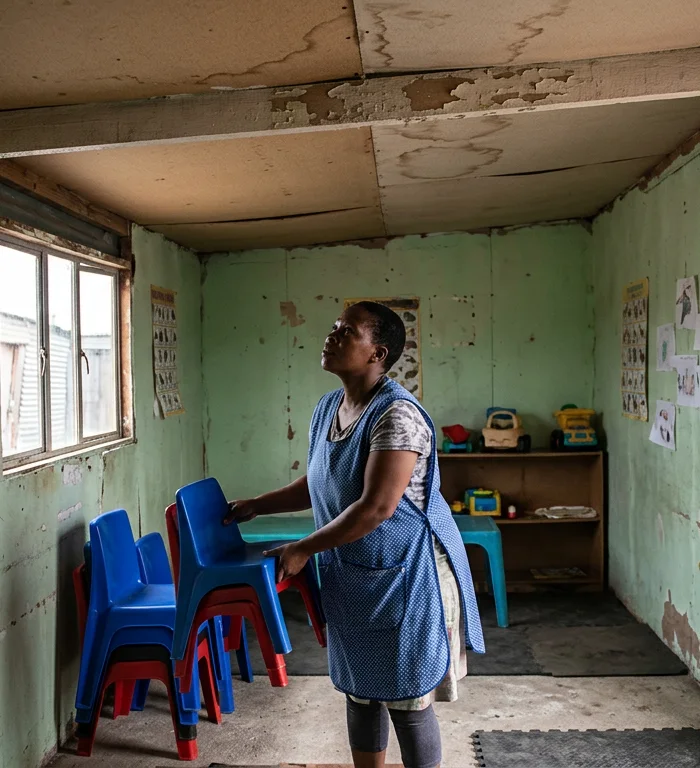
South Africa’s early learning subsidy of R24 per eligible child per day remains out of reach for some under-resourced preschools, Judy-Marie van Noordwyk wrote in a Daily Maverick op-ed published Nov. 20.
The barrier matters because operators can qualify for about R9,500 a month for 18 children only after meeting registration and safety requirements; one Knysna preschool needed about R42,000 in repairs first, the op-ed said.
Van Noordwyk wrote that the government has simplified registration and raised subsidies, but many women running preschools in poor areas still cannot afford building work required to meet safety standards and unlock public funding.
The account centred on two women identified by pseudonyms. Thandeka opened a crèche in a Knysna township after losing her seamstress job in 2011 and only obtained Silver registration in September 2026, after a grant funded urgent repairs, according to the op-ed.
President Cyril Ramaphosa said in October that early learning “lies at the very heart of our country’s future,” the op-ed said, citing his remarks at the Bana Pele Leadership Summit. He also repeated a commitment to universal access by 2030.
Thandeka’s preschool, Siyakha Educare, operated from an RDP house when Knysna Education Trust identified it in 2022, according to the op-ed. It obtained Bronze registration in May 2025 under the simplified Bana Pele system.
When Thandeka tried to move to Silver registration in May 2026, an environmental health inspection cited broken windows, unsafe classrooms and kitchen facilities, weak fencing and hazardous outdoor areas, the op-ed said. A Knysna Education Trust assessment also found a leaking roof, insufficient toilets and exposed sewage.
Knysna Education Trust provided a grant in July for work on the roof, fencing, sanitation and windows, according to the op-ed. The centre received environmental health clearance in August and Silver registration in September.
A second operator, identified as Nomsa, opened Vulindlela Preschool in 2012 after seeing children left at home while parents worked, the op-ed said. Her centre later used two donated shipping containers as classrooms, but because they sat on bricks rather than proper foundations, it could not obtain fire clearance.
The op-ed said a short-lived government campaign, Vangasali, gave Nomsa two-year conditional registration in 2021 and access to subsidies before full compliance. She saved part of the money for upgrades and obtained Silver registration in 2023, 11 years after opening.
That registration has since lapsed because Silver status is conditional and lasts three years, according to the op-ed. Van Noordwyk wrote that Nomsa is again moving through the process.
The unresolved issue is who pays for inspections and repairs before a centre qualifies for subsidy payments. The op-ed said operators must pay upfront for health, food safety and fire checks without knowing whether they will pass, while failed inspections can trigger further building costs.
More stories
- Liberia seeks bigger US exports as AGOA runs to 2028
- SAF-RSF fighting worsens 10-year oil pollution crisis, groups say
- Spain opens 200m-voter test for Europe's right
- Saudi event season faces EASA airspace warning to Jan. 31
- EU housing costs outpace incomes after home prices rise 70%
- Middle powers pursue trade links beyond Trump diplomacy
- Eritrea retakes Badme after 1-month pullback
- US widens Iran blockade to ship-to-ship transfers
- Asif Merchant receives 27 years for U.S. assassination plot
- Japan pursues Quad talks alongside outreach to Xi Jinping