

US widens Iran blockade to ship-to-ship transfers
CENTCOM said vessels taking Iranian cargo at sea may be stopped, boarded, diverted or captured, raising enforcement risks in Gulf energy routes.
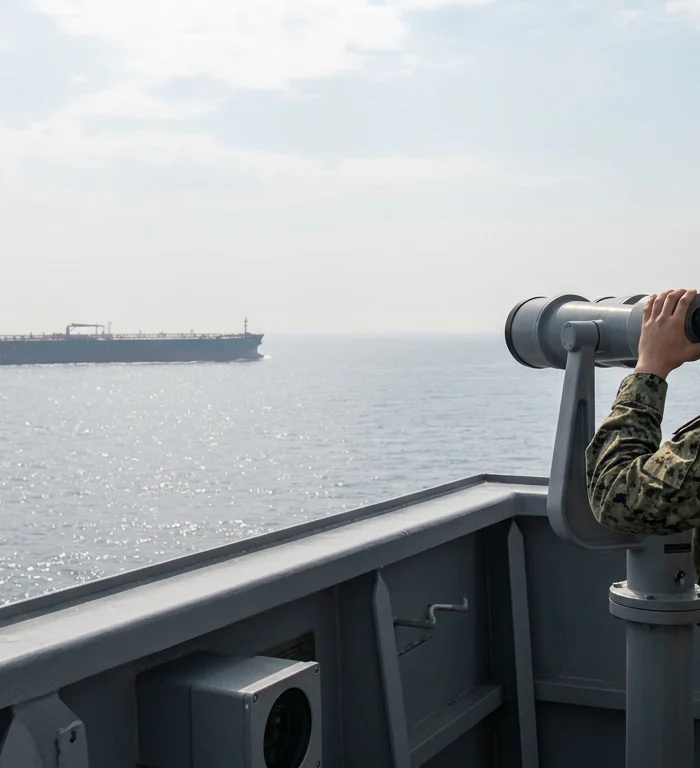
US Central Command broadened enforcement of Washington’s Iran blockade in a Nov. 18 advisory, saying vessels receiving Iranian cargo at sea may be treated as evading restrictions reinstated on July 14.
The warning targets ship-to-ship transfers, cargo moved between vessels at sea, as Iran seeks export routes after shipping roughly 1.5 million to 2 million barrels of crude oil a day before the US-Israeli war began in February.
“Any ship that receives cargo via a ship-to-ship transfer with a vessel subject to the blockade and carrying cargo loaded at an Iranian port or coastline may be considered to be evading the blockade, even if it has not entered Iranian ports or the Iranian coastline,” CENTCOM said in the advisory.
CENTCOM said such vessels may be stopped, boarded, diverted, captured or ordered to sail to the Iranian port where the cargo originated. It also said ships that refuse US orders could face enforcement measures, including force.
The advisory marks an attempt by Washington to close a maritime route that may have allowed some Iranian petroleum products to reach buyers despite restrictions on Iranian ports and oil exports. The US first imposed the blockade on April 13, lifted it in June after an understanding with Tehran, and reinstated it on July 14 after that arrangement collapsed, according to Al Jazeera.
Iranian authorities had not issued a direct response to the CENTCOM advisory, Al Jazeera reported. Fars News Agency, a semi-official Iranian outlet, published commentary on Nov. 18 proposing that Iran send a group of oil tankers through the blockade and warning of retaliation against regional energy infrastructure if US forces intervened.
Earlier in November, IRGC spokesman Brigadier General Hossein Mohebi said Washington could not impose the economic blockade it sought, according to Fars. “America can never achieve the type of economic blockade it’s after, whichever iteration it takes,” he said. He also warned that Iran would retaliate if US forces attacked Iranian vessels.
Rob Geist Pinfold, a lecturer in international security at King’s College London, told Al Jazeera that Washington sees the blockade as an alternative to a renewed kinetic campaign after recent Iranian attacks on Gulf states, particularly Bahrain. “The Americans have decided that the blockade, rather than a return to a kinetic force or campaign, is the way to actually beat Iran and bring them to the negotiating table,” he said.
Pinfold said oil accounts for around 30 percent of Iran’s economy. That makes enforcement of maritime restrictions a direct economic pressure point, though the scale of current Iranian export disruption was not independently confirmed in the article.
Reuters reported in October, citing shipping intelligence and security sources, that at least eight tankers carrying Iranian liquefied petroleum gas had left the Gulf of Oman since July. Reuters also reported on Nov. 19, citing TankerTrackers.com, that a vessel was loading Iranian crude through a ship-to-ship transfer in the Gulf; Iranian authorities did not confirm that development.
Andreas Krieg, associate professor in Security Studies at King’s College London, told Al Jazeera that Iran can evade parts of the blockade but lacks the capability to defeat it militarily. “Iran can circumvent parts of the blockade, but it cannot break it militarily in any sustainable way. The Americans possess overwhelming naval superiority,” he said.
Krieg said enforcement at sea is more complex than stopping tankers as they leave Iranian ports, especially when intermediaries and commercial networks are involved. He cautioned that Fars commentary should not be read as an authorised Iranian operational plan.
The risk now lies in whether a tanker confrontation turns into a broader regional exchange. Krieg told Al Jazeera that an American strike on an Iranian vessel could prompt retaliation against Gulf energy infrastructure, pulling neighbouring states further into the conflict.
More stories
- Liberia seeks bigger US exports as AGOA runs to 2028
- SAF-RSF fighting worsens 10-year oil pollution crisis, groups say
- Spain opens 200m-voter test for Europe's right
- Saudi event season faces EASA airspace warning to Jan. 31
- EU housing costs outpace incomes after home prices rise 70%
- Middle powers pursue trade links beyond Trump diplomacy
- Baird seeks 2 trade bills to ease Ethiopia-Eritrea tensions
- Indonesia seeks Google explanation for 19,372 YouTube removals
- Singapore issues notices to 10 Indonesia-based firms over possible haze links
- European Commission seeks disaster accountability for 3°C world