

Paraguay president falls as Ueno Bank customers queue up
Paraguay President Santiago Peña is under house arrest following Ueno Bank’s seizure, which triggered impeachment, criminal charges, and market losses.
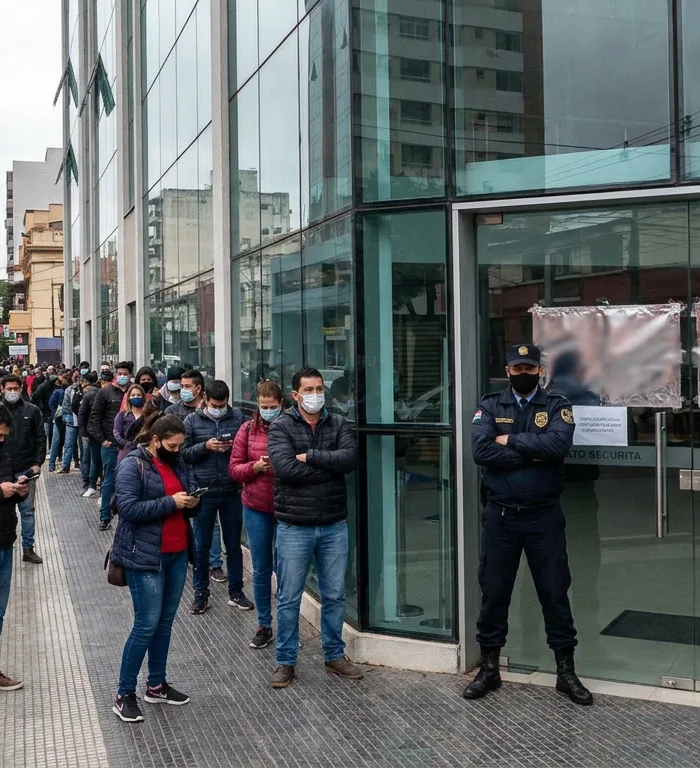
Paraguay president Santiago Peña was placed under house arrest after Ueno Bank's seizure locked more than 1 million customers out of accounts.
The order confined Peña on Friday to one of his homes in Asunción until a Saturday morning appearance before prosecutors. The case has turned a banking intervention into a test of confidence in Paraguay's political system, its payment rails and its deposit guarantees.
Senate removes Peña
Paraguay's Senate voted to remove Peña for misconduct in office, making him the second president ousted by impeachment since the end of Gen. Alfredo Stroessner's 35-year dictatorship in 1989. Regulators had seized Ueno Bank three days earlier, a sequence that left customers unable to reach money and lawmakers moving against the president.
Prosecutors ordered Peña to remain at home before facing charges of breach of trust, influence peddling and using public office for personal gain. The most serious charges carry up to 10 years in prison, while Peña denied wrongdoing.
Lawmakers accused Peña of using political influence to direct hundreds of millions of dollars in public funds into Ueno while regulators overlooked risky insider lending. Those allegations remain claims by lawmakers and prosecutors unless proven through the legal process.
Ueno freeze hits first-time savers
When regulators took control of Ueno, customers could not withdraw cash, access savings or use bank cards for purchases. Ueno had targeted poor and unbanked Paraguayans with supermarket rebates, and the bank said more than 1 million people opened their first account there.
The freeze reached beyond ordinary depositors. Players on Paraguay's national soccer team, sponsored by Ueno during its run to a World Cup victory over Germany this year, said they could not access their money.
Some depositors began recovering funds Thursday, starting with accounts holding up to 10 million guaraníes, about $1,500. Deposits are insured up to about $35,000, and the central bank said that ceiling covers 97% of Ueno's customers.
Public loans and drivers stall
The interruption also hit services that depended on Ueno's payment system. A ride-hailing app that relied on the lender shut down, leaving 3,000 drivers without work.
The state power company said $21 million in loans from the Inter-American Development Bank and Taiwan, earmarked for public works, was trapped at Ueno. Paraguay's bonds posted some of the worst losses in emerging markets this week, and the guaraní slid against the dollar following the bank intervention and impeachment vote.
The central bank described Ueno's collapse as isolated and said the wider financial system remained safe. That assurance now rests on whether insured customers regain access quickly enough to contain the strain inside one bank.
Two paths for Ueno
If insured payouts continue and customers recover small deposits, the pressure on household payments could ease first. Under that path, Ueno would remain the legal and political focal point, while the wider banking sector would depend on the central bank's ability to show that the failure does not spread.
If access remains slow or public-work funds stay trapped, the strain would move through wages, driver income, utility projects and sovereign-market pricing. For global investors, the mechanism would be country-specific credit risk rather than a broad emerging-market banking shock, unless losses or deposit fears appear beyond Ueno.
The next markers are Peña's Saturday appearance before prosecutors, the pace of repayments to insured depositors and the release of the $21 million in public-work loans. The open legal question is whether prosecutors can prove the charges and lawmakers' influence-peddling claims against Peña.
More stories
- Poland starts 2 days of mourning over 6 Krakow deaths
- Home Office faces suit over almost 1,500 EU residency cases
- Uganda ties construction push to $500bn economy target
- Armenia faces EU democracy test over opposition cases
- Cambodia freezes more than $300m in scam crackdown
- Kyiv energy strikes disrupt utilities before peace talks
- Pedro Alliana takes Paraguay presidency after bank crisis
- Republicans blame Iran war after Nov. 3 midterm losses
- Armed men kill at least 48 civilians in Oromia, residents say
- Prosecutors face De Kock claim over apartheid command evidence