

Uganda ties construction push to $500 bn economy target
Officials linked infrastructure, housing finance and local contractor capacity to a 2.4 million-unit housing deficit and preparations for the 2027/28 budget.
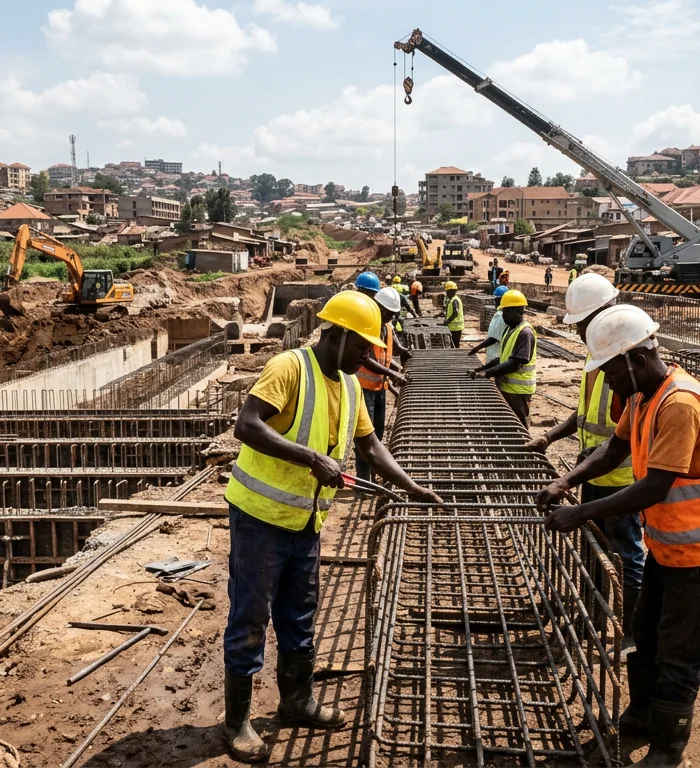
Uganda’s government tied construction investment to its plan for a $500 billion economy by 2040, Minister Henry Musasizi said at a Kampala competitiveness forum on Nov. 6, according to a Nile Post report.
The focus may shape Uganda’s Financial Year 2027/28 budget, with officials citing a 2.4 million-unit housing deficit and manufacturing-programme funding rising to Shs1.03 trillion in 2026/27 from Shs312 billion in 2025/26, more than three times higher according to Atlas360 calculations.
“Construction is central to Uganda's ambition to build a USD 500 billion economy by 2040,” Musasizi said, adding that Uganda needs infrastructure able to support competitive businesses across regions.
Musasizi, Minister of State for Finance, Planning and Economic Development for General Duties, said construction underpins activity in agriculture, tourism, manufacturing, mining, technology and housing. Agro-industrialisation needs processing plants, warehouses and cold-chain facilities, while tourism relies on roads, hotels and accommodation, he said.
The minister set out three priorities: clearer regulation, stronger Ugandan contractors and cheaper long-term finance. He said local governments should improve physical planning, simplify building approvals and enforce construction standards, while developers need clarity on costs, requirements and approval timelines.
He also called for skills, equipment access and stronger business management among domestic contractors. Musasizi said innovations in locally made construction materials could help lower building costs, and said the government would support phased capitalisation of the National Housing and Construction Company.
Dianah Nannono, head of the Private Sector Development Unit at the Finance Ministry, said the National Competitiveness Forum gives businesses a route to raise operating constraints and propose reforms. She said the discussions would feed into Financial Year 2027/28 budget preparation.
Nannono cited business-environment measures already under way. Government funding for the Uganda National Bureau of Standards rose to Shs133 billion in Financial Year 2025/26 from Shs55.9 billion in 2024/25, about 2.4 times higher according to Atlas360 calculations, and the agency received an approved recurrent allocation of Shs130 billion for 2026/27.
She said the extra funding supported regional laboratories, testing equipment, accreditation and digital systems. UNBS also recruited an additional 100 employees to expand standards enforcement and help small and medium-sized enterprises seeking product certification.
The government has also cut rural electrification connection charges to Shs30,000 from Shs700,000 for connections needing no extra pole, and to Shs30,000 from Shs1.8 million for connections needing one pole, Nannono said. Extra-large users consuming more than 1.5 megawatts during off-peak periods face a tariff of 5 US cents per kilowatt-hour, she said.
Industrial parks are another part of the programme. At Namanve Industrial Park, works covering about 45 kilometres of roads, bridges, drainage, electricity distribution, water, sewerage and ICT infrastructure had reached 82% completion as of September 2026, Nannono said.
Nannono said the challenge was to ensure Ugandan companies have enough capacity to take part in public projects and deliver quality work within agreed budgets and timelines.
At Namanve Industrial Park, the infrastructure project that was 82% complete in September 2026 is expected to be completed by Dec. 30, 2026, Nannono said.
For Financial Year 2027/28, the forum’s recommendations are expected to feed into Uganda’s budget preparation and medium-term economic reform priorities, according to officials cited by Nile Post.
In Financial Year 2026/27, the government approved Shs146.39 billion for Mbale Industrial Park infrastructure, including Shs101.28 billion for internal roads, Shs40 billion for drainage and Shs5.11 billion for electricity infrastructure, Nannono said.
Source: Nile Post report via AllAfrica, Nov. 6, 2026
More stories
- Poland starts 2 days of mourning over 6 Krakow deaths
- Home Office faces suit over almost 1,500 EU residency cases
- Armenia faces EU democracy test over opposition cases
- Cambodia freezes more than $300m in scam crackdown
- Kyiv energy strikes disrupt utilities before peace talks
- Paraguay president falls as Ueno Bank customers queue up
- Batangas State's 23 new doctors face rural service requirement
- DR Congo starts Ebola vaccine trial in 9,700-case outbreak