

Armenia faces EU democracy test over opposition cases
Civil society groups say cases tied to social-media speech sit uneasily with Brussels’ pursuit of a closer South Caucasus partner.
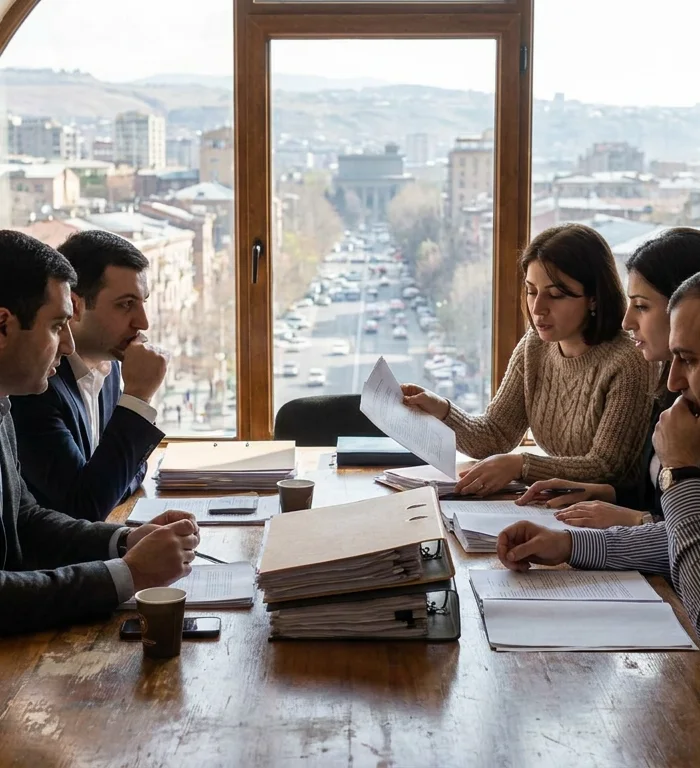
Armenian authorities have brought charges against multiple opposition figures over the past two years, mostly over social-media activity, Deutsche Welle reported in a Nov. 7 news article.
The pressure is broader than one early October arrest: over a dozen Armenian civil society organizations called the case against Adekvad leader Artur Danielyan politically motivated, testing Brussels’ rights agenda as Armenia moves closer to the EU.
Danielyan, who leads the opposition Adekvad party, was arrested in early October after Facebook posts critical of Prime Minister Nikol Pashinyan and Armenia’s security services. One dispute concerned Pashinyan’s refusal to swap an Azerbaijani soldier jailed in Armenia for Armenians held in Azerbaijan.
The civil society groups condemned Danielyan’s prosecution as “patently illegal, disproportionate, and politically motivated.” Their joint statement said: “It is punitive in nature and sends a direct signal to the broader public aimed at silencing dissent, critical views, and undesirable speech.”
Armenian prosecutors also indicted Artur Osipyan, a displaced activist from Nagorno-Karabakh, after a verbal clash with Pashinyan ahead of parliamentary elections in June. Prosecutors accused him of disrupting public order, obstructing the ruling party’s campaign and inciting violence against Pashinyan in a March social-media post.
The cases sit against the unresolved legacy of Nagorno-Karabakh. Armenia and Azerbaijan fought for three decades over the territory before Azerbaijan’s 2023 offensive restored Baku’s control and pushed more than 100,000 Armenians to flee to Armenia, a far larger group than the 19 Armenians currently detained in Baku.
Those detained in Baku include former senior figures from Nagorno-Karabakh’s de facto administration. Their cases remain politically sensitive inside Armenia, where Pashinyan’s approach to Azerbaijan and Nagorno-Karabakh has drawn opposition criticism.
The legal backdrop has also drawn rights scrutiny. Armenia added Article 226.2 to its Criminal Code on April 15, 2020, penalizing public calls to violence and the public justification or promotion of violence; the offences were later decriminalized after civil society objections.
A 2025 Freedom House report said “nearly 95% of court cases concerning incitement to violence under a 2020 criminal code amendment had involved alleged threats against Prime Minister Pashinyan and his supporters, whereas potentially prohibited statements by ruling party members were apparently not subject to the same scrutiny.”
The Regional Center for Democracy and Security, an independent think tank in Yerevan, monitored online hate speech against Nagorno-Karabakh refugees during the 2026 pre-election period. Its reports said pro-government bloggers and influential social-media users used hostile language toward displaced Karabakh Armenians, while Armenian law-enforcement agencies largely avoided criminal cases against those activists.
The EU has not adopted the civil society groups’ language. In a written response to DW, an EU spokesperson said democracy, rule of law and fundamental rights are central to the EU-Armenia Comprehensive and Enhanced Partnership Agreement and the Strategic Agenda for the EU-Armenia Partnership.
The spokesperson said “the EU is closely following developments in the country, including as regards criminal investigations.” The spokesperson added that, under Armenia’s international commitments and legal framework, such investigations “should be carried out in an independent and impartial manner, free from political considerations.”
Analysts quoted by DW said geopolitics helps explain Brussels’ caution. Tigran Grigoryan, a political analyst, said the EU has taken “a very pragmatic and geopolitically driven approach,” while Stefan Meister of the German Council on Foreign Relations said European support for Armenia appears “mainly driven by the European Russia policy.”
More stories
- Poland starts 2 days of mourning over 6 Krakow deaths
- Home Office faces suit over almost 1,500 EU residency cases
- Uganda ties construction push to $500bn economy target
- Cambodia freezes more than $300m in scam crackdown
- Kyiv energy strikes disrupt utilities before peace talks
- Paraguay president falls as Ueno Bank customers queue up
- Thai minister sees progress after Suu Kyi's first family call in over 5 years
- Batangas State's 23 new doctors face rural service requirement