Egypt tombstones show deities, sarcophagi found
Egypt tombstones bearing deity-linked inscriptions and several sarcophagi were reported from the Nile Valley, but key details remain unverified.
Omar Farouk ·
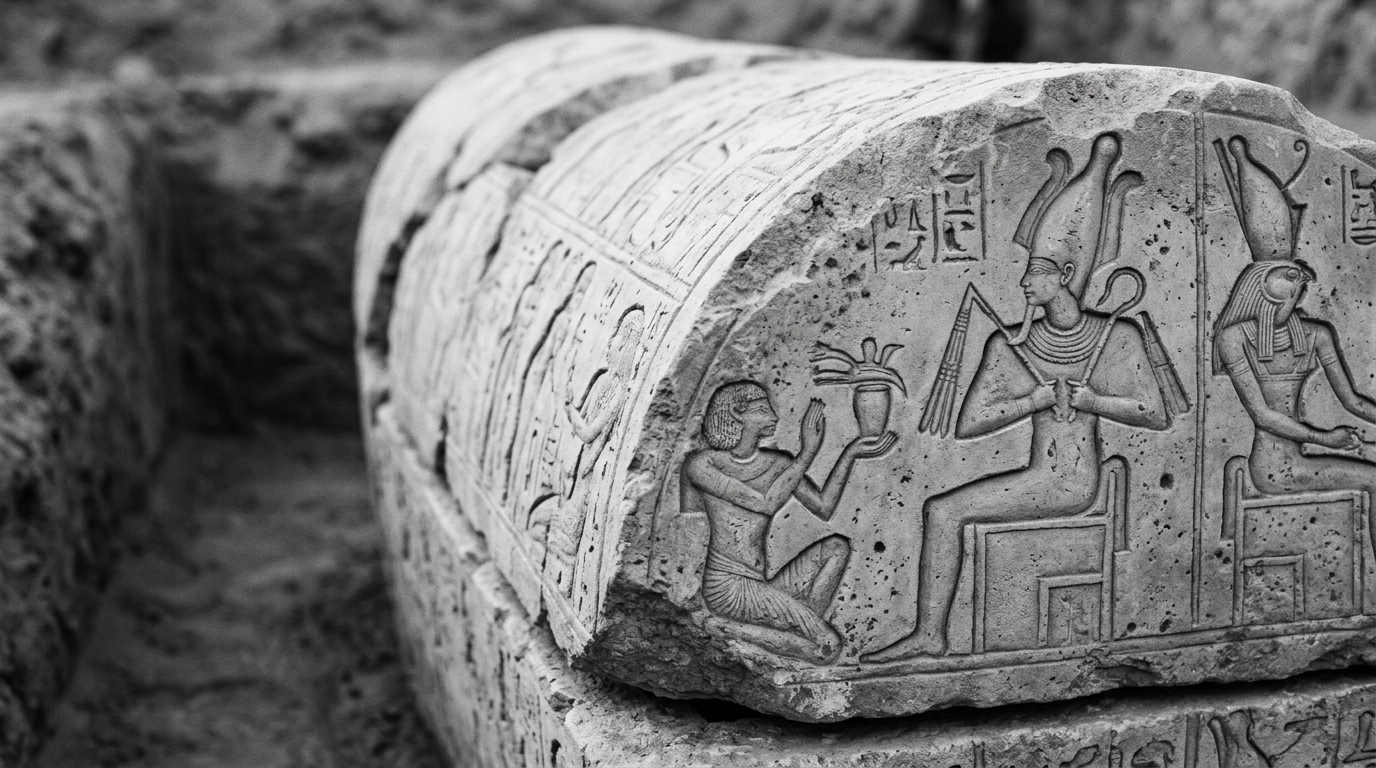
Egyptian archaeologists were reported to have found tombstones bearing inscriptions linked to deities, along with several sarcophagi, at an ancient burial site in the Nile Valley. Officials were described as presenting the material as evidence of layered cultural influence on funerary practices, including imagery of two deities interpreted as reflecting overlapping Greek and Roman-era traditions within Egypt’s late-period material culture.
The account, however, circulated through a secondary report and did not include a primary statement, an excavation dossier, or an official release that would allow independent confirmation of key elements. As a result, the discovery is being treated as a culture brief rather than a fully substantiated hard-news development.
Key details not yet documented
As presented, the report does not identify the precise location of the burial site in the Nile Valley or specify which authority led the work. It also does not provide the total number of objects recovered, nor does it set out the precise dating assigned to the tombstones and sarcophagi.
Officials and observers highlighted that the uncertainty is not about whether Egypt contains extensive late-period cemeteries, but about the particulars for this specific excavation. Missing elements include excavation context, chain of custody, any conservation plan, and the basic documentation that typically anchors archaeological reporting.
How officials framed the imagery
Officials were described as pointing to depictions of two deities on the tombstones as an indicator of cultural overlap connected to Greek and Roman-era traditions. Such references are commonly discussed under the Greco-Roman period in Egypt, when successive foreign rule and Mediterranean trade networks helped spread artistic conventions, religious iconography, and burial customs along the Nile Valley.
Nile Valley
The report also underscored a standard caution in funerary interpretation: stylistic elements associated with non-Egyptian traditions do not, on their own, demonstrate a rupture with local religious practice. Many late-period burials are known to combine multiple visual and ritual languages, particularly in urban centers and trading corridors where Greek and Roman cultural forms could be adopted alongside long-standing Egyptian traditions.
Why antiquities announcements carry weight
The account did not suggest any change to regional politics, security, or energy dynamics. Even so, Egypt’s antiquities sector has economic and reputational importance for the state, and high-profile discoveries can be used to support tourism promotion, museum programming, and cultural diplomacy aimed at sustaining visitor numbers and attracting heritage-linked investment.
Officials and observers also noted legal and soft-power considerations tied to public announcements. Visually distinctive artifacts can draw attention to site protection, illicit trafficking risks, and provenance questions, making documentation and clarity around discoveries particularly important.
Next verifiable step
A concrete next step would be a primary release by the Egyptian Ministry of Tourism and Antiquities, or a peer-reviewed or mission-authored field report. Officials said documentation would need to name the excavation location, identify the responsible mission, explain the dating approach, and provide an inventory of artifacts; until then, the account remains a secondary report with limited evidentiary value.