Iraq militias test U.S. exit as final base shuts Wednesday
Iraq militias face a September 30 arms deadline as the U.S. closes its last major base after more than 23 years of war.
Omar Farouk ·
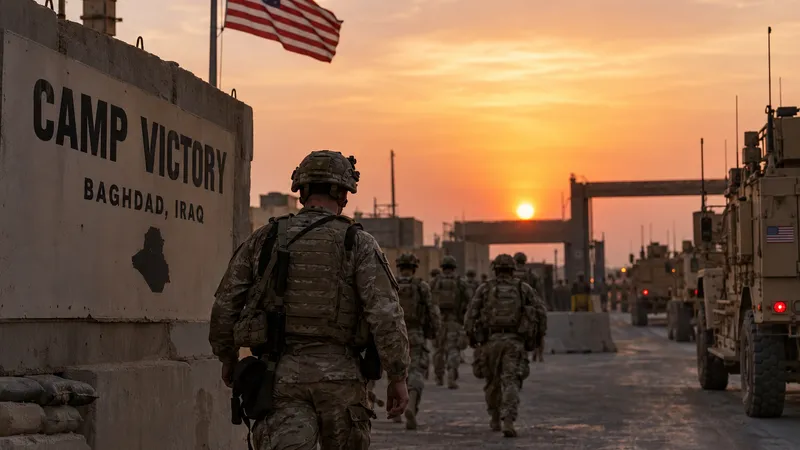
Iraq militias face a September 30 deadline to surrender weapons as the U.S. closes its last major base after 23 years of war.
September 30 tests Zaidi
Iraqi Prime Minister Ali al-Zaidi set the militia deadline during a July White House visit, placing his government’s authority against armed groups that have long operated with Iranian backing. President Trump, sitting beside Zaidi, said, "We don’t think we need the military there anymore."
Zaidi, 41, became prime minister in May after a career in business rather than public office. At the White House, he said there was "no justification for their existence after the 30th of September," referring to the armed factions.
Militia weapons outlast U.S. bases
The U.S. closure follows more than $1.7 trillion in spending and more than 23 years of military involvement in Iraq, according to the account. The drawdown leaves Zaidi facing paramilitary groups that number in the tens of thousands and include factions funded or armed by Iran.
The reported attack count reached more than 600 strikes on U.S. diplomatic and military sites in Iraq during the first two months of the U.S.-Iran war. The U.S. Embassy in Baghdad has also been issuing frequent security warnings to Americans and others, with about two each week concerning kidnapping risks linked to militants.
Iran supply lines shift
Current and former U.S. officials and defense experts said Tehran renewed support for Iraqi militias after the U.S. began its bombing campaign in Iran in February. A U.S. official said shipments of small arms, drones and short-range rockets initially slowed while Iran focused on the U.S. fight, then increased over the summer.
The same official said recent attacks involved longer-range missiles and drones, pointing to a more capable arsenal than earlier salvos. Saudi Arabia said a drone launched from Iraq near the Iranian border temporarily shut its East-West oil pipeline this month, a route that has gained importance since Iran disrupted shipping in the Strait of Hormuz.
Zaidi’s bank remains exposed
The White House has treated Zaidi as a partner who can work with Washington despite his limited political record. He owns a bank, an insurance company, and media and construction firms, according to the account.
The Treasury Department barred his bank from dollar transactions in 2024 over suspicions that it helped finance Iran and its proxies. Zaidi denied knowledge of those transactions, and former U.S. officials said they did not believe he was personally involved.
Maj. Gen. Saad Maan, a spokesman for the Iraqi military, said some militant factions had already surrendered weapons and others planned to do so. Kazem al-Fartousi, a spokesman for Kata’ib Sayyid Al-Shuhada, rejected the push, saying, "These weapons are for our sovereignty, our freedom."
Oil routes shape the scenarios
If Zaidi’s deadline produces verifiable disarmament, Iraq would reduce the near-term risk around U.S. sites, Saudi energy routes and Baghdad’s airport logistics hub. That path would support the global macro picture through lower oil-shipping risk, strengthen Zaidi’s standing with Washington, and ease security costs for energy and logistics operators.
If factions retain longer-range drones and missiles instead, Iraq remains a corridor where the U.S.-Iran conflict can spill into oil infrastructure and diplomatic facilities. That path would keep pressure on regional energy markets, expose Zaidi and his bank to closer U.S. scrutiny, and force the wider security and oil sectors to plan around repeated disruptions.