Bahçeli's 'Underground' Affection: Lebanonization
Bahçeli's praise for the series "Yeraltı," featuring a partnership between a Mardin-born Bozkurt and Haydar Ali, reflects Turkey's "Lebanonization" debate…
Selin Özalp ·
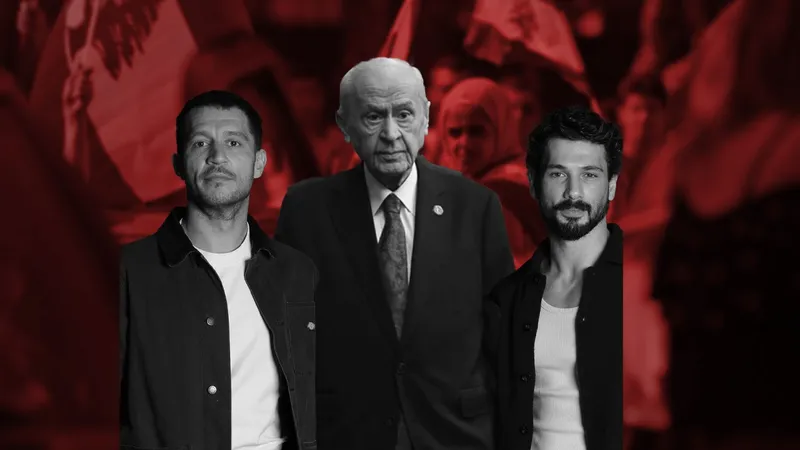
MHP Chairman Devlet Bahçeli's interest in television series is not new. It has become common for him to convey political messages through the productions he watches.
However, his particular interest in the NOW TV series **“Yeraltı” (Underground)** goes beyond ordinary viewer appreciation, carrying a political significance this time.
Bahçeli personally called and congratulated Uraz Kaygılaroğlu, the lead actor of the series, and even stated his desire to gift him a "Bozkurt" (Grey Wolf) painting if accepted. This suggests he views the series not just as a television product, but as a world of political symbols.
Because "Yeraltı" ostensibly tells the story of drug lords, intelligence connections, and power struggles in the underworld. But at the heart of the narrative is a striking partnership:
**Bozkurt and Haydar Ali**
One of the main characters in the series is **“Bozkurt”**. His underworld nickname is **“Bozo”**.
Moreover, the series specifically emphasizes that the character is from Mardin. The name is no coincidence; it is one of the symbols of Turkishness and the Ülkücü (Nationalist) movement.
Alongside him is **“Haydar Ali”**, a name that resonates particularly within the **Alevi community** in Turkey.
In the dramatic plot of the series, these two characters are not rivals but rather partners in destiny. At one point, they become **“brothers”**, managing the family together.
So much so that Bozkurt leaves the management to Haydar Ali instead of his blood relatives.
In other words, in the series, a **nationalist symbol** and a character **evoking Alevi identity** join forces to establish order.
It is precisely here that an interesting parallel emerges between Bahçeli's recent political statements and the series' narrative.
**Bahçeli's 'Alevi Initiative'**
Last October, Bahçeli made remarkable statements regarding Alevis. He stated that Cemevis (Alevi houses of worship) should be recognized as places of worship.
He called for "courage of will" on this issue, saying, "Our Alevi Islamic brothers and sisters are our lifeblood.
Going further, he proposed, "Let the President have two deputies; one Kurdish, the other Alevi."
This proposal is initially presented with rhetoric of **"brotherhood"** and **"representation"**. However, from a political science perspective, it also brings another debate: Turkey being dragged into a political model based on ethnic and sectarian representation.
In short: **Lebanonization.**
In Lebanon, the political system is based on sectarian representation. The President comes from one sect, the Prime Minister from another, and the Speaker of Parliament from yet another.
The state is divided based on identities, not citizenship.
Bahçeli's proposal for "Kurdish and Alevi presidential deputies" also evokes a similar model of representation in Turkey.
And it is precisely at this point that the "Yeraltı" series acts as a dramatic metaphor for this model.
Bozkurt and Haydar Ali's partnership is like a narrative of power-sharing based on identities. A nationalist symbol and Alevi representation stand side by side, managing the "family" together.
Moreover, in the series, this structure is established in the underworld, i. e.
, within a narco-mafia order.
Even more striking is this: In the series, mafia leaders and underworld figures are presented as characters **"working for the benefit of the state"** in later episodes.
That is, the line between the underworld and the state is blurred.
Bahçeli's description of the series as "exemplary broadcasting that keeps Turkish youth away from bad habits" therefore does not seem to be merely a television commentary.
On the contrary, it seems more likely that he appreciated the symbolic world behind this narrative.
Because the central formula of the series is: **Nationalist symbol + Alevi representation + underworld power "working for the state"**
The order established jointly by Bozkurt and Haydar Ali is almost like a prototype in popular culture of the new model Bahçeli proposes in politics.
Therefore, reading Bahçeli's admiration for the **"Yeraltı"** series merely as an appreciation for a show might be incomplete.
Perhaps the MHP leader is not just watching a mafia story on screen.
Perhaps he is watching a dramatized version of his own political vision.