Atlas360 Special: How the War May Evolve?
Atlas Newsdesk ·
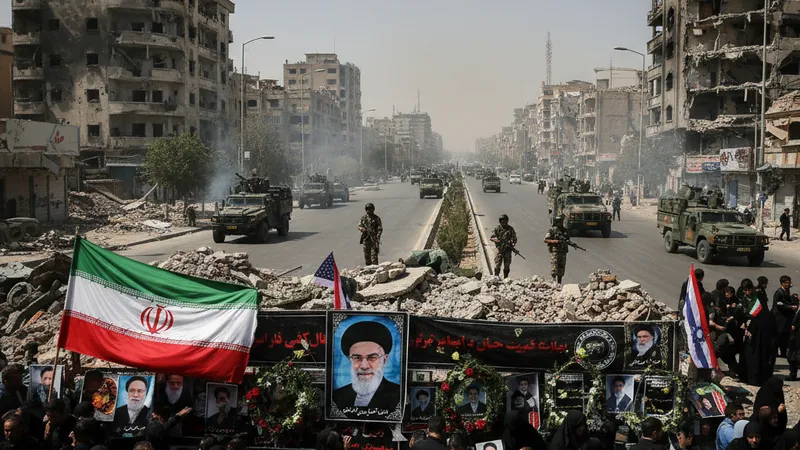
The war with Iran has entered a far more dangerous stage. Coordinated U.S. and Israeli strikes across Iranian territory last week targeted military bases, nuclear infrastructure, and senior leadership compounds. Among the casualties was Iran’s Supreme Leader, Ayatollah Ali Khamenei — a development that represents one of the most consequential leadership decapitations in modern geopolitics. The strikes were designed to shock the Iranian system and rapidly degrade its military capabilities.
Instead, they have opened a far more uncertain and potentially volatile chapter in the region. The immediate aftermath has already spread beyond Iran’s borders. Tehran responded with missile and drone attacks targeting Israel and U.S. military installations across the Gulf. Israeli forces, anticipating escalation through Iranian proxies, expanded strikes against Hezbollah positions in southern Lebanon. What initially appeared as a single high-impact strike is now evolving into a broader regional confrontation with multiple theaters of tension emerging simultaneously.
The strategic logic behind the operation appears straightforward. Washington and Jerusalem likely expected that removing the center of Iran’s political authority could trigger fragmentation within the regime. Leadership decapitation has historically been used as a tool to disrupt centralized political systems. But Iran is not a typical authoritarian state. Over four decades, the Islamic Republic constructed a deeply layered system of power designed specifically to survive external shocks, internal unrest, and leadership transitions.
At the center of this architecture are parallel institutions that operate alongside the formal government. The Revolutionary Guard commands significant military and economic resources, the Basij militia maintains extensive internal security networks, and a dense ideological infrastructure ties the regime to segments of society and the economy. These structures provide institutional redundancy. When leadership vacuums emerge, power does not disappear; it shifts and consolidates within the system.
As a result, regime collapse in the immediate aftermath of the strikes appears unlikely. Instead, the more probable short-term outcome is elite consolidation, particularly around the Revolutionary Guard and other security institutions. Leadership transitions inside Iran historically produce internal maneuvering among factions, but those rivalries tend to occur within the framework of regime survival rather than regime dismantlement. External military pressure often reinforces that instinct.
The military trajectory of the conflict also suggests escalation without full-scale invasion. A U.S. ground campaign against Iran would face enormous logistical and political obstacles. Iran’s geography, population size, and defensive capabilities make it one of the most difficult countries in the world to occupy. Even limited invasion scenarios would require massive troop deployments and long-term military commitments.
For that reason, the current strategy appears focused on degrading Iran’s military capabilities through sustained air strikes, cyber operations, and intelligence-driven targeting rather than attempting to seize territory. But the battlefield will likely extend far beyond Iran itself. Iranian strategy rarely relies solely on direct confrontation. Instead, Tehran maintains a network of regional allies and proxy groups capable of applying pressure across multiple fronts.
Hezbollah in Lebanon, Shiite militias in Iraq, Houthi forces in Yemen, and other aligned groups provide Iran with the ability to disperse conflict geographically. Rather than one concentrated battlefield, the war could fragment into several smaller theaters of confrontation stretching from the eastern Mediterranean to the Gulf and the Red Sea. Such fragmentation could produce a prolonged period of persistent instability.
Missile exchanges between Iran and Israel may intensify, Hezbollah could escalate along Israel’s northern border, militias in Iraq and Syria may increase attacks on U.S. bases, and maritime security threats could expand across key shipping corridors. This type of distributed conflict is difficult to resolve quickly. It does not produce clear frontlines or decisive victories, but it can sustain strategic pressure across the region for extended periods.
Energy markets have already begun reacting to that risk. Roughly one-fifth of global oil supply moves through the Strait of Hormuz, a narrow shipping corridor that remains highly vulnerable to disruption. Even the possibility of interruptions can generate sharp price volatility. Markets respond not only to actual supply losses but to uncertainty about future supply security. Shipping insurance costs, freight rates, and energy derivatives have already begun reflecting this elevated risk environment. If disruptions to Gulf shipping intensify, oil prices could remain elevated for an extended period.
Such an energy shock would carry significant implications for the global economy. Higher energy prices would feed directly into inflation pressures just as major central banks are attempting to stabilize growth after several years of economic volatility. The conflict therefore carries not only regional security consequences but also broader macroeconomic implications. Inside Iran, the political landscape is entering a period of transition.
The death of a long-serving supreme leader inevitably triggers internal competition among political elites. However, the regime’s core security institutions remain intact and highly capable of maintaining order. The Revolutionary Guard, in particular, is likely to play a central role in managing the transition and stabilizing the system. Historically, external threats tend to strengthen the authority of these institutions rather than weaken them. Over time, however, the conflict may approach a point where the cost of continued escalation becomes politically and economically unsustainable for all sides involved.
Rising casualties, economic disruptions, and growing international pressure could eventually push regional actors and global powers toward some form of de-escalation. That outcome would likely take the form of a diplomatic pause rather than a comprehensive peace agreement — an informal arrangement to reduce military activity while leaving underlying tensions unresolved.
There is also a political dimension that could complicate any diplomatic outcome. If the war ends without producing regime change in Iran, segments of the Iranian diaspora and political opposition groups may view the outcome as an incomplete or failed strategic effort. The expectations created by the initial decapitation strike raise the political stakes for Washington.
Any negotiated accommodation with Iran’s new leadership could therefore generate domestic and international criticism. Ultimately, the future trajectory of the conflict will depend less on the dramatic opening strike and more on how each side calculates the cost of continued escalation. If military actions remain largely confined to airpower, proxy warfare, and limited regional clashes, the Middle East could face a prolonged but contained period of instability.
If additional actors enter the conflict at scale, however, the region could be moving toward one of the largest and most consequential wars in decades. For now, the Middle East stands at an uncertain strategic crossroads. The next few weeks will reveal whether this conflict settles into a sustained but manageable confrontation — or expands into a far more dangerous regional war.