Derrick Henry’s durability steadies Ravens backfield entering 2026
Derrick Henry's durability and consistent performance have brought stability to the Baltimore Ravens' running back position.
Mehmet Şahinoğlu ·
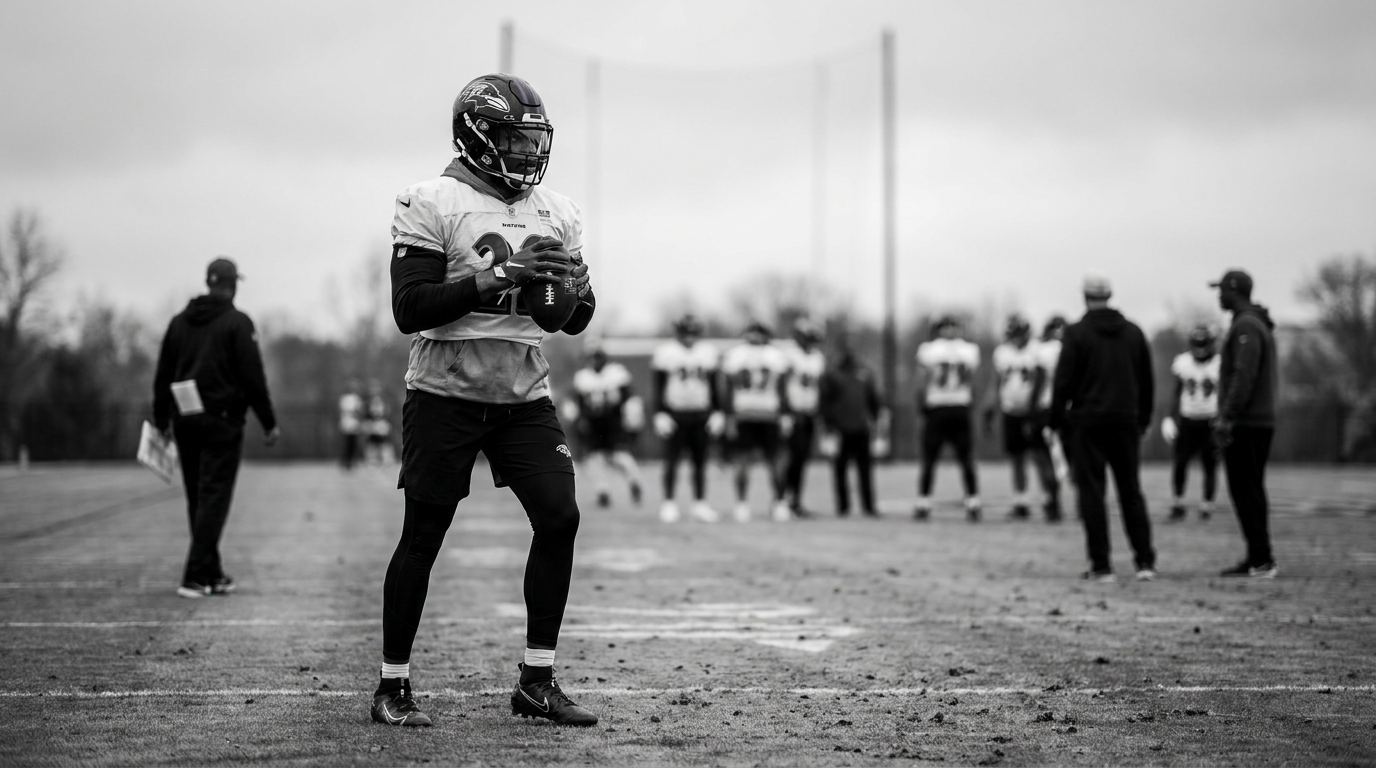
Derrick Henry has given the Baltimore Ravens stability at running back over the past two seasons, pairing heavy usage with steady week-to-week availability as the franchise transitions to a new staff for 2026. A brief fall during recent organized team activities underscored how much his health matters. He resumed drills within minutes and finished practice, reinforcing the reliability Baltimore has leaned on to shape its ground game.
That dependability has allowed the Ravens to plan early-down calls and four-minute offense with a clear focal point instead of adjusting weekly based on injuries or short-term form. The continuity helps keep the offense on schedule, reduces exposure on long-yardage downs and sustains a physical profile from September through January.
The scale of Henry’s workload illustrates the shift. He logged 325 carries in 2024, the second-highest single-season total in team history, and followed with 307 carries last season. Over the past four seasons, he has been sidelined only once and has started 51 straight games, giving Baltimore a predictable early-down option it lacked after 2013.
Durability ends Baltimore’s backfield carousel
Workload restores a single focal point
Before Henry’s arrival, the Ravens rotated Justin Forsett, Alex Collins, Gus Edwards, Mark Ingram II and Devonta Freeman through productive stretches, but none delivered back-to-back 200-plus carry seasons. The result was a ground game that produced yards yet rarely centered on a single bell-cow. Henry’s presence has restored that focal point and simplified short-yardage personnel decisions while preserving situational flexibility across different game scripts.
On-schedule offense and situational clarity
Henry’s consecutive-starts streak has given coaches a reliable baseline for touches and tempo. A steady early-down hammer keeps the offense on schedule, shortens third downs and limits exposure in obvious passing situations. That week-to-week predictability informs not only play-calling but also roster activation and special-teams usage.
New staff and reworked line shape 2026 offense
Leadership changes with familiar adaptation
The continuity at running back arrives as Baltimore implements leadership changes. The Ravens enter 2026 with new head coach Jesse Minter and offensive coordinator Declan Doyle, bringing fresh formations, terminology, motions and cadences. Henry has navigated coordinator transitions before and is adapting to the playbook with the routine that has underpinned his longevity. He is also aiming to surpass 1,500 rushing yards for a third straight season for the first time in his career.
Rebuilt interior and center decision ahead
The blocking group in front of him has been retooled to align with a power-run approach. Left tackle Ronnie Stanley and right tackle Roger Rosengarten are the only returning starters, while the club added first-round guard Olaivavega Ioane with the No. 14 overall pick and signed guard John Simpson to a three-year, $30 million deal. Baltimore is currently lining up longtime backup Danny Pinter at center, though the team could revisit that spot later this offseason.
The combination of Henry’s workload capacity and a bigger, reconfigured interior gives the Ravens a clear identity as camp approaches. Training camp will clarify the center decision and provide the first extended look at how the rebuilt front and confirmed bell-cow translate into 2026.