Special Report: The Week That Decides October
The Federal Reserve raised rates 11 days ago and said more may follow. This week delivers the two numbers that will settle whether it does.
Jurgen Goldmeier ·
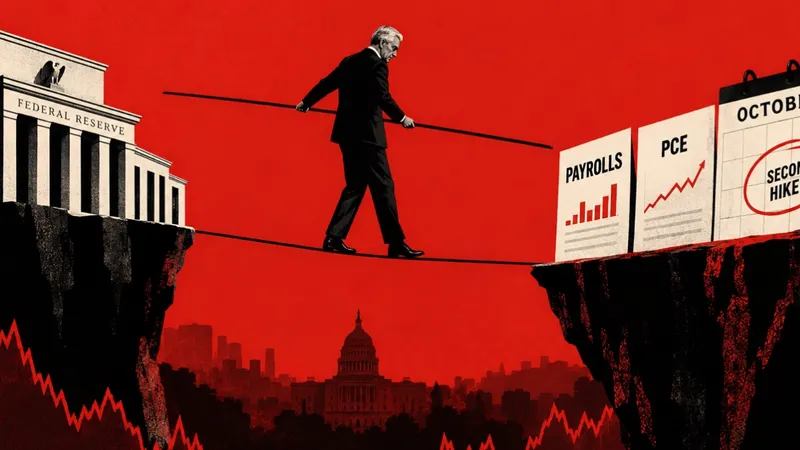
Investors begin the final days of the third quarter facing the densest US data week of the autumn, and the first full read on jobs and inflation since the Federal Reserve resumed raising interest rates. The Bureau of Labor Statistics publishes the September employment report at 8:30 a.m. ET on Friday, October 2. Two days earlier, the Bureau of Economic Analysis releases August personal consumption expenditures prices, the inflation measure the Fed targets. These are the last major inputs before the Federal Open Market Committee meets on October 27 and 28.
The stakes are concrete. On September 16 the committee voted 12–0 to lift its target range by a quarter point to 3.75%–4.00%, the first increase since 2023. "The Committee will deliver price stability," the statement said, and Chair Kevin Warsh told reporters inflation had been "too high, for too long." Sixteen of the 18 officials who submitted projections expect at least one more increase this year, according to CNBC's count; Warsh does not submit one. Futures now price a second hike in October at roughly 64%, up from 43% a month ago, according to CME FedWatch figures reported by 24/7 Wall St. on Saturday.
The bond market has run ahead of the committee. The 10-year Treasury yield touched 5.23% on Friday, its highest since June 2007, after a weak five-year auction and hot business surveys, and settled near 5.17%. The S&P 500 closed at 7,743, less than 1% below the record it set in August, according to the Associated Press. That combination leaves little cushion. Strong data would push yields higher and valuations lower; soft data would revive growth worries at the moment the Fed has said inflation, and not employment, is its priority.
One thing is settled before the week begins. Congress passed and President Trump signed a continuing resolution on September 2 that funds the government through December 11, by votes of 90–6 in the Senate and 370–48 in the House. There is no September 30 shutdown, and the BLS and BEA release calendars stand.
[INFOGRAPHIC: The Week That Decides October]
The shape of the week
Monday is the quiet day, with only the Dallas Fed's manufacturing survey and the first of some two dozen Fed appearances. Tuesday opens the labor-market sequence with August job openings and the Conference Board's confidence survey, and brings a decision from the Reserve Bank of Australia, where consensus expects a quarter-point rise to 4.60%; the tightening turn is global, and Australia will show it first.
Wednesday is the week's crowded morning. ADP's private payroll estimate lands at 8:15, followed at 8:30 by August income and spending with the PCE price index, and the third estimate of second-quarter GDP. Consensus compiled by Trading Economics calls for headline PCE up 0.4% on the month and core up 0.3%, both faster than July's 0.2%. The Cleveland Fed's nowcast, updated Friday, sits at 0.27% for core, which rounds to the consensus but only just. It is also quarter-end and fiscal year-end, so the last hour of trading will carry rebalancing flows that have nothing to do with the data. After the close, Micron reports fiscal fourth-quarter results against June guidance of $50 billion in revenue, plus or minus $1 billion, on a 14-week quarter that flatters the comparison.
Thursday brings weekly jobless claims, the ISM manufacturing index and the heaviest day of Fed speaking, including Vice Chair Philip Jefferson on the economy and monetary policy at 1:30 p.m. Nike reports after the close. Friday belongs to the jobs report. A Reuters poll expects 100,000 jobs and a 4.2% unemployment rate. ING's James Knightley also sees about 100,000 but has unemployment steady at 4.1% and expects August's 162,000 to be revised down. Average hourly earnings are seen up 0.3% on the month, or 3.1% on the year.
Why Wednesday matters more than the CPI you already saw
Readers who watched the August consumer price index two weeks ago may wonder why Wednesday's inflation number matters at all. Core CPI rose 2.4% in the year to August, its lowest since March 2021. Core PCE, the figure the Fed targets, was 3.3% in July and is expected near 3.4% for August. Both numbers are official and both are true; they measure different things.
CPI, from the BLS, asks what urban households pay out of pocket. PCE, from the BEA, counts everything consumed on households' behalf, including what employers and Medicare pay for health care, and it imputes prices for services nobody bills for, such as free checking. Those medical and "nonmarket" items carry far more weight in PCE, and they have been running hot. Governor Christopher Waller has argued that part of the gap is measurement rather than inflation, and in early September he made the case for a pause: "Give disinflation a chance. We can wait one meeting." He then joined the unanimous vote to hike after the August CPI showed core prices rising faster than forecast. The Fed targets PCE regardless. A core print that rounds to 0.3% keeps October alive; a 0.2% print is the number Waller was waiting for.
Why the 10-year moved more than the Fed
The Fed moved 25 basis points. The 10-year Treasury yield has risen about 51 basis points in a month, and the two-year about 62, according to Treasury par-curve data. The gap between the two widened to 0.36 percentage point on September 25 from 0.20 a week earlier, according to FRED. The Fed sets the overnight rate; the 10-year is set by whoever is willing to lend the Treasury money for a decade, and that price includes a term premium for supply and inflation risk that no single FOMC vote controls.
Macquarie's Thierry Wizman told CNBC on Friday that "this year it has more to do with the bond issuance than the inflation story," pointing to heavy Treasury and corporate borrowing, including for AI data centers. The Treasury has responded with buybacks, most recently up to $6 billion, according to CNN. Long rates have risen abroad too: NBC News reported Japan's 10-year at its highest since 1996 and Germany's at its highest since 2009. This is a global repricing, and it is why a soft jobs number on Friday would relieve the front end of the curve more than the back.
The labor market: weak and stable at once
The employment picture is best described as "low hire, low fire." Initial jobless claims sit just under 200,000, a level that historically means employers are holding on to workers. Yet payroll growth averaged only about 31,000 a month over the year to August, and JOLTS hires fell to 5.05 million in July. Firms are neither cutting nor adding. That equilibrium explains how the Fed could raise its 2026 growth forecast to 2.3% and lower its year-end unemployment projection to 4.1% in the same meeting. The risk in it is asymmetric: unemployment drifts up slowly while companies freeze, then jumps if they begin to cut. A claims print above 220,000 on Thursday would say more about that risk than Friday's headline.
Reading the jobs report itself takes discipline. Look first at revisions to the prior two months; in August, July was revised from a 23,000 loss to a 21,000 gain, a swing that changed the story. Look second at the unemployment rate, which comes from a separate household survey and can point the other way; household employment jumped 569,000 in August while payrolls rose 162,000. Look third at average hourly earnings, the wage channel the Fed watches, and fourth at the diffusion index, which says how many industries are hiring. A gain concentrated in health care and government is weaker than the same gain spread across sectors. Only then look at the headline.
Four ways Friday can go
These are possibilities, not predictions, and first reactions can reverse by the close. A strong report, with payrolls well above 100,000, unemployment at or below 4.1% and wages up 0.4% or more, would likely push the two-year yield higher, firm the dollar, and weigh on rate-sensitive sectors such as homebuilders, small caps and real estate. October hike pricing would move toward 80% or higher, especially after a 0.3% core PCE. An in-line report, roughly 75,000 to 125,000 jobs with unemployment between 4.1% and 4.2%, would leave the decision to the September CPI on October 14 and let Micron and Nike set the tone instead.
A weak report, under 50,000 jobs or unemployment at 4.3% or higher with downward revisions, would pull yields lower and soften the dollar, relieve growth stocks and worry cyclicals and credit spreads. If Wednesday's PCE was hot, the mix would look stagflationary and any rally would be limited. A mixed report, with strong payrolls alongside rising unemployment or the reverse, is the most likely to whipsaw; the household and establishment surveys diverged in August, and revisions would decide the narrative. The VIX, which ended Friday at 14.9, has room to move.
Who wants what
The Fed wants credibility. Warsh has tied the institution to a test of "sufficient speed" on inflation. A second straight hike would signal a cycle; a pause after soft data would invite the question of whether one data point moves the committee, which Warsh has said he wants to avoid. Minutes of the September meeting arrive October 7.
The administration wants lower rates and calmer prices before the November 3 midterms. The president posted "LOWER THE INTEREST RATES" after the hike but did not criticize Warsh by name. On Saturday the White House announced a $30 billion tariff-reduction package with China on "non-sensitive goods," according to Axios; the broader truce lapses November 10 absent an extension. Congress is out of the picture until December 11.
Markets want breadth and are not getting it. Technology led the S&P 500 last week with a 3.1% gain while the Russell 2000 fell 0.8%, and Reuters reported the equal-weight index down about 4% for September. Bearish sentiment has risen "sharply," Eric Diton of The Wealth Alliance told CNBC, even as the index sits near a record. Businesses want relief on input costs. ISM respondents cite steel, aluminum, tariffs and petroleum tied to the Middle East, and AAA put the national gasoline average at $4.48 on September 24, a record for the time of year. Nike, Carnival and McCormick will say how much of that they can pass on.
The factor nobody schedules
Oil remains the wild card. On Saturday the president rejected Tehran's seven-day plan to reopen the Strait of Hormuz, according to ABC and CBS. On Sunday the IRGC Navy said the strait remains closed and claimed to have seized a US underwater vehicle; both are Iranian claims and neither has been confirmed by US Central Command. Brent ended the week above $100, with WTI near $93, and Iran headlines have moved the benchmark by several dollars in a day. The next OPEC+ meeting of the eight voluntary-cut producers falls on Sunday, October 4, after the jobs report and before the following week's ISM services index and Fed minutes.
Five trading days, two decisive numbers, and a bond market that has already placed its bet. Watch Wednesday's second decimal, Friday's revisions line, and Thursday's Jefferson speech for the committee's center of gravity. The October decision will be made in the last week of the month, but the argument for it will be settled this one.