Wearables Are Moving From Tracking Humans to Augmenting Them
AI glasses, neural wristbands, medical sensors and brain interfaces are turning the human body into computing’s next platform.
Edward Mullen ·
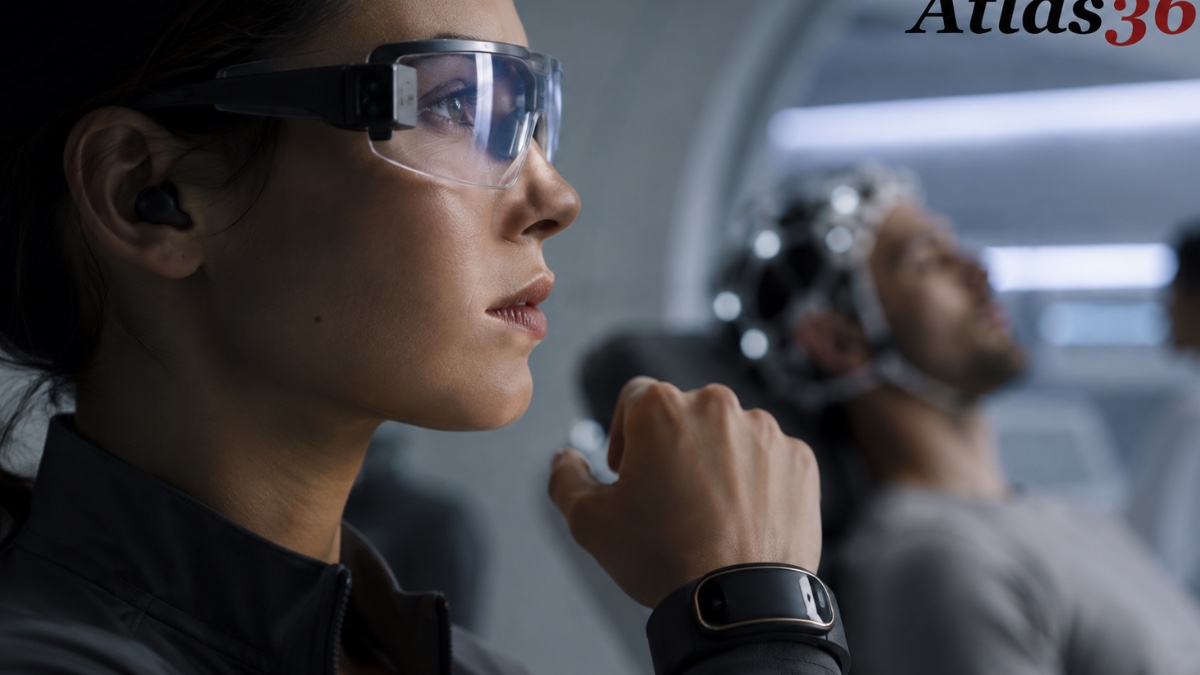
145.7 Million Wearables, New Purpose
The next great computing platform may not sit on a desk, live inside a phone or even appear as a single device: it may be assembled around the human body, with glasses handling visual context, earbuds providing private audio, rings and watches monitoring physiology, wristbands translating muscle signals and, for a small group of patients, implanted electrodes turning neural activity directly into computer commands.
That transition is already occurring at commercial scale at the outermost layer: IDC says 145.7 million wearable devices shipped globally in the first quarter of 2026, up 4.3% from a year earlier, with hearables accounting for roughly two-thirds of shipments; it expects 407.6 million hearables, 159.7 million smartwatches, 13.6 million smart glasses and 4.9 million smart rings to ship during the full year, while projecting total wearable shipments to reach 693.2 million units by 2030. Smart glasses are the most revealing part of that mix because they are moving from peripheral gadget to computing interface: IDC forecasts shipments rising 41.4% this year, while Counterpoint, using a different category definition and measurement period, says the global smart-glasses market expanded 212% year over year during the first half of 2026 and that Meta controlled about 84% of shipments.
The numbers are still tiny beside the smartphone market, but the direction matters: wearables are beginning to change from devices that report what happened — steps taken, calories burned, messages received — into systems that can perceive the user’s surroundings, interpret intent and provide assistance at the moment an action is being taken, which is a much more consequential relationship between person and machine.
Meta’s Wrist Joins the Face
The clearest version of this emerging architecture is no longer theoretical: Meta’s Ray-Ban Display glasses combine cameras, microphones, speakers, AI and an in-lens color display with a separate Neural Band that reads surface electromyography, or EMG, signals generated by muscles in the wrist, allowing subtle finger motions to scroll or select items without touching the glasses; Meta says the band was developed from research involving nearly 200,000 participants, while the $799 glasses-and-band package began selling in the U.S. in September 2025.
Google is pursuing the same destination through a different ecosystem: its Android XR intelligent eyewear, developed with Samsung and eyewear partners including Warby Parker and Gentle Monster, is scheduled to begin launching with audio models in fall 2026, giving Gemini access to cameras, microphones, speakers, navigation, translation and connected apps while keeping the phone in the background; Google has also shown display versions designed to place information within the wearer’s view. The strategic shift is that AI finally gives wearables a reason to be continuously available: a conventional app waits for a command and operates on information the user supplies, while a multimodal model attached to eyes, ears and location can potentially understand the restaurant being viewed, the conversation being translated, the object being repaired or the route being walked, reducing the distance between perception and computation. The “centaur” metaphor has roots in advanced chess, where humans competed with computer assistance and Garry Kasparov concluded that process could matter more than raw intelligence — “Weak human + machine + better process was superior to a strong computer alone” — and the modern wearable race is effectively an attempt to build that superior process around everyday life, with the interface becoming as important as the model.
AirPods Become Hearing Aids
The transformation is even further along in health, where the old distinction between consumer electronics and medical technology is beginning to blur: in September 2024 the U.S. Food and Drug Administration authorized software that allows compatible Apple AirPods Pro to function as over-the-counter hearing aids for adults with perceived mild-to-moderate hearing impairment, while the agency separately cleared Apple’s Sleep Apnea Notification Feature for supported Apple Watches; the FDA had also cleared Dexcom’s Stelo in March 2024 as the first over-the-counter continuous glucose monitor in the U.S., and in June 2026 expanded Stelo’s clearance to people as young as two who do not use insulin. These examples matter because they change the economic logic of wearables: a product originally purchased for music, notifications or fitness can acquire regulated health functions through software and sensors, turning hardware already attached to the body for hours each day into a persistent diagnostic or assistive layer; the FDA’s hearing-aid authorization was described by agency official Michelle Tarver as a step toward greater “availability, accessibility and acceptability” of hearing support. Rings, watches and earbuds are therefore becoming more than smaller smartphones — they are gaining access to signals the phone cannot continuously observe, including pulse patterns, movement during sleep, glucose readings, hearing profiles and other physiological measurements, creating a feedback loop in which the machine does not merely know a person’s calendar or search history but increasingly knows something about the state of the person themselves. That does not mean every wellness metric is medically reliable, nor that more measurement automatically produces better health, but the regulatory path already visible in hearing assistance, sleep-apnea risk assessment and glucose monitoring suggests that one branch of human augmentation will arrive under a less provocative name: not enhancement, but prevention, accessibility and chronic-care management.
Seven Patients Think to Click
The inner layer of the centaur — direct communication with the nervous system — remains experimental, medically focused and vastly smaller than the consumer-wearables business, but its progress has become difficult to dismiss: University College London Hospitals said in January that seven people had received Neuralink implants in its GB-PRIME study between October and December 2025, with the investigational N1 using more than 1,000 electrodes placed on ultrathin threads to record neural signals, while Neuralink’s own January 2026 update depicted 20 implant procedures across 2024 and 2025 and described participants controlling computers, robotic arms and other devices. The strongest evidence that BCIs can move beyond a laboratory demonstration currently comes from academic research rather than a consumer launch: a Nature Medicine study published in June followed one man with ALS who independently used an intracortical interface at home for more than 3,800 hours over nearly two years, producing 1,960,163 decoded words at an average 56 words per minute; he judged 92% of his sentences at least mostly correct, while structured testing exceeded 99% word accuracy with a vocabulary above 125,000 words, and he used the system for messages, internet access and full-time employment. “This kind of technology gives you a new piece of hope,” Neuralink trial participant Sebastian Gomez told UCLH after using thought-based control, while UC Davis participant Casey Harrell described the ability to communicate more naturally than with the assistive technologies he had previously used; those experiences explain why the first serious market for implanted BCIs is restoration rather than elective enhancement. Competition is also widening: Paradromics performed the first long-term implant in its FDA-authorized Connect-One study in June 2026 and received FDA approval in August to expand how its investigational system can connect to compatible personal computers and mobile devices, while Synchron is recruiting for new trials of its Stentrode, which is inserted through a blood vessel rather than through open brain surgery; none of these developments means healthy consumers are close to purchasing brain implants, but they establish a technical bridge from neural intent to ordinary digital systems that did not exist at practical, sustained levels a few years ago.
Back Muscles Meet Wearable Machines
Human augmentation is also developing below the neck, and the industrial version may prove economically important even if consumers never decide they want robotic clothing: occupational exoskeletons already use springs, counterweights or powered actuators to support backs, shoulders, arms and legs during lifting or repetitive work, creating a literal human-machine combination for jobs where complete automation is either too expensive or too inflexible. Research reviewed by the U.S. National Institute for Occupational Safety and Health has found laboratory reductions in back-muscle activity of roughly 10% to 44% during some handling tasks, while other studies cited by the agency found lower spinal forces or reduced shoulder strain; NIOSH also warns that assistance can transfer loads elsewhere in the body, change balance, cause discomfort or encourage workers to handle loads they otherwise would not attempt, and much of the research has involved small samples or controlled environments rather than years of real-world use. That tension offers a preview of the economics of augmentation: employers in logistics, manufacturing, healthcare and construction will not need a science-fiction super-suit to justify the technology if a wearable can reduce fatigue, extend the productive working life of an aging employee or help one person safely perform a task that otherwise needs two, but the same device could become controversial if “augmentation” quietly changes the physical workload employers expect from humans. The deeper labor question is therefore not simply whether machines replace people; it is whether companies begin redesigning jobs around technologically assisted workers — a mechanic receiving visual repair instructions through glasses, a multilingual warehouse employee hearing instant translation, a nurse wearing back assistance, or a technician controlling software through subtle muscle signals — which could create powerful productivity gains while also establishing a new baseline in which an unaugmented employee is treated as slower, less informed or more expensive.
A Camera Changes Everyone’s Privacy
Once computing is attached to a person’s senses, privacy stops being only a question about the owner of the device: Meta has spent recent weeks tightening the recording protections on its smart glasses after users found ways to obstruct the visible capture indicator, and an August 27 update was designed so, in Meta executive Alex Himel’s words, “the camera will now stop working if the light is covered during a recording”; Meta separately says its glasses use a visible LED to signal image capture, but the episode demonstrates that a wearable camera creates rights and expectations for every person standing near the wearer, not simply the customer who accepted the terms of service. The economic stakes rise further when visual data merges with health, location, voice and biometric signals, because the company operating the wearable could become an unusually intimate intermediary between a user and the physical world: the U.S. Federal Trade Commission updated its Health Breach Notification Rule in 2024 to make clearer that health apps and connected devices outside traditional HIPAA coverage can still face breach-notification obligations, while Europe’s AI Act prohibits AI systems that infer a person’s emotions from biometric data in workplace and education settings except for specified medical or safety uses. The platform contest is also becoming geopolitical: Counterpoint says the U.S. remains the largest smart-glasses market while distinct ecosystems are developing in China and India, and Google’s Android XR strategy explicitly seeks a multi-manufacturer platform, meaning the familiar smartphone struggle between operating systems, app stores and services may be recreated on the face — except this time the winning platform could mediate what users hear, record, translate, remember and ask about as they move through the world. That makes augmentation an inequality question as well as a privacy question: when a $299 pair of glasses can provide an AI assistant and a higher-end system adds a display and muscle-sensing controls, premium access could eventually mean better real-time translation, memory support, navigation, health interpretation or professional guidance, creating a future in which technology does not merely give people different devices but gives them different cognitive and sensory capabilities.
Humane’s Dead Pin Warning
The centaur thesis still has a graveyard beside it: Humane marketed its Ai Pin as an alternative to smartphone-centric computing, yet the company wound down the consumer product and shut its cloud-dependent services on February 28, 2025, after HP agreed to acquire key Humane software, intellectual property and staff, a reminder that placing AI on the body does not solve battery constraints, latency, ergonomics, social acceptance, pricing or the simple requirement that the product be better than pulling out a phone. Brain interfaces face far harder barriers — invasive procedures, long-term electrode performance, infection and surgical risks, regulatory review and the problem that some of the most impressive published results still come from one or a handful of participants — which is why the FDA’s BCI framework remains centered on investigational devices intended to restore functions for people with paralysis or amputation rather than elective consumer enhancement. The more credible transformation is therefore likely to occur in layers: first wearables observe, then they interpret, then they assist, then some begin acting through new inputs such as EMG, while neural interfaces expand within medicine; over time those layers can connect, producing an individual system that knows what its wearer sees, hears, intends and, increasingly, how the body is responding. The smartphone condensed cameras, maps, music players, payment cards and the internet into one rectangle; the next platform may reverse that process by dissolving computing across the body, and if that happens the defining technology question of the 2030s will not be whether humans become cyborgs in the cinematic sense, but how much of seeing, remembering, deciding, communicating and physically working people choose — or are expected — to do with machines continuously attached to them.