Pax Silica Puts America’s AI Partners to a New Test
Chips, critical minerals, investment and market access are becoming bargaining tools as Washington and Beijing compete to organize the global AI economy.
Lauren Collins ·
A Draft Raises the Stakes
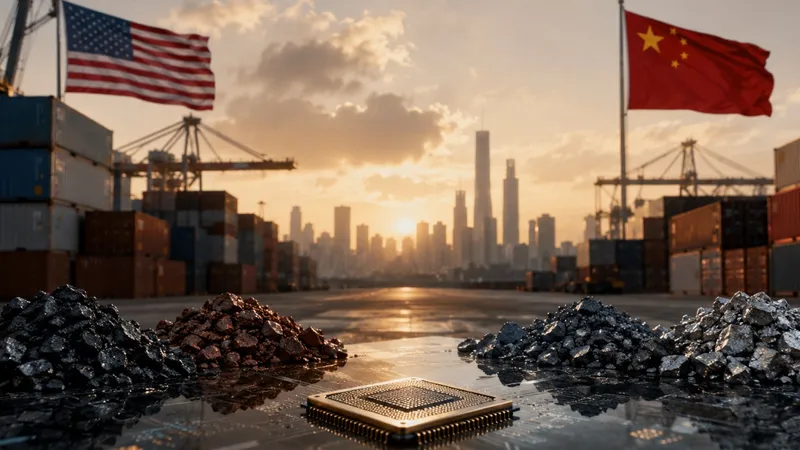
The geopolitical contest over artificial intelligence may be moving from export controls and industrial policy into something more demanding: choosing a technology camp. Reuters reported on August 14 that the State Department had prepared a draft communication for 35 governments that signed Washington’s June AI Opportunity Statement, warning that participation in competing initiatives could jeopardize their place in the U.S.-led framework surrounding Pax Silica. The proposal matters precisely because it is not yet settled policy: Reuters said the document was undated, could still change and had no confirmed delivery schedule, while the State Department declined to comment on the leaked draft. If Washington ultimately adopts that approach, however, Pax Silica would acquire a strategic meaning considerably larger than its current non-binding architecture, asking partners not simply to cooperate with America but potentially to limit how far they cooperate with China.
Pax Silica Covers the Stack
Washington created Pax Silica in December 2025 under Under Secretary for Economic Affairs Jacob Helberg, describing it as the State Department’s principal initiative for securing the economic foundations of artificial intelligence. Its scope reaches well beyond semiconductor fabrication: the framework covers critical minerals, energy, advanced manufacturing, chipmaking, AI infrastructure, connectivity and logistics, reflecting the reality that computing power depends on an industrial chain stretching from mines and electricity grids to data centers and foundation models. By late June, Pax Silica had expanded to 24 signatories, with the European Union, Germany, the Netherlands, Greece, Kazakhstan and several Latin American states among the latest entrants; separately, 35 economies signed Washington’s AI Opportunity Statement. The U.S. has also begun attaching money and physical infrastructure to the concept, including plans for as much as $50 million for an AI supply-chain verification project initially focused on Panama, an indication that Pax Silica is intended to become an operating economic network rather than another diplomatic communiqué.
Shanghai Builds Another Pole
China has meanwhile created an institutional vehicle of its own. On July 16, representatives from 29 countries signed the founding agreement for WAICO in Shanghai, establishing an intergovernmental organization headquartered in the city; Kazakhstan, Russia, Pakistan and Indonesia were among the governments identified by Beijing as founding participants. Chinese officials describe the organization as a platform for international AI cooperation and governance, with particular emphasis on broad participation and narrowing the technology gap facing developing economies, rather than as an explicitly anti-American alliance. Beijing is reinforcing that message with tangible offers: President Xi Jinping announced 5,000 AI training opportunities for developing countries over five years and plans to extend an AI-enabled meteorological warning system to 30 countries. The emerging contest is therefore not simply American proprietary technology against Chinese open models; it is increasingly a competition over which power can offer countries the more useful package of computing access, infrastructure, training, capital and political autonomy.
Europe Holds the ASML Card
Europe is where a strict alignment policy could become especially difficult. The European Commission signed the Pax Silica Declaration in June and explicitly connected participation with its own push for technological sovereignty, yet the bloc remains deeply economically intertwined with China: EU goods imports from China reached roughly €559.5 billion in 2025, while exports were about €199.5 billion, making China the bloc’s largest source of imported goods. Europe also possesses technology that gives it unusual bargaining power inside any Western semiconductor coalition because Dutch group ASML remains the world’s only producer of extreme-ultraviolet lithography systems, machinery required for manufacturing the most advanced generations of chips. That creates an awkward triangle: Europe benefits from American computing technology and security ties, depends heavily on Chinese manufacturing and trade, and simultaneously controls industrial capabilities that Washington and Asian chipmakers need, meaning Brussels is not merely choosing between two systems but negotiating from inside both sets of dependencies.
Three Powers Hold Different Cards
That distribution of leverage makes the emerging AI order resemble a geopolitical game in which no player owns the entire deck. The United States holds exceptional advantages in frontier-model developers, capital markets, advanced chip design and the security relationships underpinning many of its alliances; China brings enormous manufacturing depth, powerful open-weight AI developers, a vast domestic market and dominant positions across parts of the critical-mineral processing chain. Europe’s leverage is narrower but strategically concentrated: ASML sits at a crucial semiconductor bottleneck, the EU remains one of the world’s largest consumer markets, and Brussels can shape the conditions under which technology companies operate through its regulatory and competition regimes. Pax Silica will therefore succeed or fail not simply according to how many flags appear beside its declaration, but according to whether Washington can make membership economically valuable enough that governments accept constraints on relationships they have spent decades building elsewhere.
Kazakhstan Makes Hedging Visible
Kazakhstan illustrates why that will be difficult, particularly for middle powers. It is the only country publicly identified so far as participating in both Pax Silica and WAICO, and its importance to Washington is reinforced by the critical-mineral resources that helped make Central Asia attractive to the American supply-chain strategy in the first place; rather than an anomaly, its behavior reflects the incentives facing governments whose resources, geography or markets are valuable to several competing powers. Energy exporters can trade electricity and investment access for data-center projects, mineral-rich states can negotiate around processing and extraction, manufacturing hubs can seek technology transfer, and large developing markets can invite competing infrastructure offers without necessarily sharing either Washington’s or Beijing’s strategic worldview. Both powers already understand that economic inducements matter: Washington is developing its Panama credentialing project and a 4,000-acre economic-security zone with the Philippines, while China is presenting WAICO alongside training and development programs aimed heavily at the Global South.
The Memo Defines the Test
The decisive question is therefore not whether an AI world divided into American and Chinese ecosystems is imaginable; parts of that division already exist. The question is how far Washington is prepared to push exclusivity, because a narrow prohibition against formal membership in directly competing organizations would be very different from rules affecting Chinese models, research partnerships, telecommunications equipment, mineral contracts or commercial investment, and the Reuters report does not establish where those boundaries would ultimately fall. Europe will be central to that calculation: Brussels joined Pax Silica because diversified technology supply chains can strengthen European autonomy, but an arrangement perceived as transferring decisions over Europe’s external technology relationships to Washington would create a different political problem. The next signals will be concrete ones — whether the State Department actually sends the reported communication, whether its wording changes, how Kazakhstan is treated and whether Washington offers waivers or clearer membership benefits — because those decisions will determine whether Pax Silica evolves into a flexible coalition of trusted suppliers or the institutional frontier of a divided global AI economy.