The MBA minted the last era's bosses. These schools are minting the next one's.
Wars, tariffs and $13trn in sovereign wealth have made statecraft the executive's core skill.
Claire Dubois ·
For two generations the MBA was the escalator to the corner office — a finishing school for a globalising economy that prized efficiency, financial engineering and scale. That world is fragmenting. Wars in Ukraine, the Middle East and Sudan; American-Chinese decoupling; an arms race in tariffs and industrial policy; sanctions of unprecedented reach; and the securitisation of cross-border investment have pushed statecraft to the centre of corporate strategy. The competency that now defines the executive suite is not a functional skill taught in a business-school core. It is the ability to read the interaction of states, institutions and markets across cultures and decades — and that is the syllabus of the policy master's.
The scale of the shift is measurable. America's Committee on Foreign Investment (CFIUS) reviewed a record 440 covered transactions in 2022, its national-security machinery now sitting astride ordinary deals.
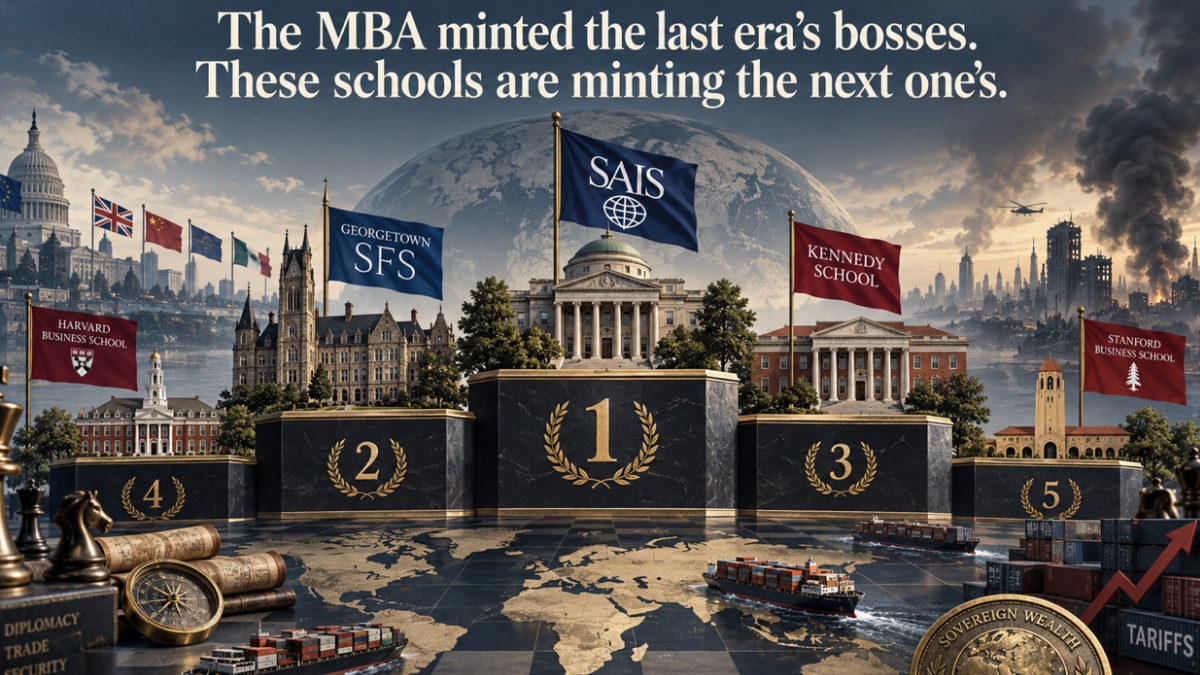
This report argues that the international-affairs and public-policy master's — the Georgetown, Johns Hopkins SAIS, Harvard Kennedy, Princeton and Sciences Po path — is the better preparation for leadership in this environment. It also names the schools, ranks them, and concedes plainly where the argument breaks down: on pay, on employer demand, and on the raw count of chief executives.
It also confronts a broader charge — most associated with NYU's Scott Galloway — that the degree itself, of any kind, has become a fraying bet. The honest verdict is a hybrid one.
Geopolitics storms the C-suite
The data on executive anxiety is stark. The World Economic Forum's Global Risks Report 2025, drawing on more than 900 experts, ranked state-based armed conflict the single most pressing immediate risk for the year, cited by 23% of respondents — a leap from eighth place the year before.
EY-Parthenon's CEO Outlook, a survey of 1,200 chief executives across 21 countries published in May 2026, found 56% naming geopolitical uncertainty their most significant risk over the coming year, a 28-point jump since September 2025.
McKinsey, which has built an entire geopolitics practice around the trend, reports that the item now dominating board agendas is not capital allocation but statecraft. Its global director of geopolitical risk quotes one chief executive bluntly.
The question this raises is uncomfortable for business schools. If the defining executive skill of the 2020s is judgment about states, institutions and cultures over long horizons, is a degree organised around finance, accounting, marketing and operations still the sharpest tool — or does one organised around macroeconomics, political economy, regional expertise, languages, institutions and negotiation fit the moment better?
Who really runs the world's money
Begin with a myth: that the MBA is a prerequisite for the top job. It is not. And the institutions that increasingly move markets — central banks, finance ministries, multilateral bodies — are led overwhelmingly by people trained in policy, economics and law, not business administration.
The pattern runs into the private sector. Peter Sands ran Standard Chartered with a Harvard Kennedy School MPA; Dennis Lockhart led the Atlanta Fed with a Johns Hopkins SAIS master's; graduates of Georgetown's Walsh School of Foreign Service sit across banking, energy and private equity.
Against them, the MBA can field Jamie Dimon (Harvard Business School), Satya Nadella (Chicago Booth) and Larry Fink (UCLA Anderson). Neither roster settles the base rate — which is precisely the problem with the credential data.
The power list: where the policy elite trains
Rankings in this field are contested — and APSIA, the Association of Professional Schools of International Affairs, the sector's membership body of 41 schools, pointedly does not publish them. The most-cited measure is the reputational survey run by Foreign Policy with the Teaching, Research and International Policy (TRIP) project at William & Mary, which asks international-affairs scholars to name the programmes that best prepare students for careers like their own. Its 2024 results put a familiar cluster at the top.
Two features stand out. The concentration is geographic as much as academic: four of the top ten sit in Washington, DC, within reach of the agencies, multilaterals, embassies and think-tanks that hire their graduates. And placement is strong where it counts. APSIA reports that its member schools achieve a 91% full-time-employment-or-doctoral-placement rate soon after graduation and supply more than 80% of America's Pickering and Rangel foreign-affairs fellows each year. The pay is lower than an MBA's; the proximity to power is not.
The two syllabuses
The intellectual case for the policy master's rests on breadth. A typical MBA core teaches the functional machinery of running a firm. A policy master's teaches the machinery of the world the firm now operates in.
This is not a new critique of the MBA; it is a distinguished one. Henry Mintzberg argued in Managers Not MBAs (2004) that conventional programmes "train the wrong people in the wrong ways with the wrong consequences." Rakesh Khurana chronicled in From Higher Aims to Hired Hands (2007) how business schools abandoned the aspiration to make management a profession.
Duff McDonald's The Golden Passport (2017) argued that Harvard Business School's central failure was its inability to develop a considered view of the state's proper role in the economy — exactly the literacy the current moment demands.
The WEF's Future of Jobs Report 2025 reinforces the point: analytical thinking is deemed essential by 70% of employers, resilience by 67% and leadership and social influence by 61%, with systems thinking among the fastest risers — the integrative, judgment-under-uncertainty capacities policy programmes claim to build.
The honest counter-evidence
A serious argument must concede what cuts against it. Here the counter-evidence is substantial — and on money, decisive.
Harvard's MBA class of 2025 posted a median base of $184,500 and total median pay of $232,800; consulting medians reached $190,000. Kennedy School graduates earn far less, weighed down by public-sector placement. On pure return on investment, the MBA wins and it is not close. Nor is the degree in retreat: GMAC found applications to graduate business programmes rose 12% in 2024, reversing years of decline, with 92% of recruiters planning to hire MBAs and a rising premium for AI-fluent graduates.
Most damaging to the caricature of the MBA as a poor manager: the academic evidence is genuinely split, and no honest piece can pretend otherwise.
Why breadth matters now is captured in one number. Sovereign-wealth funds — the clearest fusion of state and market — reached $13.2trn in assets in 2024, up 14% in a year. More than a third of that capital sits in the Gulf. Reading the region's politics is no longer a soft skill; it is a core competency, and it is not on the MBA core.
The convergence trade
The most telling evidence is what elite institutions are actually building — and the answer is convergence. Joint degrees are proliferating: Harvard runs a three-year MBA/MPP across its Business and Kennedy schools; Wharton pairs its MBA with both the Kennedy School and Johns Hopkins SAIS; Stanford partners with Princeton and Georgetown; INSEAD offers an MBA/MA with SAIS. Simultaneously, business schools are importing geopolitics into the core — SKEMA, ESCP, Esade, Bocconi, IE and HEC now teach geoeconomics and non-market strategy as foundations, not electives. And corporations are voting with their org charts.
In July 2025 the WEF argued that "every company now needs a chief geopolitical officer" — a role modelled on how chief sustainability and information-security officers emerged as new risks became material. McKinsey now expects CEOs to act as "chief commercial diplomats," conducting shuttle diplomacy between capitals.
The credential that trains for that role — macro-literate, institution-aware, cross-cultural, long-horizon — is not, in its pure form, the MBA.
The bigger doubt: is the degree itself worth it?
Step back, and a larger question frames the whole debate: not which degree, but whether the degree still pays at all. American confidence in higher education has slid to 38% — roughly half its level a decade earlier — by Gallup's tracking as cited by Scott Galloway, the NYU Stern marketing professor whose "No Mercy / No Malice" essays have become the sharpest running commentary on the sector. In a newsletter published on 14 September 2026, "Is College Still Worth It?", he distilled the mood in a line: colleges, he wrote, are "running out of students and out of answers."
Galloway's indictment is specific, and it is not that education is worthless. It is that elite universities have turned scarcity into a fetish — "a university president bragging about rejecting 90% of applicants is tantamount to a homeless shelter taking pride in turning away 90% of the needy," he has written — while raising prices faster than inflation.
The return has been eroded, he argues, not because the teaching got worse but because the bill exploded: an elite degree "can still quadruple your expected income," he wrote in 2023, "but your purchasing power has declined as tuition has exploded." His prescription is a Marshall Plan for the "unremarkable": expand public-college and trade-school seats, tax the largest endowments that refuse to grow, and make colleges share the loss when their graduates default.
Two of his more recent points bear directly on this report. First, the wage premium is now genuinely contested — economists, Galloway notes, cannot agree on whether the college earnings advantage is rising or falling, and a new US federal rule will begin scoring every degree programme on a single test: do its graduates out-earn someone who never enrolled? Second, and more pointed, the research he cites finds that for outcomes, prestige matters far less than what you choose to study . The debt data sharpen the split: among graduates who borrowed, about a third say college was not worth the cost; among those who did not, only 16% do.
That last finding is where the broad scepticism folds back into this report's argument rather than dissolving it. If the credential's blanket value is in doubt and field of study outweighs brand, then the MBA's prestige is not a safe proxy for leadership readiness — and the discriminating question becomes what a manager actually learns, and whether it fits the era. An education organised around geopolitics, institutions and macroeconomics answers that question, for a fractured world, more convincingly than one organised around the functional machinery of the firm. The degree may be under suspicion; the case for choosing the right content is stronger for it.
The verdict
For an individual maximising near-term earnings on a finance, consulting or tech track, the elite MBA remains the rational default; the salary premium is real and strengthening. For anyone aiming to lead a globally exposed enterprise, a regulated industry or a state-adjacent business, a top policy master's — a Georgetown, SAIS, Kennedy, Princeton or Fletcher — deserves far more weight than convention allows. But the dominant recommendation is the hybrid the elite institutions are themselves building. For boards, the lesson is sharper still: stop treating the MBA as a proxy for leadership readiness in a geopolitical age. Build geopolitical literacy into succession planning — and, where exposure warrants, into the C-suite itself.
The MBA built the global economy of the past forty years with remarkable success. The task of the next forty is to navigate that economy's fracture. That is a different job, and it calls for a different education — or, more precisely, for both.