

How did a $4 trillion company miss it?
Nine public warnings in 13 months pointed at Megaspeed, Nvidia’s biggest customer in Southeast Asia. Nvidia’s position never moved.
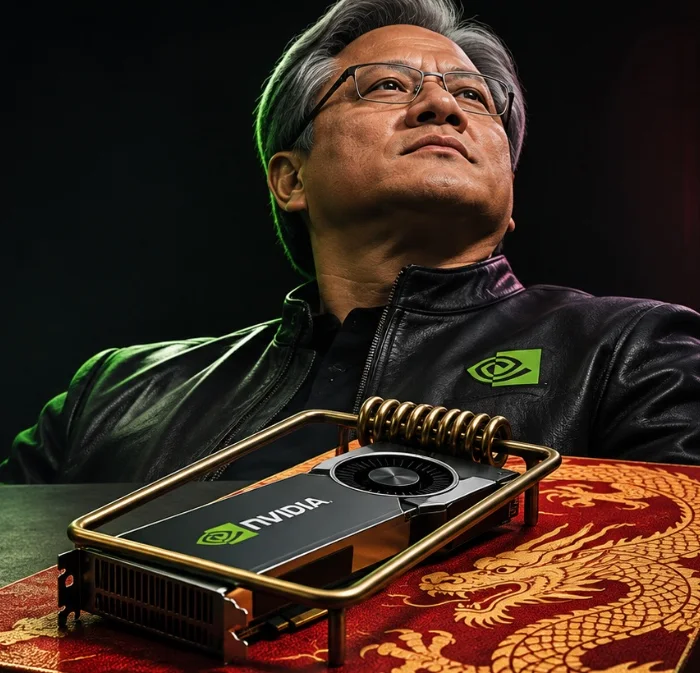
The world’s most valuable chipmaker spent Wednesday night discussing life after its founder. Nvidia’s board met to weigh successors to Jensen Huang, Bloomberg reported. By early Thursday there was no announcement, the shares were sliding in premarket trading and Chief Financial Officer Colette Kress had emerged as a contender for interim chief executive.
The immediate cause is personal. On Sunday, Huang told employees he had been unfaithful to his wife. Reports had tied him to Alice Huang, a former Megaspeed International executive whom U.S. intelligence reportedly assessed as an asset of China’s Ministry of State Security. The two are not related. Overnight, The New York Times reported a second relationship, with one of his direct reports. Nvidia, Huang and that executive have not confirmed it.
The affair explains the timing. The customer is the harder story. Megaspeed, a 2023 spinoff of a Chinese gaming business, imported at least $4.6 billion of Nvidia hardware in under three years, by Bloomberg’s count. U.S. and Singaporean investigators have examined it in public view since October 2025. Senators wrote letters. A short seller published 40 pages.
Nvidia’s answer held steady. As late as October 29, a spokesperson said the allegations against “this regional cloud” had been “thoroughly investigated and debunked.”
So how does a $4 trillion company, selling the most tightly controlled product in world trade, fail to resolve what reporters, senators and a small research shop could see? The record points to two breakdowns that fed each other. Scrutiny in Washington faded as Huang’s influence grew, and Nvidia’s own controls never closed out the warnings.
HOW HUANG RESET WASHINGTON
Until 2025, keeping Nvidia’s best chips from China was a rare bipartisan cause in Washington. The Biden administration also investigated companies suspected of diverting chips to China, Megaspeed among them, the Wall Street Journal reported.
Then the politics changed. Donald Trump’s 2024 victory gave Huang an opening, according to the Journal. His pitch was simple: America gains more by keeping China dependent on its chips than by cutting China off. Nvidia stood to gain too, and that led some officials to question his motives, the Journal reported. Most had no idea about Alice Huang.
April 2025 was the hinge. Trump fired several National Security Council staffers, and resistance to Huang inside the administration eased, according to the Journal. That month Huang and his wife attended a $1 million-a-head dinner at Mar-a-Lago, and Trump reversed a newly announced ban on shipping an Nvidia chip to China. No reporting shows that one caused the other.
By May, Huang was calling export controls “a failure” and telling Bloomberg there was “no evidence of any AI chip diversion.” He traveled with Trump to the Gulf and announced chip deals with Saudi Arabia and the United Arab Emirates.
Some of Trump’s own advisers were alarmed. After Huang’s first White House meeting of the term, a group of them compared notes, the Journal reported. One joked that Huang would sell chips to the People’s Liberation Army if the government let him. The line comes from unnamed sources.
FRIENDS INSIDE, CRITICS OUT
The wins kept coming, and officials who warned the White House got little traction, the Journal reported, because Huang could reach the President directly. He also had allies. Commerce Secretary Howard Lutnick and White House AI adviser David Sacks helped raise his standing with Trump and answer his critics. Some officials noticed that Sacks argued for exports in nearly the same words as Huang, according to the Journal’s sources. Their account alleges no coordination.
The critics fared worse. Skeptics at the National Security Council, the State Department and Commerce’s export-control unit were sidelined or left, the Journal reported. Doubt moved to back channels. Aides to Treasury Secretary Scott Bessent, Secretary of State Marco Rubio and U.S. Trade Representative Jamieson Greer quietly consulted think-tank researchers about Huang’s China ties.
Megaspeed is where it all met. On November 5, in the Situation Room, Bessent asked Lutnick why the company was missing from Commerce’s Entity List, Axios and CNN reported. Commerce says the exchange never happened. Lutnick had received the intelligence memo on Alice Huang in May, according to the Times. Nothing reported ties Lutnick’s support for Huang to that outcome, and Commerce says enforcement runs “strictly by the book.”
THE COUPLE BEHIND THE CUSTOMER
The introduction came from the husband. Kang Wei, a Chinese businessman Huang had known for about a decade, presented him to Alice Huang, who is Kang’s wife, according to people who know the couple cited by the Journal. Kang seemed to accept the affair for two years, they said. He sometimes told associates, half in jest, that his wife was Jensen Huang’s “personal assistant.”
The couple had a pattern. Over a decade they moved from videogame companies to pharmaceutical takeovers to cloud computing, the Journal’s sources said, building webs of related entities, passing stakes between themselves and at times drawing regulators’ attention. Nvidia’s chips were the newest trade.
Investigators have since closed in from several directions. Singapore detained Alice Huang in the summer of 2025 and barred her from leaving, people told of the detention said. The ban was lifted, and she now lives in Beijing, according to Bloomberg. Taiwan revoked her entry permit and is examining her visits under its Anti-Infiltration Act, the Journal reported. Kang was detained in Shanghai this year in a stock-manipulation inquiry, then released.
The gravest claim is also the least settled. People familiar with the matter told the Journal that Megaspeed sent some Nvidia chips to China. Megaspeed denies wrongdoing, and no government or court has confirmed it. Beijing calls the spy story “groundless speculation.”
A standard background check on a major customer maps its owners, its affiliates and its principals’ regulatory history. By the Journal’s account, all three would have raised questions here.
BLIND, OR OVERRULED?
Two explanations fit the record. In the first, Nvidia’s risk function never grasped what it was looking at: a failure of capability. In the second, it understood and lost the argument, as skeptics in Washington reportedly did: a failure of governance that reaches the board. The independent investigation, run with outside counsel at Wachtell, Lipton, Rosen & Katz, exists to say which.
Nvidia’s defense has substance. It inspected Megaspeed repeatedly. Bloomberg’s December 2025 analysis found no evidence that chips had reached China. No authority has found that Nvidia broke export law, and Washington still has not listed Megaspeed. Either answer will outlast the decision on Huang.
More stories
- In AI We Trust
- Analysis : Inside Manchester City's £830mn 'disguised funding scheme'
- Scientific investigation continues at Durupinar site in Turkey
- Special Report: The Week That Decides October
- Heat risks rise as El Niño intensifies across the tropics
- The MBA minted the last era's bosses. These schools are minting the next one's.
Latest news
- Cameroon faces succession test after Biya's 10-week absence
- Germany faces integration gaps with 30% migration-background share
- Vance's Iran role shifts as Trump favors blockade pressure
- Japan & Asia: Zelda remake tops Japan boxed sales with 537,041
- Sudan gold revenue reaches $3.5bn without price relief
- ADNOC L&S lifts 2026 profit outlook to $4bn
- EU defence start-ups face two funding gaps, MEPs warn
- EU receives 12.89 million tonnes of Russian Arctic LNG before ban