

Sudan gold revenue reaches $3.5 bn without price relief
Gold dominates Sudan’s export base, but economists cited by Radio Dabanga said smuggling and war spending limit the benefit to households.
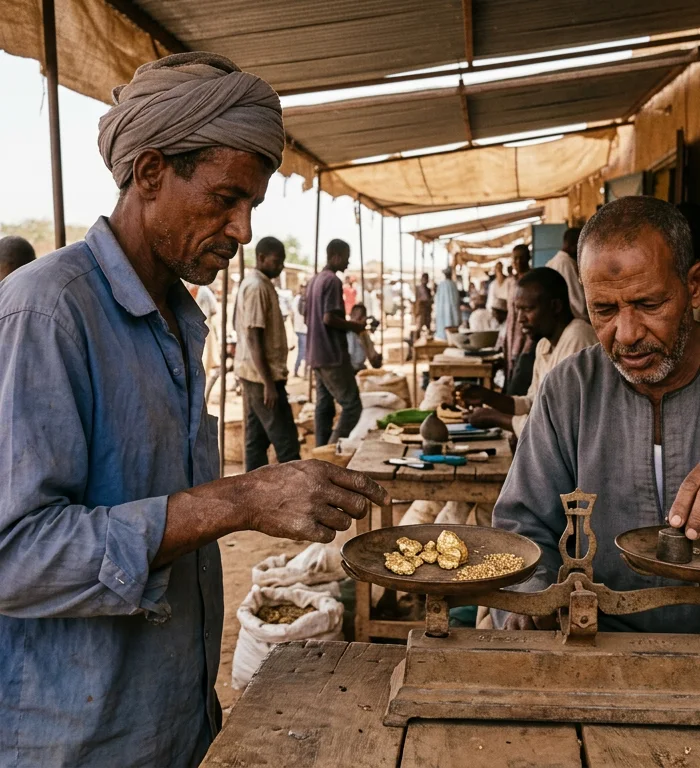
Sudan’s gold revenue reached $3.5 billion over a ten-month period, Radio Dabanga reported on Wednesday, citing an economic report from the Ministry of Minerals and Central Bank of Sudan.
The figure matters because gold represents 45% to 50% of Sudan’s exports, according to economist Haitham Mohamed Fathi, yet Radio Dabanga said the proceeds have not slowed the pound’s fall or cut market prices.
The report said more export proceeds were returned through official routes during the period. It also said authorities expect more than 80% of gold revenue to be paid into the regulated banking system in the coming period.
Fathi told Radio Dabanga that the government had tightened control over gold storage and exports as it sought to support the currency and contain rising costs. “In my assessment, these measures have not yet had an impact on the economic situation. However, increased gold production and the export figures, despite the smuggling, represent an opportunity that has been seized and a lifeline for the Sudanese economy,” he said.
“Since South Sudan's secession, gold has consistently been the most important source of revenue in Sudan's trade balance in terms of exports,” Fathi said.
Radio Dabanga reported that the Sudanese Mineral Resources Company and the Central Bank of Sudan view the export performance as a success. Economists and observers cited by the outlet said the revenue has not translated into economic stability, partly because large volumes of gold continue to leave the country through smuggling.
Fathi said Sudan produced 107 tonnes of gold in 2017, about 42 tonnes in 2018, 6.5 tonnes in 2023 and 64 tonnes in 2024. He said gold revenue reached $3.5 billion in 2025, and that the sector remains the largest export earner.
The mining base is broad but unevenly supervised, according to Fathi. He said 162 companies were active in mineral exploration, including 40 foreign firms, of which 30 were operating and 10 had stopped work. He also said 220 companies worked in small-scale or traditional mining, with about 70 processing waste from traditional sites to recover gold.
The problems are not new. Fathi said the sector has faced smuggling, environmental harm, insecurity in mining zones, frequent policy changes and weak official data since gold became a major state revenue source in 2012.
Radio Dabanga said authorities have restricted gold collection, purchase and marketing to government bodies, created a one-stop export window and sought buyers in Egypt, Saudi Arabia, Qatar and Türkiye. Fathi called for unified rules, transparent regulation and better use of major foreign and national companies.
The outlet also linked the weak household impact to higher customs exchange rates, increased taxes and local levies, and said public services such as health and education have not improved because spending on the war that began on April 15, 2023, remains the priority.
More stories
- ADNOC L&S lifts 2026 profit outlook to $4bn
- EU receives 12.89 million tonnes of Russian Arctic LNG before ban
- UK GDP rises 0.7% as tech services lead third-quarter growth
- EU household power prices fall 1.6% in first half
- KBC posts higher profit with 7% loan growth
- Nvidia loses about $430bn after China chip allegations
- Digital currencies enter Russia-India trade talks at BRICS
- Bank of Russia holds key rate at 14% as price risks rise
Latest news
- Cameroon faces succession test after Biya's 10-week absence
- Germany faces integration gaps with 30% migration-background share
- Vance's Iran role shifts as Trump favors blockade pressure
- Japan & Asia: Zelda remake tops Japan boxed sales with 537,041
- EU defence start-ups face two funding gaps, MEPs warn
- How did a $4 trillion company miss it?
- China rejects US spy claims in Nvidia-linked tech fight