

Cameroon faces succession test after Biya’s 10-week absence
A vacant vice presidency and unclear delegation rules leave decision-making opaque as the 93-year-old president continues to dominate executive power.
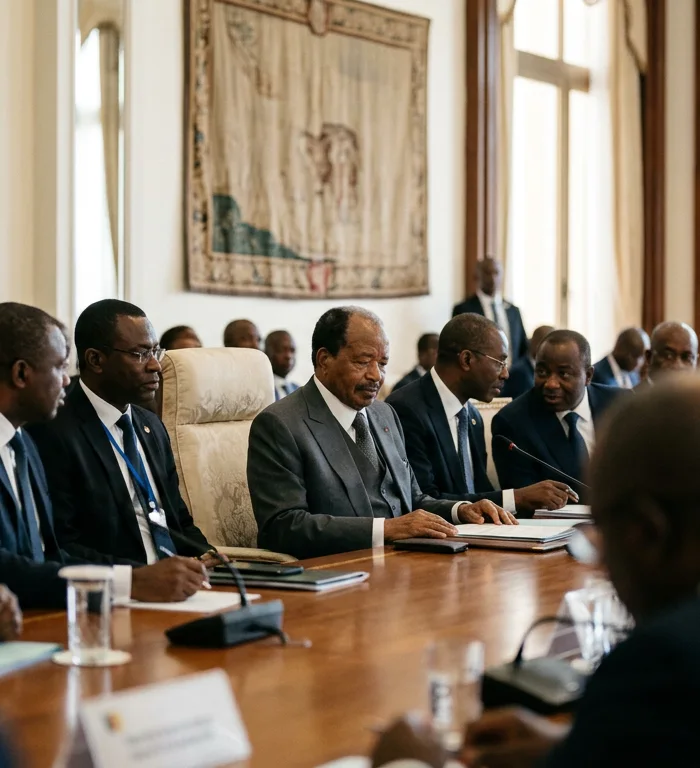
Cameroon's President Paul Biya, 93, returned to Yaounde on Aug. 20 after more than 10 weeks abroad, according to a Nov. 12 Al Jazeera news report.
The uncertainty matters because Biya has governed since 1982, while an April 14 constitutional amendment revived a vice presidency with no publicly announced appointee as of Nov. 10.
A March dispute over road rehabilitation in Yaounde, ahead of Pope Leo XIV's visit the following month, exposed tensions between central and municipal authority. Local media reports cited by Al Jazeera said the disagreement involved Housing and Urban Development Minister Celestine Ketcha Courtes and Yaounde City Mayor Luc Messi Atangana.
Cameroon's constitution gives the president broad executive authority, including defining national policy, appointing the prime minister and serving as commander-in-chief. The prime minister runs government activity within the framework set by the president.
Section 10 allows the president to delegate some powers to the prime minister, ministers or senior officials. An absence abroad does not automatically transfer presidential powers, and the government has not given a detailed public account of whether a clear delegation applies during Biya's extended absences.
Robert Besseling, CEO of intelligence advisory firm Pangea-Risk, was quoted by Al Jazeera as saying: “The political scene suffers from distinct institutional paralysis.”
Research by the Organised Crime and Corruption Reporting Project found Biya spent at least four and a half years abroad on private visits over more than three decades. Ferdinand Ngoh Ngoh, secretary-general at the presidency, received a permanent delegation of signature under a Feb. 5, 2019 decree, but Al Jazeera noted that such authority is not a transfer of presidential powers.
First Lady Chantal Biya and Biya's son, Franck Biya, are often mentioned in discussions of the presidency, according to Al Jazeera. Neither holds constitutional executive office, and claims about their influence are difficult to establish independently.
The April 14 amendment says a vice president would assume the presidency if the office became vacant through death, resignation or permanent incapacity confirmed by the Constitutional Council. If there is no vice president, an election must be held between 20 and 120 days after the vacancy, with the Senate president serving as interim leader.
Military changes added another layer to the debate. Reuters reported on Aug. 4 that three presidential decrees reshuffled senior commanders, including four of Cameroon's five joint military regions, while Cameroon continues to face separatist conflict in English-speaking regions and attacks by armed groups linked to Boko Haram in the Far North.
Opposition politician Joshua Osih criticised the constitutional amendment during April debate, saying it weakened democratic legitimacy and strengthened centralised authority, according to Focus Media Afrique. Government spokesman Rene Emmanuel Sadi told RFI in August that Biya was entitled to decide when to form a new government, while Al Jazeera said the presidency did not respond to its request for comment.
Source: news report, Al Jazeera, Nov. 12.
More stories
- Germany faces integration gaps with 30% migration-background share
- Vance's Iran role shifts as Trump favors blockade pressure
- EU defence start-ups face two funding gaps, MEPs warn
- China rejects US spy claims in Nvidia-linked tech fight
- Italy lower house advances vaccine-sceptic medic return bill
- US envoys pursue Ukraine peace talks in Moscow with Putin
- Serbia records higher turnout as students challenge Vucic
- French unions call more protests after nationwide marches
Latest news
- Japan & Asia: Zelda remake tops Japan boxed sales with 537,041
- Sudan gold revenue reaches $3.5bn without price relief
- ADNOC L&S lifts 2026 profit outlook to $4bn
- EU receives 12.89 million tonnes of Russian Arctic LNG before ban
- How did a $4 trillion company miss it?
- UK GDP rises 0.7% as tech services lead third-quarter growth