AI regulation fight puts Trump against AI safety warnings
President Trump rejected tighter AI regulation, siding with data center expansion as public resistance to AI infrastructure grows.
Mateo Fernandez ·
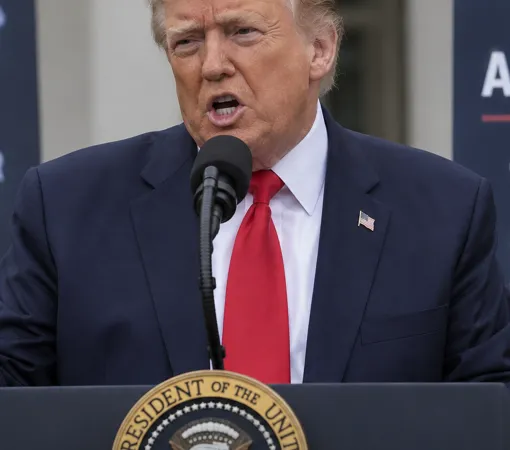
President Trump rejected tighter AI regulation Monday, saying AI could drive 20-25 years of growth if data centers keep expanding.
The president used Truth Social posts and a public call with Nvidia CEO Jensen Huang to argue that federal limits would damage US companies and benefit China. His comments put the White House on the opposite side of some AI executives who have called for more safety checks on advanced systems.
Trump casts AI as China race
Trump wrote that artificial intelligence needed presidential leadership rather than new federal guardrails, and he described organized resistance to AI and data centers as a conspiracy. He said regulation could push companies toward financial distress, an argument he tied to US competition with China.
On a call with Huang during a Los Angeles technology summit, Trump called AI “the oil of the next 20-25 years” and said it was larger than the internet. He also dismissed warnings about machine control, saying: “The robots will not be taking over. The AI will not be taking over the rest of the world. The whole thing is a hoax.”
Trump added that the administration still had to be careful, but said caution should not stop the industry. That framing treats AI infrastructure as an economic asset first, with safety risks handled through selective intervention rather than broad rulemaking.
Safety camp cites slower rollout
Anthropic CEO Dario Amodei has been one of the industry leaders urging a slower pace for the most advanced AI tools. In a post on his personal blog, he called for coordination among democratic countries and for embedded third-party safety evaluators.
Amodei wrote that an extra year or two before models reach critical capability levels could reduce the risk that “something goes seriously wrong,” if the time were used to improve alignment. Trump singled out Amodei in his posts and said the administration had acted against some AI leaders or companies before when it opposed their conduct.
The divide is not only technical. Vice President JD Vance has said the administration should “regulate smartly,” while expressing skepticism toward companies that ask Washington for additional safeguards. He described some industry appeals for regulation as feeling like “a Trojan Horse.”
Data centers test local consent
The political pressure is building outside Washington as data centers move from abstract AI capacity to local land, power and water disputes. A March Gallup poll cited in the source material found nearly half of respondents strongly opposed local AI data center construction, compared with just under 40% of Republicans.
Those figures give the issue a bipartisan edge ahead of November’s midterm elections. They also create a practical constraint for AI companies: even if federal rules remain light, local permitting and utility capacity can slow projects that need large computing clusters.
Nvidia call shows company exposure
Huang’s role underscored the stakes for Nvidia, whose chips are central to AI data center buildouts. He put Trump on speakerphone at the Los Angeles event, giving the president a friendly venue to defend the industry in front of technology investors and executives.
For Nvidia, a lighter federal approach would support a clearer path for AI infrastructure spending, provided data center projects can secure power and local approvals. For Anthropic, the immediate risk is different: its public safety position now sits in open tension with a White House message that treats broad AI warnings as politically suspect.
If Trump’s approach holds, the macro effect would be to keep US policy focused on investment, compute capacity and competition with China. Nvidia would remain positioned around demand for AI hardware, while the broader sector would face more fights at the state, municipal and utility level.
If public resistance and safety warnings gain ground instead, the mechanism would be slower approvals, more third-party testing and tighter coordination among allied governments. That path would likely raise compliance burdens for AI labs, temper the pace of data center construction and shift the industry toward formal safety verification.
The open questions are whether Congress, state regulators or local governments move faster than the White House, and whether AI companies keep pressing for rules after Trump’s rebuke. The answer will shape how quickly the US builds AI infrastructure, how Nvidia and AI labs manage political risk, and how Washington frames the technology race with China.