

FCC approves prison cellphone jamming despite 2.5-mile warning
Wireless carriers warn the rule may disrupt emergency calls and networks outside facilities, while prison officials say contraband phones fuel crime.
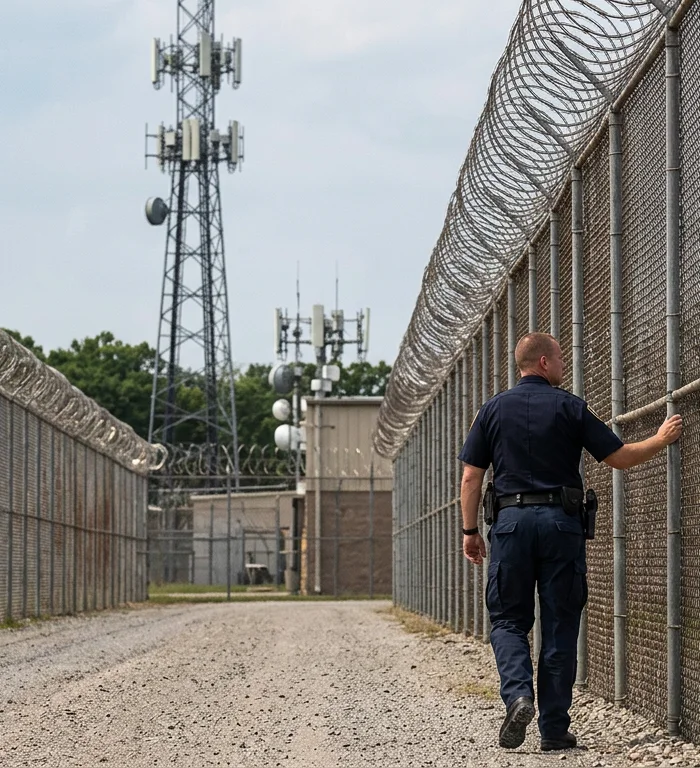
Federal Communications Commission voted Nov. 19 to authorize state and local prisons and jails to use targeted jamming against contraband cellphones, according to FCC meeting materials and statements.
The order creates an exception to a jamming ban Commissioner Anna Gomez said had constrained non-federal actors for 90 years, while CTIA said in an Oct. 1 filing that test interference reached 2.5 miles.
CTIA, the wireless industry lobby group, told the FCC a pilot with Virginia Tech Applied Research Corporation and the South Carolina Department of Corrections showed the micro-jamming system “blocked 911 calls” and “caused interference that impacted wireless network infrastructure up to two and a half miles away.”
The same CTIA filing said outdoor recreation-area scenarios left calls from targeted contraband devices connected in one-half to two-thirds of attempts. CTIA said the test showed current jamming technology is “both over and underinclusive at once.”
FCC Chairman Brendan Carr said the technology can now be aimed with “geographic precision” and that no facility will be required to use it. “Today, we are finally authorizing state and local prisons and jails to use targeted jamming against contraband cell phones for the first time,” Carr said.
Carr said contraband phones enter prisons “by the thousands each year” and cited estimates that as many as 500,000 inmates nationwide regularly access such devices. He said the phones have been used to organize scams, drug trafficking and violent attacks.
The Communications Act bars willful or malicious interference with licensed or authorized radio communications. The FCC previously interpreted that provision to prevent non-federal entities from using jamming technology against contraband devices in prisons; the new order carves out state and local correctional facilities.
Carr said prisons seeking to deploy the systems must apply to the FCC, describe their deployment plans and show through testing that the jamming stays within the designated area. He said nearby communities will receive notice before operations begin.
Supporters included prison phone companies ViaPath and NCIC Correctional Services, the National District Attorneys Association, the Correctional Leaders Association and the National Association of Police Organizations. The police group said inmates use contraband phones to coordinate attacks, riots and deliveries of drugs and weapons.
Gomez, the only Democrat on the three-member commission, voted for the order after safeguards were added but partially dissented. She said jamming can block 911 calls and public-safety networks, and said the FCC should have made clear that families of incarcerated people should not pay for jamming through higher calling-service charges.
The order could face a court challenge. CTIA has said the FCC “has no authority to allow jamming” under the Communications Act, and AT&T said in December 2025 comments that jammers cannot distinguish contraband phones from legitimate devices on the same spectrum bands.
Freedom of the Press Foundation Chief of Advocacy Seth Stern urged the FCC to consider that contraband phones can document abuse inside prisons. In a letter included in the FCC docket, Stern cited footage used in the film The Alabama Solution and in legal scrutiny of Alabama prisons.
Source: FCC meeting materials, FCC filings and Ars Technica, Nov. 20, 2026
More stories
- Congress tests Black Democrats' growing policy influence
- Cotton faults Lutnick over AI chips allegedly sent to China
- Vance declines to back Iran strikes as Trump defends war
- Paul seeks 20%-30% federal credit for U.S. film shoots
- Trump targets data centers abroad with tax threat to firms
- Cao faces Senate scrutiny over $32.5m-a-day Iran blockade estimate
- Pentagon plans for limited Iran ground operation
- Colombian economy struggles despite high oil prices
Latest news
- Russia strikes Ukraine as Odesa faces electricity strain
- Bahrain reports two injuries after Iranian aerial attacks
- Baltic responders fight Sparta II fire after drone strike
- Dietitians advise small swaps for plant-based eating
- Europe faces attribution gap after 16 cyber, physical incidents
- Young adults overestimate life insurance costs by 10 times
- Estonia to close 5 Russia road crossings for six months
- Greece targets 2.3% growth in 2027 budget