

UK’s 600-troop drop tests Europe’s rapid-reaction burden
The Germany exercise puts NATO readiness and drone-era airborne tactics back before Washington defense planners.
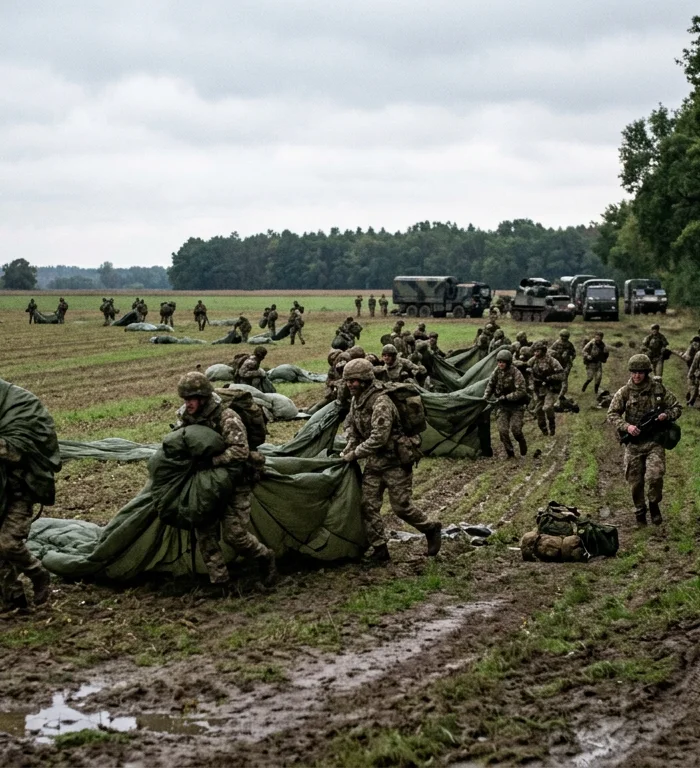
The British Army parachuted about 600 soldiers from 3rd Battalion The Parachute Regiment into Germany at the end of a seven-week exercise, according to a secondary news report.
The drill matters in Washington because it offers a live allied test of rapid-reaction forces against drone-equipped opponents, a capability the Pentagon and Congress are pressing European NATO members to strengthen.
The report said the British troops fought a mock force using drones, placing the exercise inside the tactical problem now shaping Western land warfare: how light forces move, concentrate and survive when small unmanned systems can spot and strike exposed formations.
For the White House and Pentagon, the exercise is less about ceremony than lift, readiness and survivability. If European allies can deploy airborne forces quickly and operate against drones with limited U.S. support, Washington has more room to reserve scarce airlift, electronic-warfare and command assets for other theaters.
The U.S. debate is also political. Members of Congress in both parties have pressed NATO allies to carry more of the conventional defense burden in Europe as U.S. planners give greater weight to China and the Indo-Pacific.
The British Army
The supplied report does not say whether U.S. aircraft, electronic-warfare units or command-and-control assets supported the British drop. That distinction matters: an allied airborne force that can jump without U.S. help is a different strategic asset from one that still depends on American enablers to enter contested airspace.
The drone element is the harder test. Airborne units are designed to arrive fast, but Ukraine has shown how drones can make visible troop concentrations, landing zones and vehicle columns vulnerable within minutes. The British exercise suggests NATO armies are adapting training around that risk, but the report does not provide enough detail to judge whether the force defeated drones, avoided them or simply trained under simulated pressure.
If the exercise shows British airborne troops can deploy, disperse and fight under drone surveillance, Pentagon officials could use it as evidence that European allies are improving frontline deterrence. That would support arguments for shifting some U.S. enabling capacity toward Indo-Pacific requirements.
If the lesson is instead that British forces still need American airlift, intelligence or electronic-warfare cover for a contested insertion, the burden-sharing case weakens. In that scenario, European airborne drills remain useful for readiness, but less persuasive as proof of standalone deterrence.
The next measurable test is whether Pentagon posture documents or NATO defense ministerial readouts by June 15, 2025, identify European-led rapid-reaction commitments that do not rely on dedicated U.S. airlift enabling units.
More stories
- Eisenkot secures first coalition deal but lacks majority
- Germans oppose Ukraine aid as poll shows support slipping
- Kim Jong-un receives 10 envoys after constitutional shift
- Ukraine claims Libya strike sinks Russian naval corvette
- COP31 climate talks collapse over fossil fuels and funds
- Russian military faces 1,087 recorded suicides in Ukraine war
- DR Congo starts Ebola vaccine trial in 9,700-case outbreak
- EU faces Vietnam rights pressure over $57.9bn trade gap
- Otzma Yehudit gains ground with 8 seats before Israel vote
- Philippine House passes under-13 social media curbs
Latest news
- Trump prepares tariffs on China and other major exporters
- New-car buyers pay record average $50,087 in October
- Banks face ECB reserve debate over liquidity and profits
- Investors see Anthropic debut gains fade below $83 a share
- Iraq orders federal control over Kurdish-area oilfields
- Nvidia shares retreat as AI rally cools before PCE data