

EU faces Vietnam rights pressure over $57.9 bn trade gap
To Lam’s Brussels visit highlights Europe’s expanding Vietnam relationship and scrutiny over labor pledges, repression claims and a widening EU goods deficit.
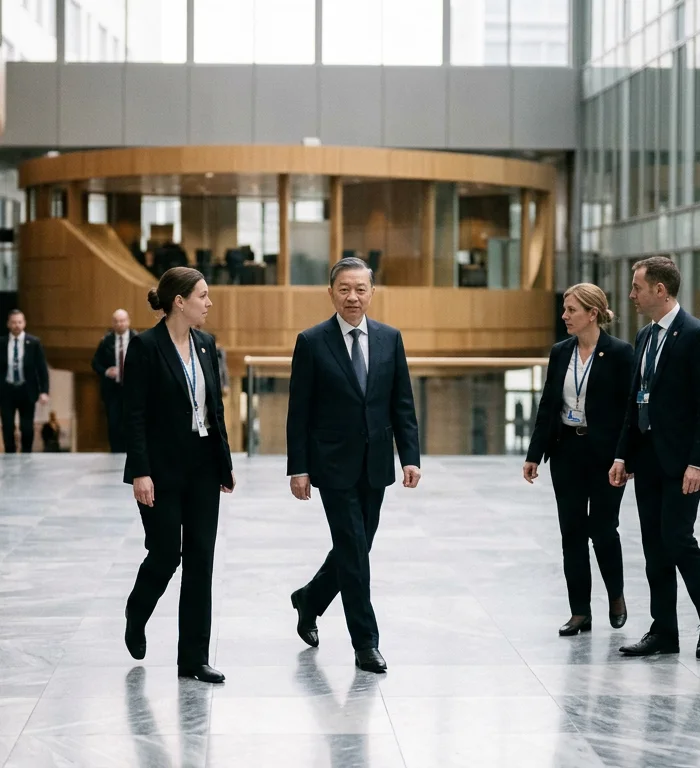
Vietnamese President To Lam arrived in Brussels on Wednesday for EU and Belgian talks, a Deutsche Welle article reported Oct. 22, as EU-Vietnam goods trade reached €76 billion in 2025.
The article said the EU’s goods-trade deficit with Vietnam reached €51.7 billion ($57.9 billion) in 2025, more than double roughly €24 billion in 2019 and equal to about 68% of total goods trade, according to Atlas360 calculations.
The visit followed Vietnam’s Oct. 18 free-trade agreement with the European Free Trade Association, which includes Norway, Switzerland, Iceland and Liechtenstein, according to the DW article. It also came more than six years after the EU-Vietnam Free Trade Agreement took effect in August 2020.
Khac Giang Nguyen, a visiting fellow at the ISEAS–Yusof Ishak Institute in Singapore, told DW that the relationship "is a welcome advertisement for keeping markets open" during global tariff disputes.
"This is a win-win for both sides," Nguyen said. "Vietnam offers Europe an established manufacturing base and another foothold in Asian supply chains. Europe offers Vietnam capital, technology and a large market, helping Hanoi reduce its exposure to American demand and Chinese industrial inputs."
Vietnam now ranks as the EU’s largest goods-trading partner in Southeast Asia and its 14th-largest globally, the DW article said. For Vietnam, the EU is its fourth-largest trading partner and a major source of foreign investment.
Diplomatic and security ties have advanced alongside commerce. The EU and Vietnam upgraded relations in January to a Comprehensive Strategic Partnership, the first such EU arrangement with a Southeast Asian country. EU foreign policy chief Kaja Kallas met Vietnamese Foreign Minister Le Hoai Trung on Wednesday to discuss security cooperation, including the South China Sea, where Vietnam has territorial disputes with China, according to the article.
Rights groups are urging Brussels to tie closer cooperation to political and labor changes. In an open letter sent this week to European Commission President Ursula von der Leyen and European Council President Antonio Costa, 12 international human rights organizations raised "grave concerns over the Vietnamese government's intensifying repression" and called for EU pressure on reforms.
Vietnam remains a one-party communist state that restricts political opposition, independent journalism and civil society, the DW article said. Rights organizations cited by DW said repression has grown under To Lam, who previously led Vietnam’s public security ministry.
Labor commitments are another fault line. During EVFTA negotiations and related political talks, Hanoi accepted obligations covering human rights, worker protections and environmental standards. Those included changes to allow independent worker organizations and closer alignment with International Labour Organization standards, according to the article.
Rights groups say Vietnam has not met those pledges. The DW article said Hanoi has not ratified the ILO convention on freedom of association and that independent trade unions remain prohibited. "The EU has taken no action in response to Vietnam's repeated breaches of its EVFTA-related obligations and pledges; instead, in January it upgraded bilateral relations," the rights organizations wrote in the letter.
Trade gains have also been uneven, according to researchers cited by DW. Hai Thiem Bui, a researcher at the Stockholm Center for Global Asia at Stockholm University, told DW that larger foreign-invested manufacturers and established exporters have been better able to use tariff cuts than smaller Vietnamese firms facing complex EU requirements.
Vietnamese exporters also face EU rules including the Carbon Border Adjustment Mechanism, a levy system tied to emissions in some imports, and deforestation regulations requiring supply-chain information. "The next phase of EU-Vietnam trade relations is likely to depend less on tariff liberalization and more on whether Vietnam can adapt to increasingly demanding EU standards concerning labor rights, sustainability, and regulatory governance," Bui said.
The widening deficit has become more visible as Brussels seeks stronger economic security and export opportunities for EU industries, according to the DW article.
More stories
- DR Congo starts Ebola vaccine trial in 9,700-case outbreak
- Makura cites 50 AfCFTA ratifications in Africa image challenge
- Indonesia cuts Singapore gas exports by 31m cubic feet a day
- Taiz hospital cuts dialysis sessions to 2.5 hours
- Lebanese doubt Oct. 27 Israel vote ends south Lebanon presence
- Kenya records second Ebola death in first outbreak
- WHO backs Kenya Ebola response after second case
- Bunia health teams rebuild trust after 4,000 Ebola deaths
Latest news
- Grok picks Republicans in 92% of forced API election prompts
- Bihar presses lenders over 38.25% credit-plan progress
- Berkshire shares set records after Buffett succession selloff
- MTCH2 blockade reduces fat-cell formation in early lab work
- Kotak Mahindra Bank posts 26% profit gain
- CDC counts 4,588 US measles cases in 2026
- FICCI seeks Dutch manufacturing investment after $58.1bn FDI
- Macklemore repeats Palestine call in 17-song Red Rocks set