

Taiz hospital cuts dialysis sessions to 2.5 hours
Republican Hospital officials say fuel and medical-supply shortages threaten care for 270 dialysis patients in Yemen’s government-held city.
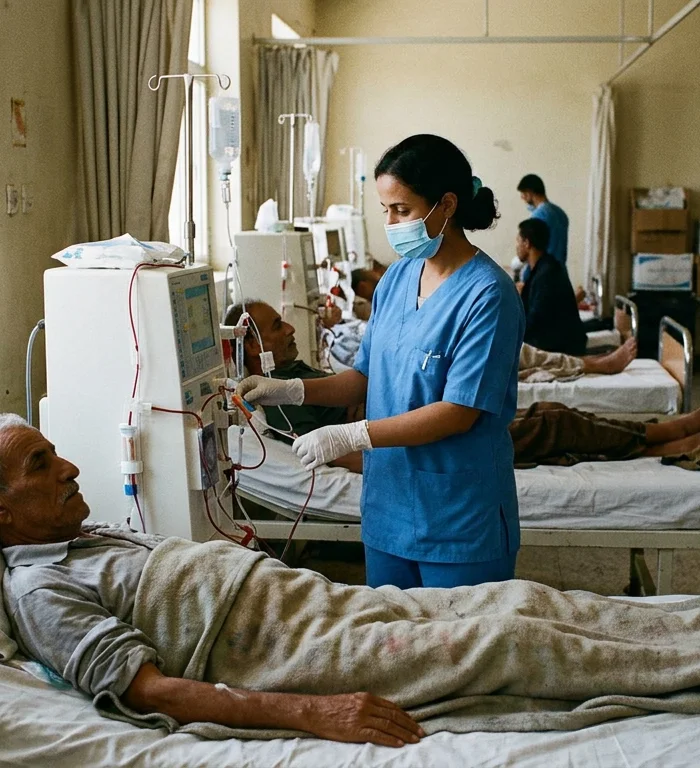
Republican Hospital in Yemen’s Taiz has cut dialysis sessions for 270 regular patients to two and a half hours, its dialysis centre director told Al Jazeera in a report published Oct. 24.
The reduction from four hours shows how the renewed Houthi siege is straining healthcare in the government-held city, where the WHO said 42 facilities reported severe shortages and hospitals need 156,000 litres of fuel a month.
Dr Essam Mahyoub Dahan, director of the dialysis centre, said a full shutdown could come within days. “Because of the siege and the shortage of diesel and medical solutions, we have recently been forced to reduce dialysis sessions from four hours to just two and a half,” Dahan told Al Jazeera.
“We know this is not adequate, but we have no choice if we are to keep the centre operating for as long as possible before it shuts down completely,” he said.
The centre depends on specialised dialysis solutions that are normally supplied by Yemen’s Ministry of Health every three months, according to the report. Dahan said stocks were near exhaustion after a delivery due earlier in October did not arrive because of the siege.
Taiz’s health office said in an Oct. 12 statement that 1,110 kidney-failure patients across the governorate rely on dialysis services. It said hospitals in the governorate collectively provide about 210 dialysis sessions a day.
The city was under a complete Houthi siege between 2015 and 2016 during the early years of Yemen’s war. The latest restrictions began in the first week of October after Houthi advances in the Taiz countryside, Al Jazeera reported.
Fuel is central to the hospital system because much of Taiz’s power infrastructure has not been restored after 11 years of war. Dr Shaheed al-Ameri, Republican Hospital’s deputy director-general for technical affairs, said the hospital had no reserve diesel and was buying fuel almost daily on the black market at five times the pre-siege price.
Al-Ameri said some hospital departments, including essential units, had already stopped operations. “If this situation continues much longer, we fear we will reach a complete and comprehensive collapse of healthcare services,” he told Al Jazeera.
The WHO warned on Oct. 22 that shortages of fuel, oxygen, medicines and medical supplies were disrupting lifesaving care across Taiz governorate. It said diesel shortfalls also threaten oxygen production, water pumping, vaccine refrigeration and sanitation services, increasing disease risks for displaced families and other vulnerable groups.
Amnesty International on Thursday called on the Houthis to reopen roads into and around Taiz. It said the closure of the main road between Taiz and Aden threatened hundreds of thousands of civilians with reduced access to food, water and healthcare.
The supplied report did not include a Houthi response to the allegations or an independent verification of hospital stock levels. The immediate risk described by doctors is that shorter dialysis sessions may leave patients without enough treatment before fuel and supplies are replenished.
More stories
- Lebanese doubt Oct. 27 Israel vote ends south Lebanon presence
- Kenya records second Ebola death in first outbreak
- Taiz's Republican Hospital warns 270 dialysis patients face shutdown
- Singapore regulator finds 65 harmful apps, 24 wrongly rated
- Democrats tie Iran war to $4.27 gasoline in midterm races
- Biya faces Cameroon succession pressure after 74-day absence
- Brazil election race tightens as court crisis deepens anew
- US-China talks lift tone before Trump-Xi summit this week
Latest news
- France to deploy 70,000 police before Saturday protests
- Estonia protects 15 shipwrecks in Baltic heritage push
- UAE leads AI adoption with 73.3% working-age use
- American Express to cut 3,500 jobs in restructuring tied to AI
- Flow Games raises $49 million as labor and safety pressure builds
- Jio Platforms draws 22.19 times bids for IPO