Trump’s 2028 Joke Reopens the Republican Succession Question
Donald Trump joked about a 2026 White House run, sparking debate over constitutional term limits and the Republican Party's ongoing succession race.
Atlas Newsdesk ·
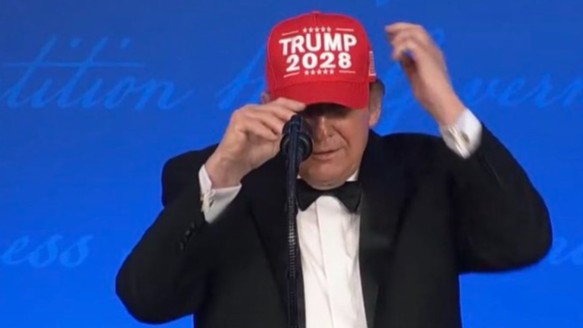
President Donald Trump used the closing stretch of an hourlong speech to joke about entering another presidential contest, placing a red “Trump 2028” cap on his head as he addressed journalists at the White House Correspondents’ Association dinner in Washington. His wording framed a future victory as his fourth, reflecting his continued insistence that he also prevailed in the election he officially lost in 2020. The remarks were delivered sarcastically as part of a performance filled with jokes, insults and comments about the news media, rather than through a campaign event or formal filing. The distinction is central: Trump generated a headline about another run, but he did not establish a viable candidacy or produce any legal mechanism that would allow one.
The Joke Followed April Gunfire
The setting added weight to a line that otherwise belonged to a comedy routine. The July 24 dinner was a replacement for an April gathering disrupted when an armed attacker opened fire near the original venue, forcing Trump, administration officials and other guests to evacuate; the rescheduled event moved to Washington’s Waldorf Astoria and operated under tighter security. Organizers reduced attendance to roughly 700 people, required guests to pass through two identification checks and eliminated the traditional red carpet and preliminary receptions. Trump opened by praising the decision to hold the event again, then shifted into a long, frequently improvised address that alternated between respect for individual reporters and familiar attacks on journalists, politicians and celebrities.
Two Elections Set the Limit
The constitutional obstacle is direct. The 22nd Amendment states that no person may be elected president more than twice, and Trump has already secured two certified victories: 304 electoral votes in 2016 and 312 in 2024. That language prevents him from simply appearing as a conventional candidate for another election under the rules governing his previous campaigns. Although constitutional scholars have debated unusual succession scenarios because the amendment specifically addresses election to the presidency, such theories offer no straightforward route to a third elected term and would almost certainly produce immediate litigation. The operative political fact is therefore unchanged by the dinner speech: a cap, a slogan or a declaration from a stage cannot remove a constitutional restriction.
The 2020 Claim Returns
Trump’s use of “fourth” rather than “third” is tied to his refusal to accept the certified outcome of the 2020 contest. National Archives records show Joe Biden received 306 electoral votes that year, compared with 232 for Trump, making Biden the lawful winner and ending Trump’s first administration in January 2021. Trump later returned to power after defeating Kamala Harris in 2024, when he won 312 electoral votes against her 226, but that victory did not retroactively alter the previous result. By counting 2020 as one of his successes, Trump converts an unsupported election claim into a recurring political device—one that reinforces loyalty among supporters who share his view while forcing Republican officials to decide whether to challenge the premise or treat it as humor.
Republicans Face a Succession Test
The immediate audience for the joke extends beyond the journalists in the ballroom. Republican donors, campaign professionals, elected officials and potential 2028 contenders must prepare for a presidential race while operating inside a party that remains closely identified with Trump and his political organization. Repeated references to another run can discourage would-be successors from moving too early, keep fundraising and media attention centered on the president, and give Trump leverage over anyone seeking his endorsement. That does not require an actual campaign: ambiguity itself can protect his influence by making every Republican contender answer questions about loyalty, continuity and whether the party’s future should be defined by Trump personally or by a candidate promising to preserve his agenda. That strategic effect is an inference from the party dynamics surrounding the remark, not evidence that Trump has begun a lawful bid.
Changing Article V Math
Removing the term limit would require an undertaking far beyond a presidential announcement. Article V allows Congress to propose a constitutional amendment with approval from two-thirds of both chambers, after which three-fourths of the states must ratify it; an alternative route begins with applications from two-thirds of state legislatures and leads to a convention, but that method has never produced an amendment. The president has no formal power to enact such a change alone, and an executive order, party resolution or campaign promise could not substitute for ratification. Achieving those supermajorities before the next presidential election would demand a national coalition reaching well beyond Trump’s political base, making repeal a remote prospect under present conditions.
No Filing, Plenty of Ambiguity
The practical signals now matter more than the punchline: campaign registration, fundraising documents, ballot litigation, congressional action or organized pressure for a constitutional amendment would indicate movement beyond political entertainment. Trump’s current Federal Election Commission profile continues to identify his 2024 campaign organizations and reporting period, rather than displaying a new presidential operation for 2028. The greater uncertainty is whether he will keep using the idea to dominate coverage and shape the Republican nomination, particularly as potential successors begin building alliances before the contest formally develops. For now, the dinner remark changes neither Trump’s constitutional eligibility nor the certified history of the three elections he has contested; its consequence lies in keeping the party, the press and prospective candidates focused on a race he cannot ordinarily enter.