

Trump puts China in nuclear talks as 2026 treaty cliff nears
His comments put pressure on State and NSC officials to define whether any post-New START framework must include Beijing.
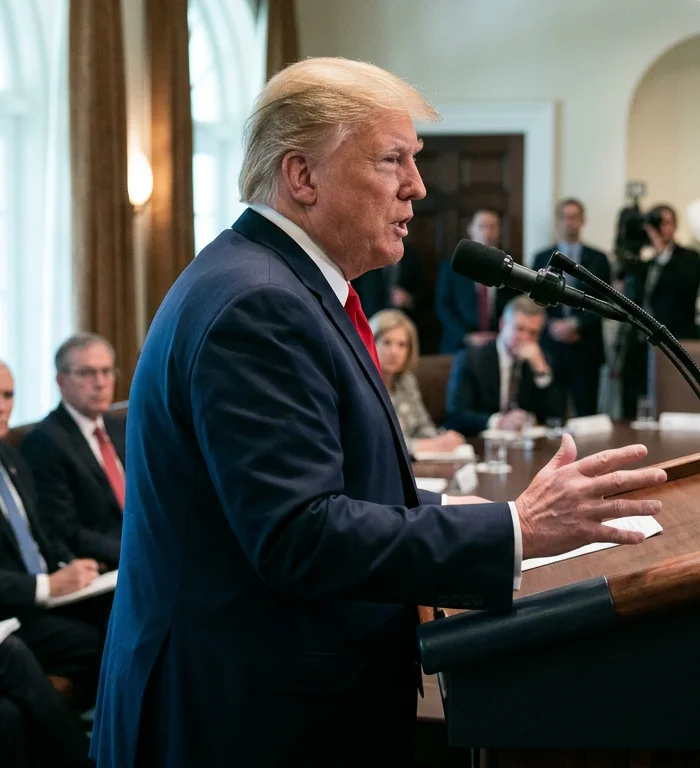
President Trump put China and Russia at the center of his nuclear nonproliferation agenda at a recent press conference, tying the issue to talks on limiting arsenals before New START lapses in February 2026.
The deadline matters because the U.S.-Russia treaty’s expiration would leave the two powers without legally binding limits on deployed strategic arsenals for the first time since 1972.
Trump also turned to a personal reference, saying he was “genetically blessed” because of his family connection to the Massachusetts Institute of Technology while discussing nuclear power and weapons. Video from the event showed Vice President JD Vance and Secretary of State Marco Rubio smiling while Trump spoke.
The policy signal for Washington is less the phrasing than the pairing of Moscow and Beijing. During Trump’s first term, his arms-control team conditioned talks with Russia on bringing China into the process, an effort Beijing rejected on the grounds that its nuclear arsenal was far smaller than those of the U.S. and Russia.
That gap is narrowing in U.S. defense planning. Pentagon China Military Power reports have estimated that Beijing has surpassed 500 operational nuclear warheads and is on track to field more than 1,000 by 2030, shifting debate in Washington toward deterrence against two nuclear peers.
For the White House, the next practical test is whether the National Security Council and State Department frame any New START replacement as a bilateral U.S.-Russia channel or as a trilateral negotiation that includes China. The Pentagon’s role would be to translate either path into force-planning requirements, while Congress would press for details on verification, warhead ceilings and compliance.
If the administration predicates talks with Moscow on China’s participation, the global effect would be to slow any replacement framework while testing whether Beijing accepts formal limits. If Washington instead opens a bilateral strategic-stability channel with Moscow, it could preserve a narrower arms-control track while leaving the larger U.S.-China nuclear buildup outside binding limits.
More stories
- Germans oppose Ukraine aid as poll shows support slipping
- Kim Jong-un receives 10 envoys after constitutional shift
- Ukraine claims Libya strike sinks Russian naval corvette
- COP31 climate talks collapse over fossil fuels and funds
- Russian military faces 1,087 recorded suicides in Ukraine war
- US faces China, Russia in Africa minerals contest
- Middle powers pursue trade links beyond Trump diplomacy
- South Africa's preschool subsidies face repair-cost barrier
- Japan faces ASEAN doctrine test after Fukuda dies at 90
- Palm oil buyers face EU deforestation risk from Dec. 30
Latest news
- Trump prepares tariffs on China and other major exporters
- New-car buyers pay record average $50,087 in October
- Banks face ECB reserve debate over liquidity and profits
- Investors see Anthropic debut gains fade below $83 a share
- Iraq orders federal control over Kurdish-area oilfields
- Nvidia shares retreat as AI rally cools before PCE data
- Macy’s parade faces balloon limits as storm winds approach