

Palm oil buyers face EU deforestation risk from Dec. 30
Euronews cited Indonesian investigations linking major consumer brands to a Central Kalimantan plantation where deforestation signs were identified in 2024.
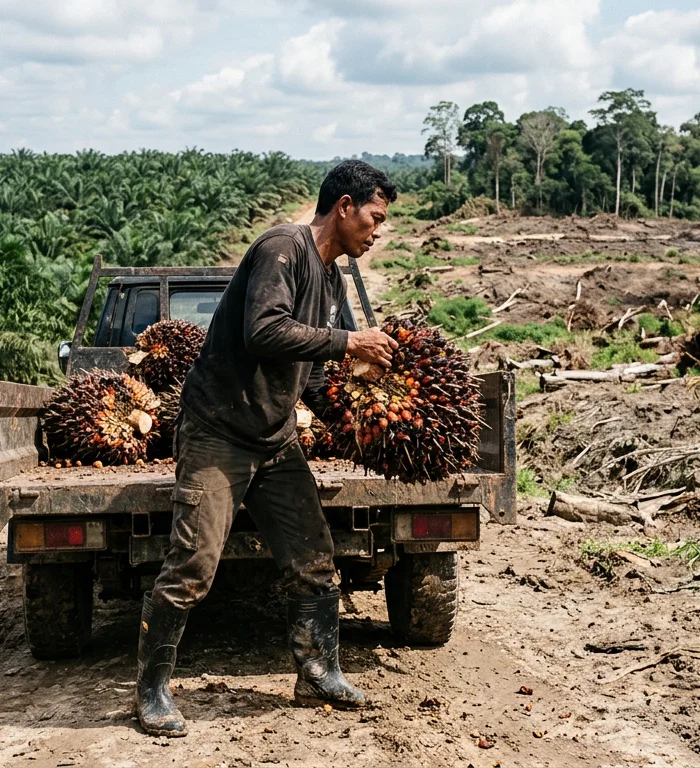
EU suppliers of seven commodity groups face new market-access risk on Dec. 30, 2026, when the bloc's deforestation law starts, Euronews reported in an Oct. 30, 2026, article citing Indonesian investigations.
The law covers cocoa, coffee, soy, palm oil, wood, rubber and beef, and uses Dec. 31, 2020, as the cut-off date for deforestation, making the 2024 Indonesian findings a potential compliance test.
The investigations by Indonesian environmental organisations and government authorities said some of the world's biggest consumer-goods companies risk breaching the EU rules through palm oil sourced from Indonesian plantations accused of illegal activities, according to Euronews.
Environmental groups WALHI Kalteng, TuK Indonesia and Sawit Watch traced palm oil supply links between plantations in Indonesia's Central Kalimantan province and international consumer brands, the article said. Companies identified as recent buyers from the plantation included PepsiCo, Unilever, Ferrero, Mondelez and Procter & Gamble.
The investigation identified signs of deforestation in 2024 at PT Karya Makmur Abadi, a palm oil plantation owned by KLK Group, according to the article. That timing matters because the EU rules bar products tied to forest clearance after Dec. 31, 2020, from the bloc's market.
The reported findings indicate a risk that palm oil from land cleared after the EU cut-off date could enter the EU market. They did not establish that every named company has violated the law, and the supplied article did not include responses from the named consumer-goods companies.
Achmad Surambo, executive director of Sawit Watch, said major European palm oil buyers had not adequately controlled their exposure to deforestation and environmental damage. "Indonesian communities want immediate and strong enforcement of European supply chain sustainability regulations,” Surambo said.
Perrine Fournier, a trade and forest campaigner at Fern, said the Indonesian findings show the country's palm oil industry "remains tainted by illegality," according to Euronews. The article described the investigation as raising questions about whether the EU will enforce the law as planned.
The measure has faced repeated political delays after concerns about administrative costs, traceability requirements and burdens on businesses and trading partners, Euronews said. Countries that produce covered goods, including Brazil, Indonesia, Malaysia, Colombia, Ghana and the United States, have lobbied Brussels to reconsider the law.
US Ambassador to the EU Andrew Puzder criticised the law as over-regulation, selective protectionism and an unnecessary non-tariff trade barrier, according to the article. That opposition places the regulation at the intersection of environmental policy, corporate supply chains and trade relations.
The scope is broader than palm oil. Any supplier of the seven covered commodity groups must prove that goods entering the EU are not linked to deforestation, making the rule a due-diligence requirement as well as a market-access condition.
Indonesia has lost forests because of illegal logging, mining, new oil palm plantations and slash-and-burn land clearing, Euronews said. Environmental activists cited in the article warned that clearing forests for agricultural production, including palm oil, can leave land more exposed to fire.
Dec. 30 enforcement test
On Dec. 30, 2026, the EU deforestation rules are scheduled to apply after repeated delays. The observable issue is whether Brussels enforces the traceability and proof requirements for the seven covered product groups as written.
The Dec. 31, 2020, cut-off date is the threshold regulators and companies must use when assessing land clearance. The Indonesian case cited by Euronews turns on alleged deforestation signs in 2024, after that cut-off.
Source: news article, Euronews, Oct. 30, 2026
More stories
- Singapore caps private-hire car loans at 60% to 70%
- Japan faces ASEAN doctrine test after Fukuda dies at 90
- Undocumented learners face South Africa matric barriers
- CIR places 25 Sudan commanders at reported sexual-violence sites
- Brent heads for fourth monthly gain as Middle East risk persists
- European coffin makers seek EU case with ranks down to 90
- Ethiopia's coffee sector faces $453m EU export risk
- EU faces Vietnam rights test over $57.9bn trade gap