

Ethiopia’s coffee sector faces $453m EU export risk
ODI Global warns compliance gaps could exclude up to 60% of smallholders from a market taking about 30% of Ethiopia’s coffee exports.
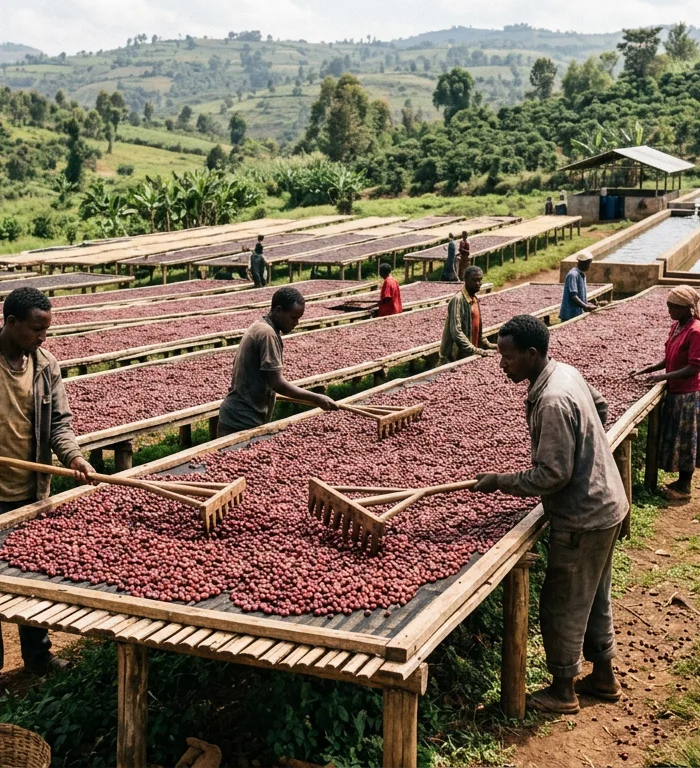
Ethiopia's coffee industry risks as much as $453 million of export income if EU deforestation rules shut non-compliant suppliers out of Europe, an ODI Global briefing paper published in October 2026 said.
ODI Global said the exposure matters because the EU takes around 30% of Ethiopia's coffee exports, while disruption could cut gross domestic product by as much as 0.5%.
The European Union Deforestation Regulation requires companies selling covered commodities in the bloc to prove goods are deforestation-free and lawful in the producer country. For coffee, that includes geolocation data, or plot-level coordinates, tying shipments to farms.
Ethiopia's challenge is the structure of production. About 4 million smallholder farmers produce roughly 95% of national coffee output, and many cultivate scattered plots of less than one hectare, according to the briefing paper.
By July 2024, Ethiopia had compiled geolocation data for about 200,000 hectares of coffee land out of an estimated 860,000 hectares, or around 23%. ODI Global said 57.4% of marketed coffee moves through local collectors or outside legally designated marketplaces, making farm-level tracing harder.
The paper said geolocation gaps alone could leave 10% to 20% of smallholders exposed to exclusion, while traceability failures could affect as much as 57% of supply chains. With unresolved legal documentation, ODI Global said up to 60% of smallholders could be at risk.
The Sidama Coffee Farmers' Cooperative Union told researchers it had removed 40% of its member cooperatives from EU export channels because of compliance constraints. The Oromia Coffee Farmers' Cooperative Union had collected geolocation data for 92,000 of more than 557,000 member farmers, the paper said.
ODI Global estimated gross EU-destined revenue losses at about $160 million if 20% of supply is excluded, rising to $453 million at 57% exclusion. If all displaced coffee is sold elsewhere, lower prices in alternative markets could still leave net losses of about $42 million to $118 million, it said.
Europe is not Ethiopia's only coffee market. The briefing paper said Asia accounts for about half of exports, compared with 28% for Europe and 12% for the U.S., while China's imports reached 9,470 tonnes worth $65.49 million in the first quarter of the 2025/26 fiscal year, according to the Ethiopian Coffee and Tea Authority.
The economic stakes extend beyond farmers. Coffee accounts for about 35% of Ethiopia's merchandise export earnings, and ODI Global said disruption could reduce foreign-exchange earnings by 2.2% to 6.3%, or 8.5% in a severe scenario involving traceability and geolocation failures.
The paper also questioned whether exclusion would advance the regulation's environmental aim. Citing European Forest Institute data, it said no more than 20 coffee plots were linked to deforestation after 2020, while garden, semi-forest and forest coffee systems dominate Ethiopian production.
Ethiopia welcomed the European Council's decision in October 2024 to delay implementation by one year. The paper said Ethiopia's Coffee Traceability Management System is intended to follow coffee from production plots through processing and export, but researchers said its effectiveness remains uncertain while data collection, land registration and supply-chain integration remain incomplete.
Large operators face the implementation deadline in late 2026 under the phased timetable examined by ODI Global, making traceability, geolocation coverage and legal-compliance evidence the main indicators to monitor.
Smaller enterprises face their implementation deadline in mid-2027 under the same timetable, with smallholder inclusion in EU-bound supply chains dependent on compliance support and buyer acceptance.
Source: ODI Global briefing paper, October 2026; Addis Standard via AllAfrica, Oct. 22, 2026.
More stories
- EU faces Vietnam rights test over $57.9bn trade gap
- Albania lawmakers clash over policing of student protests
- Policy Alert seeks Nigeria hearing over $50bn offshore plan
- WHO rejects Nigeria outbreak label after 1 imported Ebola case
- Cali Fund collects just $7,085 toward $1bn nature goal
- Singapore prepares grid for up to 6.5% annual demand growth
- Under-50 bowel cancer rates rise across 27 regions
- Syria's 20,000 Uyghurs face postwar suspicion, Feng says
Latest news
- Gemini flags 69% of held-out thermal-video falls
- Obakulactone reduces joint swelling in arthritis-model rats
- Congress faces Supreme Court rulings with control at stake
- Lockheed Martin sets F-35 framework for at least 850 jets
- Anthropic reports $80.7 billion loss ahead of planned IPO
- Ronson and Remi gather 11 acts for Amy Winehouse tribute