

Lockheed Martin sets F-35 framework for at least 850 jets
Lockheed Martin’s F-35 framework covers at least 850 jets over 10 years, but does not yet place orders or settle contract prices.
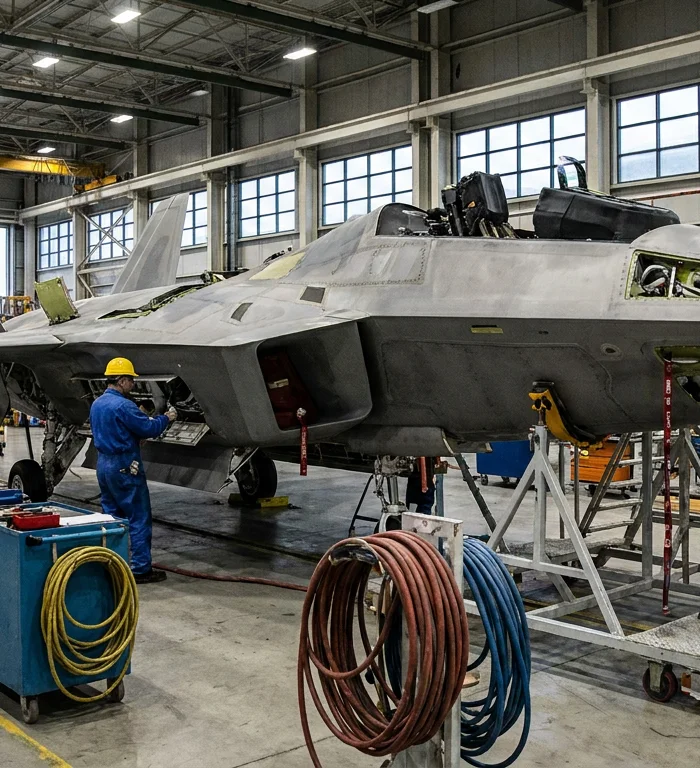
Lockheed Martin's F-35 framework covers at least 850 jets over 10 years, but does not yet place orders or settle contract prices.
The company and the Department of Defense announced the preliminary arrangement on October 22, covering aircraft production and sustainment. Its scale establishes a longer planning horizon for the fighter program, while the company says a formal award depends on further authorization and negotiations.
Lockheed will commit at least $7 billion of its own funding to initiatives supporting the program, according to the department. That commitment is separate from the aircraft volume covered by the framework; the announcement does not establish a final purchase price for those jets.
Authorization comes before firm orders
The arrangement is a long-term contracting framework rather than an aircraft order. Lockheed said multiyear authorization would allow it and the F-35 Joint Program Office to complete negotiations over prices, delivery timing and contractual provisions before a formal award.
The company placed that authorization decision in the coming months, without identifying a firm date. Until those steps are complete, the minimum aircraft total should not be read as a finalized delivery schedule or a completed sale.
The scope extends beyond US aircraft purchases. Lockheed said the framework also includes overseas orders, an initial supply of spare parts and kits for aircraft modifications, bringing both production and support requirements into the proposed arrangement.
F-35 links investment and production
Under the framework, Lockheed targets output of 156 aircraft a year. That annual production goal is distinct from the minimum of 850 jets covered over the decade: the announcement does not allocate that minimum across individual years or customers.
The F-35 uses stealth technology designed to reduce its detectability and is central to Lockheed's aeronautics business. That division accounts for close to 40% of quarterly revenue, although the supplied material does not identify the quarter or separate the fighter's contribution from other aeronautics revenue.
Under Secretary of Defense Michael Duffey presented the arrangement as a way to strengthen the US defense production base by tying financial rewards to performance. His statement sets out the department's rationale, but does not establish that the proposed incentives have already improved manufacturing output or aircraft availability.
Pricing will shape the commitment
If authorization is granted and negotiations produce a formal award, the framework could give Lockheed a clearer basis for coordinating its planned investment with aircraft production. For suppliers and international customers, agreed quantities and delivery dates would provide more useful planning information than the headline aircraft total alone.
If authorization or negotiations take longer, the initial framework would still leave procurement timing unresolved. Lockheed's self-funded commitment makes the relationship between investment spending and eventual contract terms an important financial question; the announcement does not specify the spending timetable.
The broader economic effect remains difficult to assess without agreed prices and a delivery schedule. The next concrete milestones are multiyear authorization and a formal contract award, which would clarify how the decade-long framework translates into purchases, production commitments and support work.
More stories
- Tesla profit drops 43% despite $1.5bn cash flow
- Abu Dhabi crown prince brings 60-member delegation to Greece
- Oil prices rise after reported attack on Saudi oil field
- Tesla cuts spending plan to $20 billion amid AI overhaul
- JPMorgan to close Turkish securities unit
- AI trade gains as SpaceX update lifts Nasdaq, chip stocks
- Japan output edges up as factories beat July forecasts again
- Warsh's remarks kept rate-risk signals alive
Latest news
- Gemini flags 69% of held-out thermal-video falls
- Ethiopia's coffee sector faces $453m EU export risk
- EU faces Vietnam rights test over $57.9bn trade gap
- Obakulactone reduces joint swelling in arthritis-model rats
- Albania lawmakers clash over policing of student protests
- Congress faces Supreme Court rulings with control at stake
- Anthropic reports $80.7 billion loss ahead of planned IPO
- Ronson and Remi gather 11 acts for Amy Winehouse tribute